Colleen Grablick
A 911 dispatcher failed to communicate the urgency of the flooding last week at a D.C. dog daycare, officials said Monday. The floods resulted in the death of ten dogs.
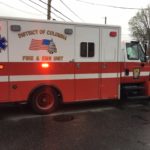
Marking the first significant update from city officials regarding the flood that occurred at District Dogs one week ago, officials said it took nearly 30 minutes for DC Fire and EMS crews to enter the building after the first 911 call was placed, due to a miscommunication by a 911 dispatcher.
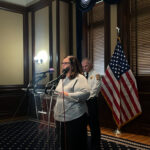
“We could have done things differently,” said Heather McGaffin, director of the Office of Unified Communications, at a press conference on Monday.
According to transcripts of 911 calls shared with reporters, two District Dogs employees who were not working that day – a manager and an assistant manager – placed 911 calls from Montgomery County and Prince George’s County respectively, and the calls were transferred to D.C.’s OUC, which handles the city’s 911 calls. Both employees were watching the scene unfold at the day care on Rhode Island Avenue NE via camera footage.
The manager placed the first call at 5:06 p.m., saying “It broke the wall, the whole building is going underwater right now. Water was coming out through the walls and we saw the walls break down through the cameras…the cameras are not working anymore but we know people are in danger.”
Three minutes later, an assistant manager, located in Prince George’s County at the time, called, saying “I am watching the cameras and the whole place is flooding, there are people in there, animals in there and it’s like the whole place is completely flooded…everything collapsed from the water. The water was coming from everywhere. The walls collapsed.”
But the call was not relayed properly by a 911 dispatcher to DC Fire and EMS teams, according to officials. When a call is placed to 911, a call taker receives information from the caller and loads it all into an electronic card. This card is then shared with a dispatcher, who sends the information along to DC FEMS or D.C. police teams. In this case, the dispatcher described the flood as a “water leak” to DC Fire and EMS teams, and did not specify the intensity of the floodwaters – which had broken a wall of the facility. As a result, the call was classified as an “assist card for flooding conditions,” instead of a “water rescue.”
Further complicating matters, DC Fire and EMS had already been called to the area to perform water rescues of vehicles trapped in floodwaters. When a dispatcher realized crews were already on scene, the call for flooding conditions at District Dogs was canceled.
A third call was placed at 5:18, this one from a person inside District Dogs, saying “We are trapped in water. We are trapped in water that is above our heads. There are six people trapped in the water and we have no way out.” According to the call transcripts, during the phone call, the 911 call taker then confirmed that the emergency at the day care should be categorized as a water rescue.
According to the timeline shared with reporters on Monday, it wasn’t until 5:22 that dispatch notified DC FEMS of the incident at District Dogs. Crews entered the facility by 5:29 p.m.
“I would’ve liked to have been there earlier,” DC FEMS Chief John Donnelly said on Monday.
“Urgency and disconnect,” McGaffin told reporters Monday, explaining how the dispatcher could have so misinterpreted the call. “I mean, words are on the screen, but the dispatcher never talked to the caller.”
In other situations, FEMS teams are able to read and interpret call cards themselves — but in this case, the teams on the scene were in the middle of a water rescue, and relied on the dispatcher’s voicer over the radio. As a result, they heard only “water leak,” and did not believe there was severe flooding occurring in the building, officials said Monday.
“A water leak call is different than a water rescue call, and the water rescue assignment [is already] on the scene,” a FEMS spokesperson said. “So nobody recognized at that point, that there were people that needed assistance. What they were getting was a water leak, and that’s what was dispatched.”
Officials did not share the radio dispatches between responders with reporters, only the 911 calls placed by the employees and the person inside District Dogs.
Additionally, OUC and DC FEMS have no official code for a building flooding with people trapped inside — an oversight McGaffin said she and DC FEMS Chief Donnelly addressed after meeting with reporters on Monday. Going forward, situations like what occurred at District Dogs will be characterized in emergency response communications as a “collapsed building.”
During the combative press conference on Monday, McGaffin refused to categorize the error as a “mistake,” but said that OUC was examining ways to improve communications between dispatchers and emergency crews. She would not comment on whether the dispatcher who made the error would be disciplined or removed from their role, but said they are still working at the agency.
“What I will say is that it leaves room for us to strengthen how we communicate with responders on the scene, especially when they’re not in front of their computers,” McGaffin said. “We are dedicated to doing that, and we will be making procedural policy and operational changes to reflect that.”
Monday’s press conference came after a week of questioning and frustration from owners whose dogs died in the flood, and who demanded transparency from the city on the timeline of the emergency response. Ward 5 Councilmember Zachary Parker also wrote letters to McGaffin, and Donnelly, asking for a timeline of the response.
It also marks the latest in a troubled history of errors at OUC – a D.C. agency that frequently faces criticism for its mishandling of emergency responses, particularly those that result in death. OUC has several times sent emergency responders to the wrong locations, and fallen short of national standards for dispatching services in a timely manner. An audit last September found that one year out from an initial audit that included 31 recommendations, the District had made ‘minimal progress’ in implementing those changes.
Questions still remain about the tragic flood; owners who lost their pets are still wondering why the facility, owned by Jacob Hensley, did not have better emergency preparedness plans – especially after last summer, which saw three intense floods at the facility. Councilmember Parker has also written a letter to DC Water, asking why the facility flooded so quickly and what is being done to mitigate flooding along Rhode Island Avenue.
Since the 1800s, the block of Rhode Island Avenue where District Dogs sits has been vulnerable to chronic flooding, a spokesperson for DC Water said last week. Shaped like a bowl, it pulls in stormwater from various directions. The city has been working for the past six years on a tunnel that would run under Rhode Island Avenue that would add 90 million gallons of stormwater storage. While the project, called the Northeast Boundary Tunnel, is expected to help mitigate severe flooding upon its completion (which is slated for this September) it’s only designed to provide drainage for a 15-year storm; or a storm that’s so severe it only happens every 15 years. With climate change increasing the incidents of intense flooding, even that may not be enough to offset the damage of extreme rain. Currently, the sewer system at Rhode Island Avenue only accommodates a 2-to-5-year storm – and what happened last Monday might’ve been a 15-to-20-year storm, a DC Water spokesperson told DCist/WAMU last week.
This story was updated to note that it was nearly 30 minutes between the first 911 call and first responders entering District Dogs.