Margaret Barthel
The Fairfax County Board of Supervisors unanimously passed a policy updating the county’s rules governing parking requirements for new developments on Tuesday night, following years of community debate.
The final “Parking Reimagined” policy is aimed at reducing the number of parking spaces developers are required to include in projects. The new parking minimums depend on a variety of factors, including whether the project is residential, retail, or office, where it is located, and whether it’s close to transit. The plan also adds in requirements for bike and pedestrian infrastructure to help non-drivers navigate large parking lots.
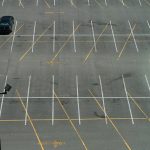
County leaders hope the change — while modest — will ultimately mean more space for housing, parks, and other public amenities, instead of large, mostly-empty suburban parking lots that become heat islands in the summer and produce stormwater runoff when it rains. They also say that lessening parking requirements will make building affordable housing and other developments less costly — and prevent costs from being passed on to residents buying or renting a home. (Building new parking can cost as much as $60,000 per space in Fairfax, according to reporting from The Washington Post.)
“Fairfax County is extraordinarily diverse in its topography and its land use and its design,” said Board of Supervisors Chairman Jeff McKay. “It’s very hard to do ordinances or parking [tabulations] in a one-size-fits-all environment with a county that’s so different at a granular street level.”
McKay called the final policy “a grand compromise,” one that he said recognizes the concerns of residents who worry about having enough parking as well as the frustrations of locals who see underused parking lots as an eyesore and a missed opportunity. The policy will take effect in January.
Tuesday was the first time the county has fully revised all of its zoning regulations about parking since 1988, and in those decades, a lot about the county and how people get around has changed. (The county adopted separate parking minimums for commercial and residential buildings in Tysons in 2010, and for areas near other Metro stations in 2018.)
“When we did our last parking ordinance, there was no Metro. There was no Connector bus. There wasn’t much in the way of Metrobus. There were few bicycles and fewer trails,” said Mason District Supervisor Penny Gross, the longest-serving member of the board and its vice chair. “So we really were very car centric.”
Gross also pointed to one example of the waste of space caused by overly high parking requirements in her district: a nearly-always empty parking garage at the Plaza at Landmark Shopping Center, which she said was built in the 1980s solely because the county’s regulations required it.
“It’s a multimillion dollar investment that is not being used,” Gross said.
Loosening parking requirements could help the county avoid building too many new underused parking garages, and get rid of existing ones that are underused in future redevelopments, advocates believe. That space could be repurposed. In fact, the offending Landmark garage came up in the public comment period, in video testimony from a resident who lives nearby and recorded himself walking through the parking garage’s levels — and finding only two cars parked in the entire structure. “That’s where we should put more pickleball courts,” one supervisor joked while the video ran. (The board had previously heard testimony from residents arguing for more pickleball courts across the county.)
The new policy comes at a key moment in the sprawling suburban county’s development. County leaders are grappling with transforming areas near the Silver Line and other transit hubs into more walkable urban places — and as the advent of hybrid work complicates that mission. Fairfax, the largest jurisdiction in the D.C. region, has also struggled to build housing at the rates some experts believe the region needs to satisfy burgeoning demand for the area’s workforce.
Those big shifts have raised plenty of controversy and concern, particularly among local homeowner’s associations worried that less parking in commercial corridors may result in people taking up parking spots in residential neighborhoods. Meanwhile, the policy enjoyed enthusiastic support from many younger residents eager to look ahead to a less-car-dependent, more affordable future in Fairfax.
Reductions near transit, little change in residential neighborhoods
“Parking Reimagined” doesn’t limit the number of parking spots a developer can choose to build on a given project — but it does reduce the number they’re required to build in most cases, particularly near rail and bus lines. It also simplifies certain parking-related processes for developers and business owners and adds requirements for better pedestrian and bike infrastructure in and around large parking lots.
Most significantly, the new policy imposes a tiered structure for determining parking minimum requirements, cutting them back particularly in mixed-use areas near transit and in places designated by the county’s comprehensive plan for revitalization, such as Annandale and the Route 1 corridor. For example, multifamily buildings near transit stations could build as few as 0.4 spaces per bedroom, a roughly 20-40% reduction from the overall standard for multifamily buildings.
The policy also streamlines the process for when a “parking tabulation,” or a review of the number of parking spots required, is needed after a building changes hands. Small business owners testified that the current tabulation rules are clunky and often lead to delays or onerous new parking requirements for existing buildings — issues that can cost businesses dearly and even prevent them from opening.
The policy also takes a few notable steps to push for more pedestrian and bike infrastructure, requiring pedestrian routes through new or redeveloped surface parking lots of more than 50 spaces and putting in place the county’s first-ever requirements for bike parking.
The final vote on “Parking Reimagined” comes after years of community debate and county staff research on the subject. Earlier in the month, the county’s planning commission approved the policy, but scaled back several of the county staff’s original recommendations, making more modest cuts in the parking requirements for multifamily housing and houses of worship.
In the end, the supervisors mostly followed the planning commission’s suggestions, approving a base rate of 1.45 spaces per unit in a multifamily building instead of the staff’s recommended 1.3 spaces per unit, which is in line with national parking demand survey data.
What “Parking Reimagined” does not do is also significant: it does not change the overall amount of parking required for single-family detached houses, though it does adjust it based on the new tiered system. Similarly, for townhomes or stacked townhomes, the minimum number of spaces also remains the same, with an added requirement for visitor parking in those neighborhoods. That could result in more parking spaces being built, since it means some of the required spaces for a development of townhomes would need to be in common space, not individual garages or driveways.
A zoning debate, Northern Virginia-style
The back-and-forth debate over the relatively modest change in Fairfax echoes more heated and more expansive arguments over zoning reform in neighboring Arlington and Alexandria, where younger residents — many of them organized by the YIMBYs of NoVA and their partners — eager for more density and more housing have butted heads with older, more entrenched homeowners wary of crowding and possible strains on county services.
“A true parking reimagination would abolish all parking minimums and switch to parking maximums,” said Aaron Wilkowitz, a Fairfax resident and a leader with the pro-housing group YIMBYs of NoVA, during the public comment period. “But I recognize that progress is sometimes slow and incremental.”
Wilkowitz and other supporters, several of them George Mason University students and public school teachers, applauded the tiered system and transit-oriented development orientation of the policy. But they said in mostly leaving single-family home parking rates the same, the county had missed an opportunity to make a bigger difference for residents struggling to afford living there.
“Low income residents take buses and are less likely to own cars, so ‘free’ parking is actually a tax on carless, low income residents to subsidize wealthier car owners,” Wilkowitz argued. “That’s the single most important thing I’m going to say tonight.”
But other public commenters, several of them leaders or members of homeowners’ associations, disagreed. They argued lowering parking requirements, especially on multifamily buildings, would result in “the likelihood of overflow parking and adverse impacts” in their neighborhoods, as Sally Horn, of the McLean Citizens’ Association, put it.
“This is particularly so since it is more likely than not that developers will provide only the minimum required off street parking for multi-family buildings that primarily house middle-to low-income residents,” she said.
Others said they wanted to see the county build out its transportation infrastructure before it made significant cuts to parking.
“Annandale has a few bus routes that will not generate an appreciable decline in the number of cars and trucks,” said Susan Jollie, an Annandale resident. “‘Parking Reimagined’ will turn our roads into parking lots.”
“Transit improvements on a massive scale have to come first,” Jollie said.