Colleen Grablick
“Sorry, I’m late – the bus was late.”
It’s a refrain that’s become almost as familiar in D.C. as the buzz of cicadas or nightly summer fireworks. While it’s never been perfect or as fast as rail, bus service is a vital mode of transportation for the region’s residents, especially when reaching areas lacking a Metro stop. It’s also flat fare and has not been subject to similar fare evasion crackdowns as the rail system.
But more and more often, otherwise consistently scheduled buses appear to be arriving later or sporadically. More and more often, WAMU colleagues, whom I trust not to betray their journalistic integrity by lying, blame their morning tardiness on a bus that came later than usual. My own once reliable H2 trips to the newsroom have, in recent months, become unpredictable.
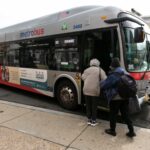
High-ridership lines like the 50s, Ss, and D31 are also reportedly overcrowded or slow, creating both a safety risk and an accessibility problem. Many of the most crowded lines, according to Metro, are school routes.

When DCist/WAMU asked readers if they noticed a decline in bus service in recent months, several responded sharing similar experiences. “Service on the 96 has plummeted and ghost buses are a regular occurrence,” one rider wrote in an email. Another said they previously took a fairly dependable H4 at the same time every morning, but that these days that bus doesn’t show up at all during the typical 45-minute window it used to arrive.
“It’s not the biggest issue in the world, but the differences in bus times mean I have to choose between being 30 minutes early to work or 10 minutes late for work, which is really frustrating,” they wrote.
A Metro board meeting last week confirmed that riders aren’t imagining things: bus service declined across different metrics in the last quarter of the fiscal year, according to Jordan Holt, director of performance improvement at WMATA.
“[Metrobus] performance dipped over the past six months, and we’ve been able to correlate that with an increase in traffic,” Holt said at the meeting, sharing Metro’s fiscal year 2023 performance report.
Car-clogged roads have slowed and crowded buses, making riders’ journeys longer – and with a precarious financial forecast and a potential solution hung up inside D.C. executive government, it’s unclear when the city could expect major improvements. Metro is staring down a gaping $750 million budget deficit that, if it’s not addressed with additional funds, could result in further reductions in service.
“I do think we have to tell our customers pretty openly and transparently, buses are probably only gonna get more crowded,” Randy Clarke, Metro’s general manager, said at the board meeting, acknowledging the ridership levels which are creeping up to pre-pandemic levels. “If we have to do a hiring freeze and any other fiscal measures…there’s just no getting around it, ridership is coming back and our service will not be able to maintain if we don’t have the funding available.”
Too many cars, not enough (clear) bus-only lanes
From January to June, traffic congestion worsened by 3%, according to WMATA — and the more cars on the road, the slower buses run. Increased traffic can also create bus bunching, when two buses are running up against each other in short succession instead of spacing out. Of all bus service from July 2022 to June 2023, 77% of buses were on time, short of Metro’s 78% target, but on-time performance levels fluctuated over the year, the agency said. (Metro’s on-time bus performance was also 77% in fiscal year 2022.
“In Q4, Metro focused on the collaboration between its street operations team and the bus control center to address bus bunching in real time, aiming to spread out service to reduce wait times and crowding for customers.” reads Metro’s performance report.
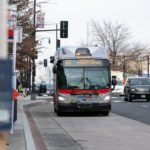
One of those solutions, however, has been put on pause by the D.C. Department of Transportation. Last year WMATA launched a “Better Bus” campaign, which, among other system improvements, sought to reduce the amount of vehicles that block bus-only lanes. The Clear Lanes Project, a joint effort by WMATA and DDOT, installed 140 mounted cameras on buses to capture the license plates of offending cars that park or drive in the bus-only lanes. After a warning period, the cameras will issue fines to drivers: $100 for driving in a bus lane or $200 for parking or idling in a bus lane.
“We are paying people to sit in traffic,” said Tracy Hadden Loh, a WMATA board member, speaking to bus drivers stuck in bus-only lanes cluttered with vehicles. “The buses are getting stuck non-stop.”
A warning period for the new program occurred over the summer, totaling 14,000 warnings, according to Metro. Ticketing and fines were set to begin in September but DDOT, the body in charge of enforcement, has decided to extend the warning period.
“For the time being, we will continue with the warning period and will make an announcement once we have reached a new enforcement date,” a spokesperson for DDOT wrote in a statement to DCist/WAMU.
Originally, Metro said extending the warning period would give people returning to offices more time to learn about the program but at the board meeting, Clarke punted the question to DDOT. Metro has done its half of the job by installing the cameras on buses, which he said were ready to go.
“It’s up to them to [the District] ultimately to do the enforcement … legally we don’t have that area,” Clarke said.
Ward 6 councilmember and chair of the transportation committee Charles Allen sent a letter to Metro and DDOT officials asking why they felt an extension was necessary and what additional educational campaigns the agencies had planned, especially considering that both had conducted outreach projects over the summer. Also, he noted, many bus lanes in D.C. are labeled clearly; they are painted red, and read “BUS ONLY.”
“I don’t know what viable reasons there could be to not move forward with enforcement,” Allen said in an interview. “If we want our buses moving faster, having enforcement of our bus priority lanes is certainly a big factor.”
For Metro’s part, it has tried to implement other bus improvements over the year, including all-door boarding that’s expected to come by the end of 2023. The council has also set aside $12 million to expand overnight service on a dozen routes starting next year, but this would require more drivers — a challenge as the agency faces a fiscal nightmare.

Minding a budget gap
Metro is running the maximum bus service under its current budget appropriations, yet chances are if you board an S2 or 54 during peak weekday hours, you’ll be rubbing elbows, literally, with the rest of your busmates. (This reporter has been on a 52 on weeknight recently that was so crowded, it would’ve been impossible for a person in a wheelchair or using a walker to squeeze on.)
“Yesterday I saw an S9 that we could not fit another human being on – packed,” Clarke, a noted bus and rail rider, said at the board meeting. “Followed by a 52 that we might’ve fit three or four more people, and that’s happening throughout almost the entire day on certain routes.”
Simply put, Metro ridership is back, rebounding from pandemic lows to a degree that the current operating levels can’t handle – and that the agency can’t afford to meet. According to Metro’s most recent ridership data, published in June, ridership is up about 15% on weekdays compared to June 2022. And while more than 400 bus operators were hired from July 2022 to June 2023, this still may not be enough to ramp up service to meet ridership demand. (Some of those 400 operators were used to fill vacancies left by retired staff members, those who were promoted, or those who moved to rail operation.)
Clarke said they’re “kinda in a jam” — he’d love to add more service on the 50s and S lines, for example, but Metro would need to rely on overtime pay, an expenditure the agency can’t afford right now.
The bus woes come as Metro approaches what officials have labeled a potential “transit death spiral” — the “unprecedented” multi-million budget gap that could cause drastic service cuts and layoffs. Officials are calling for significant increases in state funding to avoid major disruptions to service starting next summer. Without a budget boost, trains might stop running at 9:30 p.m. and come only every 20 or 30 minutes.
During last week’s budget meeting, Clarke and Metro officials called on state legislatures in Maryland and Virginia to lift the legislative cap on additional Metro funding so the region can avoid a proper transit meltdown, but as the financial future remains uncertain, officials are planning for a potential hiring freeze in January. That hiring freeze would mean only slower and more crowded buses, and could escalate to lay-offs in June if more state funding doesn’t shore up.
It would also be a puncture to Metro’s recent rail improvements; as of September, the agency says it’s running more rail service than at any other time in its 47-year history. Certain lines arrive every three minutes during peak hours – a drastic improvement from the years in which the system was beleaguered by pandemic budget fallouts and the 7000-series train derailment.
Ghost buses continue to haunt riders
Some riders have also experienced a return in “ghost buses,” despite the agency’s commitment to solving that issue earlier this year.
The real-time busETA website uses GPS software to track bus arrival times, allowing riders to watch a bus move along the route and, in theory, plan their trips more efficiently. “Ghost buses” are those that vanish from the location tracker mid-route, or simply never arrive at the scheduled stop. It’s a frustrating issue that’s upset riders for years and that Clarke planned to eliminate. In Dec. of 2022, the agency said it updated its tracking software to solve the ghost bus problem, which usually occurred when an out-of-service bus was not removed from the tracking service.
According to Holt, who presented the fiscal year 2023 performance report to Metro’s board last week, bus prediction availability (which measures the number of trips that Metro provides real-time arrival predictions) started to drop in May, and has stayed low through August. Overall in fiscal year 2023, Metro provided real-time bus information for 94% of trips; that translates to roughly 11,000 rides per day out of 11,900 trips. In June of this year that fell to around 91% and has stayed there through the beginning of the current fiscal year — a decrease Holt attributed to equipment and “integration issues.” Of those trips with predictions, 86% were accurate, according to Metro.
“It’s not the GPS units on the buses themselves that are failing, sometimes we’ve seen an increase in loose wire connections that need to be fixed,” Holt said, adding that technological snafus with fare boxes have also been identified, and WMATA is working with vendors to solve the software malfunctions.
Metro did note when it announced its ghost bus fix that removing some scheduled buses from the busETA platform would result in “surprise” buses. The opposite of a ghost bus (or maybe a friendly ghost), it’s a bus that doesn’t show up on the website tracker but then appears at the stop; not a bad problem to have, but a complicating factor as people plan their commutes nonetheless.
In a statement to DCist/WAMU, a spokesperson for WMATA said that Metro did fix its ghost bus issue last year, but is aware of recent customer complaints.
“We are aware of recent reports related to missed trips and are working to resolve these issues,” a Metro spokesperson said. “We apologize to customers who have been impacted.”