Colleen Grablick
GOP members of the House of Representatives convened a hearing on violent crime in D.C. yet again Thursday, echoing sentiments expressed in multiple previous hearings on the topic. Republicans lambasted local officials for what they painted as a lax posture toward crime, and condemned what they see as the U.S. Attorney for D.C’s prosecutorial failures.
Opening the hearing with a dramatic compilation of local TV news clips, the Republican members of the House of Representatives subcommittee on Crime and Federal Government Surveillance portrayed D.C. as a city overrun with violent crime. They characterized the D.C. Council’s police reform efforts as moves that strained cops’ ability to control crime, and accused local legislators of trying to “defund the police.”
“No section of this city can be considered safe anymore,” said Andy Biggs (R-Arizona), chair of the subcomittee. “The Washington, D.C. city council has passed laws that emboldened criminals and hamstruang the police.”
In 2020, despite calls to defund the police from residents and activists, the council approved a budget that year that included a 1.6% increase in police department funding – giving MPD a total of $568 million. (Mayor Bowser’s budget initially proposed a 3% increase.)
Democrats on the committee, meanwhile, called the hearing a distraction, designed to “mislead the American people.” Much of the conversation mirrored the discussions held in previous congressional hearings on the same topic.
“This hearing is not a serious exercise,” said Rep. Jerry Nadler (D-NY). “The Republican majority offers no policy solutions that would actually protect residents of Washington, D.C. or other big cities. Instead, they seek only to flood the cities with more guns while they work against meaningful legislation to invest in our communities to support proven public safety measures.“
The hearing comes as D.C. records its highest number of homicides in a single year since the 1990s, and while overall violent crime is up 38% from last year. A large majority of violent crime, particularly gun violence, impacts residents east of the Anacostia River, but other high-profile violent incidents have risen to national attention. Last week, Rep. Henry Cuellar (D-TX) was carjacked outside of his Navy Yard apartment.
Over the past two years, Republican lawmakers on Capitol Hill have repeatedly made crime in D.C. a priority of their platform and legislation. Republicans as well as some Democrats on the Hill voted to block a D.C. bill that would’ve revised the city’s century-old criminal code in March – marking the first time in decades that Congress used their power to overturn a local bill (because D.C. is not a state, the federal government must review all local legislation). House Republicans also introduced a resolution to block a package of police reforms passed by the D.C. Council. (President Joe Biden ultimately vetoed the congressional resolution.)
Lawmakers called on several witnesses Thursday, including Gregg Pemberton, the head of the D.C. Police Union, Lindsey Appiah, Deputy Mayor of Public Safety and Justice, Charles Stimson, an expert at the Heritage Foundation, and Thomas Abt, the founding director of the Center for the Study and Practice of Violence Reduction at the University of Maryland.
Three victims of violent crime in D.C. also testified Thursday – voices that have not been heard in previous hearings. One man was robbed at gunpoint downtown, while another, who owns a bar downtown, was assaulted by an armed man in the bar in front of his four-year-old child. A third person, a D.C. Fire and EMS paramedic, shared a story of being assaulted while responding to a call.
Mitchell Sobolevsky, the man who was robbed at gunpoint, said the perpetrator in his case went on to re-commit after serving a 24-month sentence. Gaynor Jablonski, the bar owner who was attacked at his bar in front of his son, expressed exasperation at the outcome of his attacker’s sentencing.
“He gets 8 months, and I’m left with explaining to my five-year-old why I had to fight this man and my five-year-old tells me when I drop him off every day to be safe,” he said. “You could enact whatever new law you want – we could have 1,000 new gun laws, we could have 1,000 new police officers, you could throw millions at this DA’s office. If nobody’s going to do their job and prosecute and hold people accountable, what’s the point?”
While he was absent from the hearing (he was not invited, according to a source in the USAO’s office) U.S. Attorney for D.C. Matthew Graves was a large subject of discussion throughout the day. Because D.C. isn’t a state, most of D.C.’s violent crimes committed by adults are prosecuted through the federal District Attorney’s Office. Earlier this year, a report found that Graves’s office was declining to prosecute 67% of cases, a statistic that Graves attributed to several factors, including D.C.’s lack of a functioning crime lab.
Graves also told the Washington Post that most of the cases he declined to prosecute were nonviolent crimes. In 2022, his office prosecuted 87.9 percent of arrests made in homicides, armed carjackings, assaults with intent to kill, and first-degree sexual assault cases, he said. Updated prosecution rates are expected to be published on Oct. 19, according to the U.S. Attorney’s Office, in addition to a presentation explaining the factors that go into them.
We will be announcing the FY2023 charging rate on October 19, 2023, and providing an unprecedented look into the issues that drive it. We will post information next week about how you can watch.
— U.S. Attorney DC (@USAO_DC) October 11, 2023
“Our goal is to get justice for victims. That’s why we are on pace to charge 6,000 cases this year alone and have had nearly 200,000 communications with victims year-to-date about their cases,” Graves said in a statement Thursday in response to the victims at the hearing. “We will continue to do all we can under D.C.’s criminal justice system to get the best outcome possible for victims.”
As in previous hearings, the questioning from Republican lawmakers focused on what they perceive as D.C.’s “soft” on crime policies and rhetoric, which they point to as a cause in the rise in violent crimes.
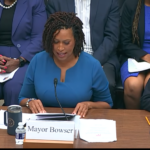
Rep. Matt Gaetz (R-Fla.), who is currently under a House investigation for alleged sex trafficking involving an underage girl, called out increased sexual assault statistics in the District., as he listed out the upticks in other violent crimes which, he said, make the city unsafe. He asked Appiah what’s behind the statistics, and what Mayor Muriel Bowser is doing to address it.
“There’s a host of complex reasons why [those statistics] are the case,” Appiah said, rejecting Gaetz’s accusations that the rise in crime was largely the result of locally implemented policies. “There’s a host of proposals that the mayor made, related to penalty enhancements, to aligning penalties for gun crimes with federal penalties.”
The council, over the past year, has also made legislative changes that increase penalties for offenders. Recently, emergency legislation that’s now up for a permanent vote in the D.C. Council tilted the law in favor of pretrial detention for individuals charged with a violent crime and created a new gun offense. It also included a provision that allows prosecutors to extradite people for misdemeanor offenses and allows police and prosecutors to use GPS data from ankle monitors to prove people’s guilt in court.
The D.C. Council’s recent police reform bills also predictably came up for debate. Pemberton, the chair of the D.C. Police Union, replayed many of the same points he’s already provided to lawmakers in his previous congressional appearances on the topic. He described several of the council’s bills as blows to D.C. police retention and morale.
The Comprehensive Policing and Justice Reform Amendment, which made permanent several provisions instituted on an emergency basis following the police killing of George Floyd, required body-camera footage to be made public in use-of-force incidents, limited the use of tear gas, and prohibited neck restraints. It also created a database of police discipline files that would be available for open records, and would bar discipline from the collective bargaining process, making it easier for the department to fire cops accused of bad behavior.
“Without delving into the granular details of how terrible these bills are, or how blatantly awful the rhetoric used by the council was, I can assure the members of this committee that the direct result was a mass exodus of police officers from the department,” Pemberton said.
The department currently has around 3,380 officers, down from 3,800 in 2020. Ward 2 Councilmember and chair of the judiciary and public safety committee, Brooke Pinto, has recently authored legislation that would offer hiring and retention bonuses to officers as a part of her broader public safety package.
“You will find no mayor who is more supportive of the police than Mayor Bowser,” Appiah said.
D.C. Council chairman Phil Mendelson, who was not invited to testify, said in a statement that the council has been supportive of efforts to hire and retain more police officers, and pointed to the recently passed public safety bills.
“I’m pleased to see the committee’s focus on the U.S. Attorney and the inefficiencies inherent in the District’s judicial justice system, much of which is controlled by federal agencies that Congress routinely provides insufficient resources,” Mendelson said. “If Republicans are truly concerned with crime in the District, I look forward to working with GOP members of the committee to fully support these agencies’ funding and resource requests.”
By way of actual solutions, little was specifically discussed. Stimson from the Heritage Foundation suggested putting the city’s crime lab under federal control to solve the city’s current lack of a functioning evidence processing lab (the crime lab could be re-accredited as soon as next January). Meanwhile Abt, with the University of Maryland, suggested Congress appropriate funds to support the outsourcing of evidence until the crime lab is functioning again. He also suggested an influx of federal dollars invested in localities nationwide for community-based violence reduction efforts.
Democrats highlighted Congress’ inability to pass comprehensive gun reform legislation, in response to the discussion of the city’s illegal firearm problem.
“We have significant gun trafficking from our neighbors in Virginia, Maryland, North Carolina, South Carolina, and Georgia,” Appiah said. “That is where the illegal flow of guns into the District is, so working with our partners like ATF, FBI, and our federal partners is deeply important to help us stop that flow.”
Rep. Eleanor Holmes Norton (D-DC) said the hearing itself was an intrusion on District residents’ self-governance, granted in the 1973 Home Rule Act.
“While the federal government controls much of D.C.’s criminal justice system, to the extent that this hearing focuses on D.C.’s local laws and local government, it violates the purposes of the D.C. Home Rule Act,” Norton said at the hearing. “If House Republicans cared about democratic principles or local D.C. residents, they would bring my D.C. statehood bill, which would give D.C. residents voting representation in Congress and for local self-government, to the floor.”
Jacob Fenston contributed to this story.
This story was updated to add comment from Phil Mendelson.