Margaret Barthel
 Matt Blitz
This story was republished by El Tiempo Latino. Puedes leer este artículo en español aquí.
It may be an off-off-year election, but Virginians are voting early in solid numbers in an election that will determine control of both chambers in the closely-divided state legislature. The outcome could have significant implications for abortion access, education policy, voting rights, and energy and climate policy in the commonwealth.
In contrast to many high-profile Republicans in recent years, Gov. Glenn Youngkin has been urging Republicans to vote early, and while Democrats won in early voting turnout in recent years, Youngkin’s message may be working.
More than half a million Virginians have voted so far, with Monday seeing the highest single-day turnout so far, at over 30,000 in-person and absentee ballots. That’s roughly half of all the early votes cast early during the governor’s race in 2021, a highly competitive top-of-the-ticket contest. And some of the busiest days of early voting come in the final week.
About 41% of early votes were likely for Republicans, according to estimates from the Virginia Public Access Project. That’s about 2.3% more than last year and more than 3% compared to 2021. If these numbers are accurate, it appears Youngkin’s message to Republicans to get out and vote early is working.
Democrats for their part are banking on Virginia voters’ overall support for maintaining abortion rights to turn out voters and keep control of the Senate and perhaps win the House. Republicans are focused on parental rights and crime in their attempt to hold the House and win the Senate. At least, that’s the popular narrative among political watchers.
In Northern Virginia, turnout is especially robust in Prince William and Loudoun counties, which are home to the most competitive legislative races in the region.
There, Democrats hope to hold or make further inroads in the exurban and rural areas of both counties, which have shifted from reliably red to increasingly blue in recent years. Meanwhile, Republicans are trying to leverage Youngkin’s popularity, whose 2021 victory came in part because he outright won or narrowed GOP losses in those areas.
That was the context as candidates, volunteers and voters of both parties turned out for rallies and canvassing on Saturday in the Manassas area.
Democrats focus on abortion, quality of life issues
At around 11 a.m. on Saturday morning, Josh Thomas, the Democratic candidate for House District 21, was knocking on doors in a small neighborhood of townhomes off Route 234.
“My sense is it’s going to be close, but I’m feeling good about it,” he says.
With Thomas was Del. Dan Helmer, who represents the current HD-40 and is the Virginia House Democratic Caucus campaign chair. Helmer originally flipped parts of what is now HD-21 from red to blue in 2019. Democrats hope Thomas will help them further consolidate their hold in western Prince William County — and retake the House of Delegates.
A victory for Thomas, Helmer says, is “incredibly important” to that wider goal.
“He is exactly the right person to represent this district,” says Helmer. “And his doing so is a critical component about whether or not women will have access to safe and legal abortion.”
Many believe Democrats’ road to victory next week — and potentially in 2024 — will be powered by the party’s stance on protecting abortion rights, which for Virginia Democrats is pretty simple: keep the existing state laws the same. That would mean the procedure stays legal through the second trimester of pregnancy, and after that if the pregnancy becomes a serious health risk and multiple doctors agree that it’s necessary.
Youngkin and Republican candidates around the state are pushing for a 15-week restriction on the procedure, which they say is a reasonable consensus position on a fraught issue. But they’ve been hampered in making that case after several prominent Republicans — including Youngkin himself and Thomas’ opponent, John Stirrup — were caught on tape vowing to support more aggressive restrictions on abortion access. Multiple polls suggest Virginia voters, like most Americans, don’t especially like the idea of rolling back abortion rights.
But despite all that, Thomas’ pitch to voters in Manassas on Saturday doesn’t always put abortion front and center. At one door — which he’s already knocked on twice in the last several months — Thomas focuses on cost-of-living issues and worries about public safety.
“We’re fighting for all those things like affordability, lower crime, and certainly appreciate and hope to earn your vote this year,” he says, while a dog tangles its leash around his ankles. He says he got into the race after watching neighbors struggle to avoid eviction after the pandemic.
Thomas briefly touches on his position on abortion — “I stand on keeping the laws where they are right now” — but only after he’s asked about it.
Thomas says that isn’t unusual, at least for the doors he’s assigned to knock, which are mostly for voters his campaign believes may be persuadable. With them, he says the primary issue is public education, followed by concerns about data center development — a hot-button issue that has consumed county politics — and maybe abortion after that.
“I’m talking to independents, and I don’t think it is necessarily number one or two on the minds of the average independent where I live. But it does come up,” he says.
But even if he’s talking about abortion less than overarching Democratic rhetoric would lead you to believe, Thomas still believes the issue will be a key one, even if not the only one, in determining the swing of the election, particularly by turning out the Democratic base.
“So is it what is going to activate a lot of people to vote? Yes,” he says. “Is it probably one of the top two reasons converts from the Republican side vote for Democrats? Yes. And even with independent voters, it’s probably two or three.”
“No issue is that consistent across all those different groups,” he explains.
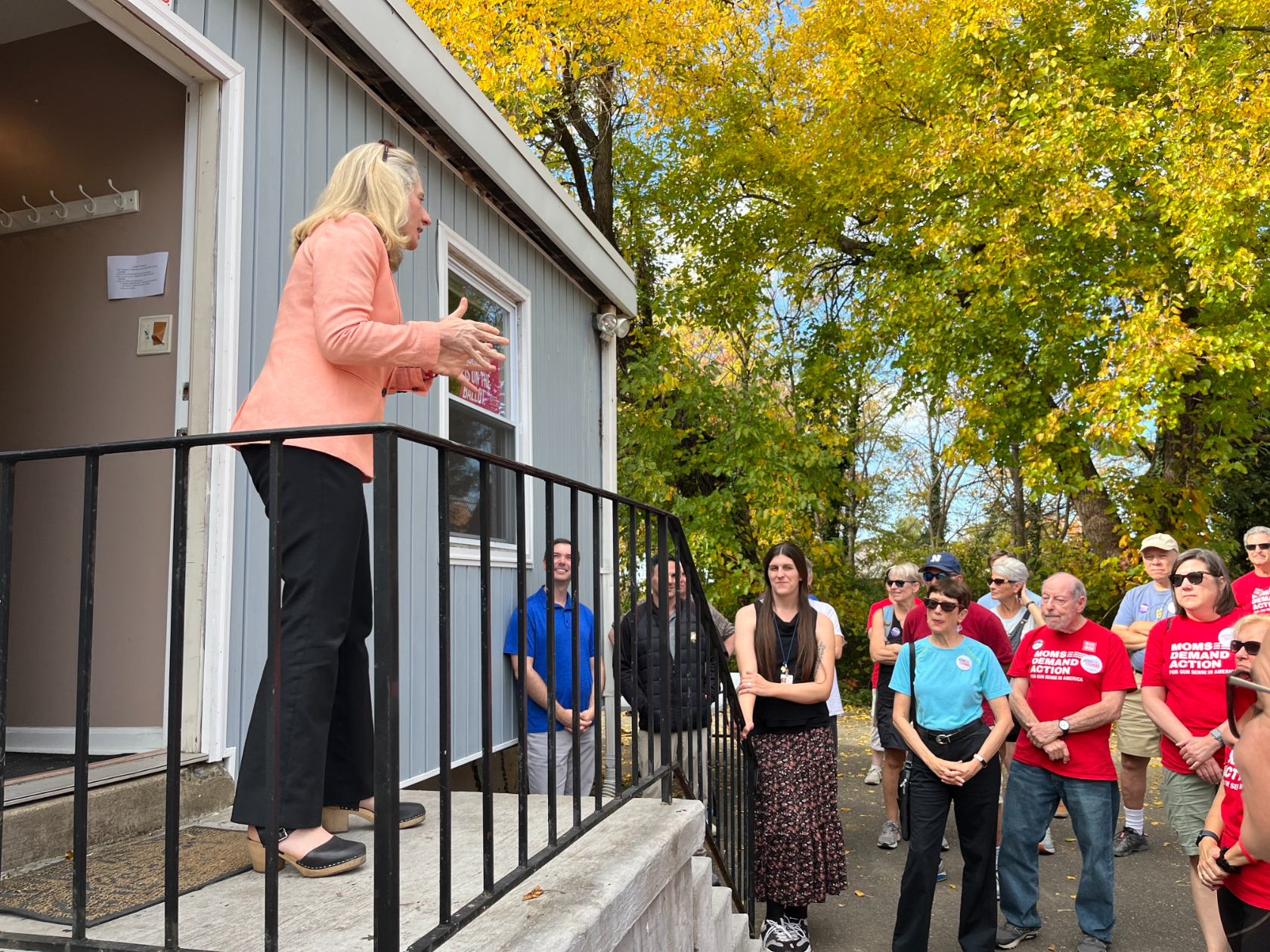
Other Democratic candidates in the Manassas area also appear to be walking a similar line. Later in the morning, Thomas and Helmer stopped by a canvass launch event for Thomas and Del. Danica Roem, who’s currently seeking a promotion to the Virginia Senate in District 30, which overlaps with HD-21. About two dozen people are gathered in the back of Roem’s campaign headquarters along Route 28, most in bright red Moms Demand Action shirts representing the gun control group.
Helmer opened the event by hitting on Democratic talking points on abortion, emphasizing that Virginia is the last state in the South not to restrict the procedure after the Dobbs decision.
But Roem has a much more local message on her mind. In her speech to volunteers, Roem focuses almost entirely on her campaign slogan, which is “Fixing Roads, Feeding Kids,” a nod to her work on alleviating traffic congestion and ending childhood hunger in Virginia. She wants volunteers to talk up her record advocating for universal free school meals and trying to make Route 28 safer.
“I’m spending my campaign focused on fixing roads, feeding kids, protecting our land, instead of gutting your civil rights,” she says, in response to a question about abortion in her race in an interview. “You’re not going to see me try to take away your civil rights.”
That focus on quality-of-life issues was how Roem, the first openly transgender legislator in the commonwealth, ousted a 13-term conservative Republican in 2017.
Rep. Abigail Spanberger (VA-07), a veteran of three razor-thin congressional contests in Virginia and a potential nominee for governor, also stopped by to fire up the canvassers. Asked about the role of abortion in powering a potential Democratic victory on Election Night, she echoed Thomas and Roem.
“I think it will have played a factor across the board, but I don’t think it’s the only factor,” she says.
Youngkin’s early voting pitch
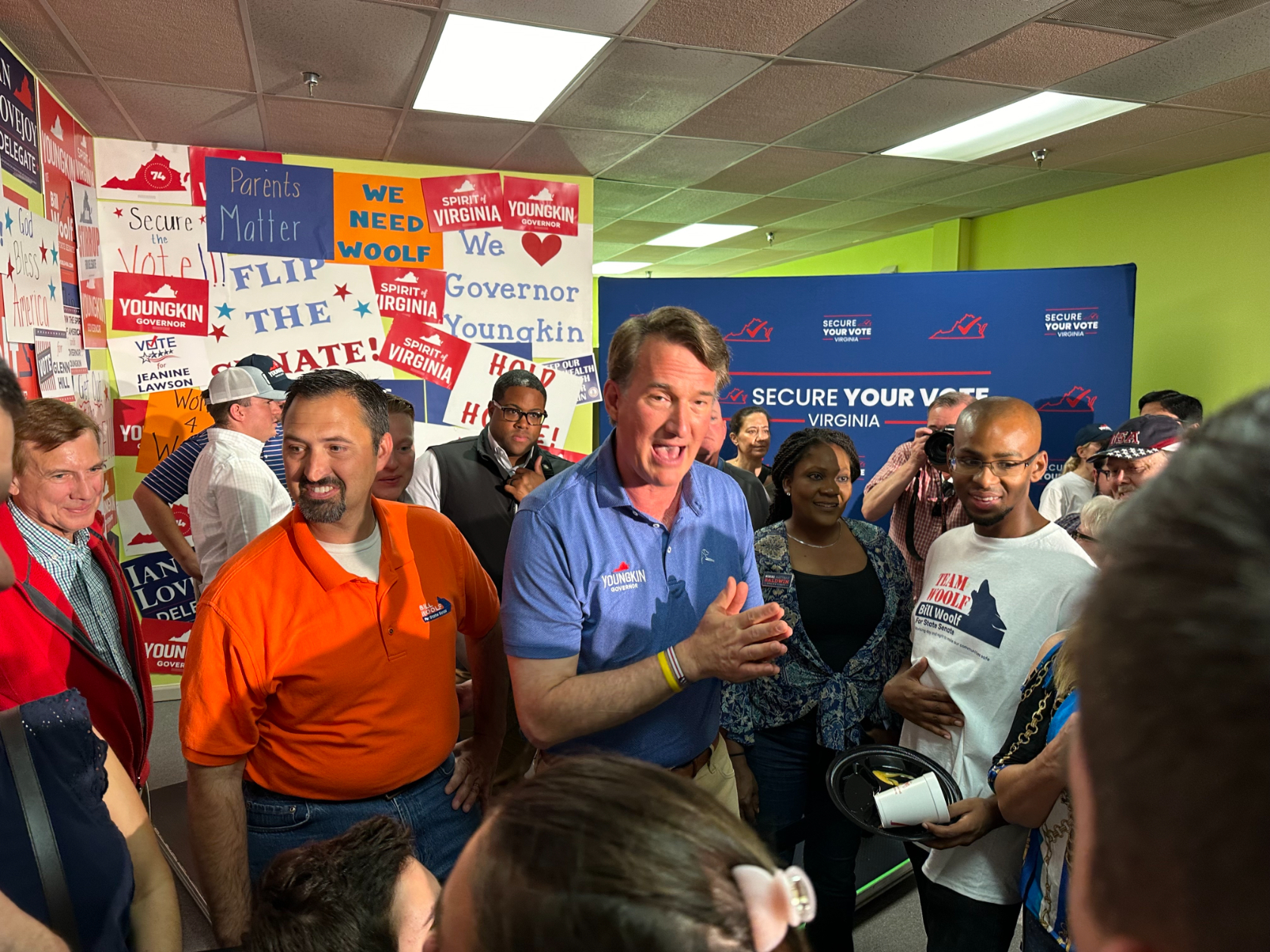
About an hour later and two miles away also in Manassas, Virginia Governor Glenn Youngkin joined several Republican candidates onstage to make their plea to voters to get to the polls early.
Since early last month, Youngkin has embarked on a bus tour to encourage Republicans to vote early and absentee. It appears to be working, particularly in the hotly contested Prince William and Loudoun Counties.
The strategy is a departure from national Republican messaging in previous years when former President Donald Trump and other high-profile conservatives cast doubt on the security of early voting and urged people to vote in person on election day. Even within the past two weeks, Trump had some mixed messaging on voting early. But Youngkin embraced early voting back to his 2021 campaign, and has continuously credited the push for helping him to secure the governorship two years ago.
Saturday afternoon saw the bus make a stop at Virginia State Senate candidate Bill Woolf’s campaign headquarters at a shopping center in Manassas.
After quick speeches from a number of other Republican candidates, including Wolfe, who is running against Virginia Delegate Danica Roem for the state Senate seat in District 30, Youngkin appeared on stage to raucous cheering and the musical stylings of Norman Greenbaum’s “Spirit in the Sky.”
Youngkin asked the crowd who had voted early and was greeted with lots of raised hands.
“For those who do not have your hand up, go, go, go, go vote!” Youngkin yelled. “When Republicans vote, Republicans win!”
The Virginia Governor leaped into a speech focused on supporting the Republican ticket in Prince William County and by-now common refrains like parents’ rights, supporting law enforcement, job growth, and tax relief. He did not mention his proposed 15-week abortion restriction.
Afterward, he spent time talking, taking photos, and asking people if they had voted yet.
Amidst this gaggle of supporters, Youngkin told DCist/WAMU that low voter turnout during last year’s midterms, particularly compared to the 2020 and 2021 elections, still haunts him.
“I’m tired of being down thousands of votes when we go into these elections,” he said. “And so we work so hard to tell everybody, listen, the rules are the rules. Let’s go win, let’s compete.”
Youngkin’s push did encourage a number of those at the rally to do something they rarely do: Vote early.
“I usually vote on November 7,” Prince William County voter Matt told DCist/WAMU. He declined to provide his last name. “There was a lot of stuff that came in the mail that said ‘Get out there and vote early.’ And, so, I basically looked up where to do it and did it.”
He said the top concerns for him are crime and school policies.
Liz Dordal, who lives in Prince William County, said she likes the convenience and ease of voting early. The main issue she’s voting on is immigration, saying as a Mexican-American she believes people “should have to wait their turn and they should have to do it the right way.”
She thinks the governor’s push is working, with many of her friends voting prior to Election Day for the first time.
“People are getting the word that ‘hey, you don’t have to wait till the very last minute,’ Dordal said. “And I’ve been in elections where I waited till that day. I had the time to wait, but we had people who were waiting for hours in the morning before they went to work. So, to me, if it’s a really important election, I think you should try to go out early.”
Despite Youngkin’s stance, some still want to vote on Election Day. Prince William County resident Pat Gorman, whose primary issue is abortion, said he plans to vote on November 7th.
“I would prefer that everybody voted on one day. I mean, that’s how it’s always traditionally worked and seems to be a lot simpler that way and a lot less confusion and things of that nature, you know,” Gorman.
Gorman said that this is partially related to his belief that Virginia’s elections are “not 100%” safe and secure. He provided an anecdote about how his son voted early last year, but his vote wasn’t counted due to him not being registered.
“So, no, not really. I don’t think that they’re all that safe. But we are keeping a closer eye on it this year, hopefully,” Gorman said.
Other voters DCist/WAMU spoke to, including those who did vote early, also expressed some mistrust in Virginia’s election process. One voter said that “there’s a little bit of a shadow of doubt,” while two other voters said they “pray” the elections are safe and secure. Several shared stories of some perceived mix-up they witnessed at the polls that either prevented a registered voter from voting or allowed a non-registered resident to vote.
For his part, Youngkin reiterated his belief that Virginia’s elections are sound, but he also subtly cast doubt on the process nationwide.
“I think our elections are safe and secure. It’s all paper ballots. We do not have voting machines. We have counting machines,” Youngkin told DCist/WAMU. “And we can run an audit on any precinct or any voting area if people have questions. And so, yeah, they’re safe and secure.”
A detailed breakdown of early and absentee voting won’t be known until after Election Day. So while it may take time to assess the impact of Democrat messaging on abortion and the Republican push for early voting, the outcome is likely to be closely watched nationally by both parties going into 2024.
This story has been updated with the correct number of congressional races Rep. Abigail Spanberger has won in Virginia and with Virginia Public Access Project’s updated data about party-affiliated early voting.