Martin Austermuhle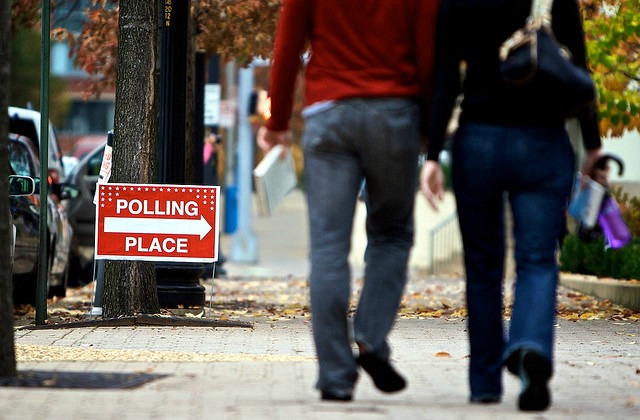
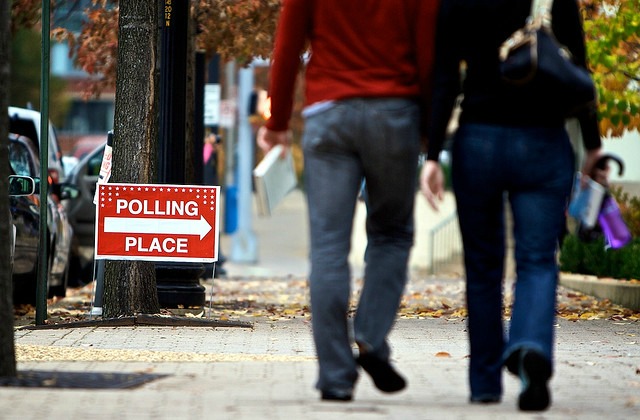 Photo by Samer Farha
Like voters across the country, come November 6 D.C. residents will head to the polls to cast ballots for their members of Congress and the next U.S. president. And as it has for as long as anyone can remember, election day will fall on a Tuesday. (The District’s April 3 primary also falls on a Tuesday.)
Some Democrats in Congress would like that to change, though.
The Hill reports that Reps. Steve Israel (D-N.Y.) and John Larson (D-Conn.) introduced legislation last Friday that would change U.S. law to allow elections for members of Congress and the president to be held on the weekend. If it were up to them, voters could head to the polls starting at 10 a.m. on Saturday and vote through Sunday at 6 p.m. The rationale? Higher turnout:
Election turnout in the United States has traditionally lagged behind that in other Western democracies. According to a study of participation by political scientist Mark Franklin, American participation in presidential-year elections averages around 55 percent, versus 76 percent for parliamentary elections in France and the United Kingdom, and turnout in the high 80s for countries like Germany, New Zealand and Denmark.
“As a representative democracy, voting is a fundamental responsibility for all Americans and the system should be as accessible as possible for as many as possible. Unfortunately, the system we have now was designed to meet our country’s needs over 160 years ago and it no longer makes any sense. It’s time we stop making people choose between exercising their responsibility to vote and meeting their everyday obligations,” Larson said in a statement.
For opponents, the logistics of the move would be too much to justify it. Additionally, with more states offering early voting options, is voting on a Tuesday even that big of a deal anymore?
Though the debate isn’t new and may not go anywhere anytime soon, it ties into similar discussion that have taken place in the District. The House recently passed legislation that would allow the city more flexibility in scheduling special elections. Currently, a special election has to be held on the first Tuesday 114 days after a vacancy is declared. Under the new measure, which has been pushed by D.C. Del. Eleanor Holmes Norton, the city could hold an election between 70 and 174 days after a vacancy. (Though it would still fall on a Tuesday.)
Why the range between 70 and 174? Because last year’s special election—which happened on the first Tuesday 114 days after D.C. Council Chair Kwame Brown vacated his At-Large seat—fell on April 26, the last day of Passover. The date led to a lawsuit which was eventually settled; the settlement includes flexibility within a certain timeframe to set an election. (More recently, there have been complaints that the April 3 primary will coincide with the D.C. public schools’ spring break, when in theory parents will vacation with their kids.)
But even if federal law changed for general elections, would changing D.C.’s Tuesday primaries be necessary? Maybe not. The District offers plenty of options for voting, from absentee ballots to early voting at eight centers across the city. (Thirty-two states have early voting; 27 states and the District have no-excuse early voting.) For the April 3 primary, D.C. voters can head to one of seven voting centers starting on March 24; if that’s not early enough, the early voting center at the D.C. Board of Elections and Ethics in Judiciary Square opens on March 19 and stays open until March 31.
Still, turnout for local elections has been low in recent years—last year’s special election only attracted 10 percent of registered voters, while the 2010 mayoral primary only slightly exceeded 37 percent. Would weekend voting increase those totals? Or has the spirit of civic engagement simply dulled in recent decades?