Colleen Grablick
D.C. Mayor Muriel Bowser issued two emergency declarations Monday intended to address major issues in the city that have sparked intense criticism of her administration: the opioid crisis, and a rise in violence impacting young people.
Opioid deaths
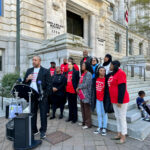
Speaking at a press conference, Bowser declared the city’s opioid crisis a public emergency, falling short of fully meeting the demand from community organizers, residents, and lawmakers who have pressed the mayor for years to declare a public health emergency. The latter declaration would give the mayor greater executive authority to open emergency resources and contracts, and receive federal funding; the public emergency the mayor opted for also provides greater flexibility with contracts and spending, but mainly centers around improving internal data-sharing between city agencies.
The order requires D.C. to revise its data-sharing between the Department of Behavioral Health and D.C. Fire and EMS, in order to more efficiently track non-fatal overdose information. It will also mandate that the Office of the Chief Medical Examiner create a new data tracking system for overdoses in order to deploy outreach teams in areas where overdoses are prevalent (the data would not be made public). Bowser said a full public health emergency “involved a lot of issues” that she did not think were necessary.
“What we’re talking about is getting information quickly, in real-time, for greater coordination,” said DBH Director Barbara Bazron at the press conference.
The declaration comes as D.C. is on track to record its sixth consecutive year of record-high overdose fatalities. According to the most recent data available from the Office of the Chief Medical Examiner, 296 people fatally overdosed in D.C. through the end of July this year, a majority of them older Black men in wards 5, 7, and 8. That’s a 17% increase from the same time period in 2022, which saw a total of 461 deaths by the year’s end — the deadliest year on record. Bowser’s administration has touted its distribution of Narcan (the opioid overdose reversal drug) and the opening of a new sobering center in October as solutions, but advocates have long said the city’s response is reactive and lacks cohesion.
In addition to the financial flexibility afforded by a public emergency, the city also has millions of opioid settlement dollars to spend on abatement efforts. Currently, the fund has some $14 million in it, with more to be paid out over time from various lawsuits with pharmaceutical manufacturers and major drug stores. But doling out the funds has so far proven to be a slog; it took the city months to seat an advisory commission that’s supposed to guide the disbursement of the funds, and the group only had its first meeting late last month. Bowser said Monday’s order will work in tandem with recommendations made by the commission.
“The faster that the commission and others are able to prioritize the investments, that will make this order more impactful,” Bowser said.
Youth violence
The mayor’s second emergency is tailored to youth violence; it attempts to create more placements for young people in custody of the Department of Youth Rehabilitation Services (DYRS). DYRS oversees the city’s youth jail — the Youth Services Center (YSC) — where children wait in pretrial detention, and New Beginnings, a facility for young people who have been committed by a judge to DYRS custody. It also oversees the placement of children in shelter houses and group homes.
The agency, and specifically YSC, has been facing capacity issues for months; a problem that, compounded by staffing issues, has created dangerous conditions for children, and worried family members and juvenile justice advocates. Over the summer, kids were sometimes confined to their cells for up to 23 hours a day because of staffing problems.
Bowser’s order aims to expand DYRS’ capacity by “incentivizing” private providers to open additional beds at shelter homes and group homes specifically for girls. (Shelter homes are where children who do not need to be at YSC go while awaiting sentences; group homes are secured facilities for committed youth under DYRS custody.)
It also seeks to address a chronic overpopulation problem at YSC by adding a new 10-bed unit. The facility, which has recently come under renewed scrutiny after a brawl earlier this fall injured five staff members, has a capacity of 88 kids — although it frequently fluctuates slightly below or above that limit. As of Monday, Nov. 13, there were 101 children at YSC according to data from the Office of Independent Juvenile Justice Facilities Oversight, an office established to perform oversight of the facility.
The order would do all this mainly by expediting contracts for new work, Bowser said Monday.
“I see this, as most emergencies are, as an administrative tool,” she said. “Largely, it will help us in a contracting aspect. It could impact how we deploy personnel, but mostly it’s a contracting vehicle.”
According to Mark Jordan, the executive director of the independent monitor’s office (which has unfettered access to the facility and the ability to interview staff and kids), last month about 24% of DYRS staff were not available to work because they were on some form of leave. Meanwhile, in October, incidents of injury and assaults at YSC reached some of their highest levels ever recorded since the office began performing oversight in 2021, according to a recent report. (Bowser plans to sunset the oversight office in January.)
Monday’s announcement marks the latest in a series of moves by Bowser aimed at tackling youth crime and violence. She is currently asking the D.C. Council to pass her legislation that would expand when judges can detain a young person accused of a crime before their trial. Earlier this summer, she revived enforcement of D.C.’s juvenile curfew — a law that’s been on the books since the mid-90s but hasn’t been enforced for years — in an attempt to curb youth crime and arrests. (Research, including studies on D.C.’s own law, has not found a strong connection between curfews and crime reduction.)
She also announced a new slate of anti-crime measures in October, which in addition to rolling back some recent police reform measures, would re-institute drug-free zones — a policing tactic from the War on Drugs that would prevent people from gathering in certain areas for the suspected exchange of illegal drugs. Research has shown these zones did not typically reduce drug use or sales but did increase rates of incarceration in Black communities.
Bowser’s crime reduction policies so far have been criticized by some residents and advocates who believe she should be focusing on holistic crime prevention measures like job programs and violence interruption. There is one provision in the order that calls for the creation of moving “Safe Passage” units, teams consisting of non-law enforcement adults like violence interrupters who will intervene with youth at risk of being involved in violence. But Eduardo Ferrer, the policy director of Georgetown University’s Juvenile Justice Initiative, said both orders issued Monday largely focus on reactions to harm, rather than prevention.
“Both orders reflect why the District is struggling so much right now,” he said. “The glaring omission in this [youth violence] order, is that there’s no emergency expansion of behavioral health supports. There’s no emergency expansion of income support for young people and families…so what we’re really seeing is just a focus on jails, prisons, and community-based detention, rather than actually investing in young people and their families and addressing the root causes of what’s bringing young people into the system in the first place.”
The Bowser administration, meanwhile, contends that accountability measures are a necessary component of the city’s public safety apparatus.
“While we understand that we’re not going to arrest our way out of this violence, we also know that young people need to have consequences and boundaries,” Bowser said at the press conference.
Deputy Mayor for Public Safety and Justice Lindsey Appiah, who worked at DYRS for nearly a decade, issued a similar sentiment Monday.
“We’ve consistently asked ourselves, ‘what does love look like in public policy when it comes to protecting our children?'” she said. “The answer to that question has taken many forms and has guided many of our decisions related to the policies and programs we put in place to help our kids thrive… that certainly includes creating and enforcing necessary boundaries.”