Morgan Baskin
Ward 2 community members and advocates for the unhoused say they’re disturbed by the sudden announcement this month that the D.C. government will delay the opening of a homeless shelter in the West End by six months.
They call the decision – which comes after an anonymous group of residents filed a second lawsuit in October to prevent the shelter from opening – detrimental to the health of unhoused people waiting on shelter, particularly as winter approaches.
“It’s just really disappointing to see that the objections of neighbors are preventing the shelter from opening during a critical time, when we know that having access to that shelter would be a life-saving resource for people in the neighborhood,” says Courtney Cooperman, a West End resident recently named to a team of community advisors who will help oversee the shelter’s opening.
“Every time I’ve shared the news with a friend who weighed in in support of the Aston over the summer, or was one of the 150-plus people that showed up at the rally in support of the Aston, there’s just a sense of frustration,” Cooperman says.
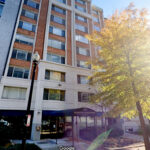
Mayor Muriel Bowser announced her administration’s intent to acquire a vacant graduate dorm from George Washington University to the D.C. Council this spring, which health and human services officials said would become a shelter for adult couples and mixed-gender families – populations that existing homeless shelters do not serve. Located in a building called the Aston on New Hampshire Ave. NW, the facility would also be the first family homeless shelter in affluent Ward 2.
Another distinguishing characteristic of the shelter – which proved controversial among critics – is officials’ plan to provide some basic medical services for residents with chronic conditions. Health officials have stressed that the Aston will not serve as a medical facility and that the health screenings and assessments they’ll have on tap are already services D.C. offers to unhoused people elsewhere.
Yet two separate lawsuits filed in July and October by the West End DC Community Association, an anonymous group that says they have residential and business interests in the neighborhood, target the facility over those services, arguing that the building isn’t zoned for that purpose, among other complaints. (“I live in the neighborhood. I got my COVID vaccine and flu shot at Walgreens that is .1 miles away from the Aston, and as far as I know, no one filed a lawsuit over that,” Cooperman says.) While the first lawsuit sought to prevent D.C. from buying the Aston, the second aims to prevent it from opening at all.
“The District … has no right to unilaterally redevelop and operate the Aston in a manner that violates well- established use restrictions and approval procedures for the applicable zone,” the lawsuit reads. In its request for relief, the lawsuit alleges, “The District’s redevelopment and use of the Aston as a non-congregate shelter facility will permanently alter the Aston and surrounding neighborhood, to the detriment of the neighborhood’s residents and commercial tenants.” S. Scott Morrison, the attorney representing the West End DC Community Association, did not immediately return DCist/WAMU’s request for comment.
An unnamed party also reportedly filed a complaint about the site with the federal department of Housing and Urban Development on Sept. 24.
The Aston’s health services were meant to replicate those at other temporary shelter sites across the city. An influx of federal funding during the COVID-19 pandemic allowed D.C.’s Department of Human Services to launch a program called the Pandemic Emergency Program for Medically Vulnerable Residents, or PEP-V, which allowed medically vulnerable unhoused people to quarantine and receive basic services during the worst of the pandemic. Advocates for the homeless credit the program with preventing COVID-related deaths among unhoused people.
And as DHS prepares to wind down the city’s last remaining PEP-V site, at the Capitol Skyline Hotel on I St. SW, advocates for the homeless worry that its 80-some residents will be left in limbo while the Aston waits to open.
Amber Harding, executive director of the Washington Legal Clinic for the Homeless, calls the Aston “sort of a safety net for the closure of PEP-V.”
“Now DHS decided to move that [opening date] along, but they didn’t change their decision on closing PEP-V. So now it’s like, where do all these people go?” Harding says. “These are people who have generally pretty high medical needs, [or] may have been in a non-congregate setting for a long time now, and have had a medical clinic on site. [These are] people who are really going to struggle in the low barrier system.”
Snapshot data from mid-November on vacancies across the city’s shelter system, obtained by DCist/WAMU, shows that low-barrier shelters in several wards are reaching capacity. Harding worries that those residents will have to move to emergency, seasonal hypothermia shelters, which provide even fewer services than year-round low-barrier shelters. (Human services officials also told community members this month that they will reduce the Aston’s capacity from 190 residents to 100.)
“Who’s gonna suffer for those delays? Not the government. They’re not gonna go, ‘you know what? My bad, I’m going to keep PEP-V open a couple more months so you have someplace safe this winter,’ or ‘Oh, we caved to the neighbors and delayed the opening of the Aston. My bad. Let me make sure that consequences don’t fall on you,’” Harding says. “No – the [consequences] are just going to fall on people.”
A spokesperson for DHS did not provide a comment on where the Capitol Skyline residents might go before the site closes in mid-December.
For their part, the West End DC Community Association’s second lawsuit also took a swing at PEP-V, dismissing D.C.’s efforts to keep the sites open as “hemorrhaging $2 million per month.”
“I think it’s important for people to understand that at the core of the opposition to this is this idea that wealthy neighborhoods should not have to bear this kind of responsibility – that we shouldn’t have to house this type of facility,” says Jim Malec, chair of the advisory neighborhood commission with jurisdiction over the area, who notes that the ANC held 10 hours’ worth of public meetings over the proposal. “And I just think that that’s wrong.”