Elliot C. Williams

Every Sunday afternoon, a big row house on the corner of Adams Mill Road and Kenyon Street NW overflows with locals participating in various volunteer programs and grassroots activities.
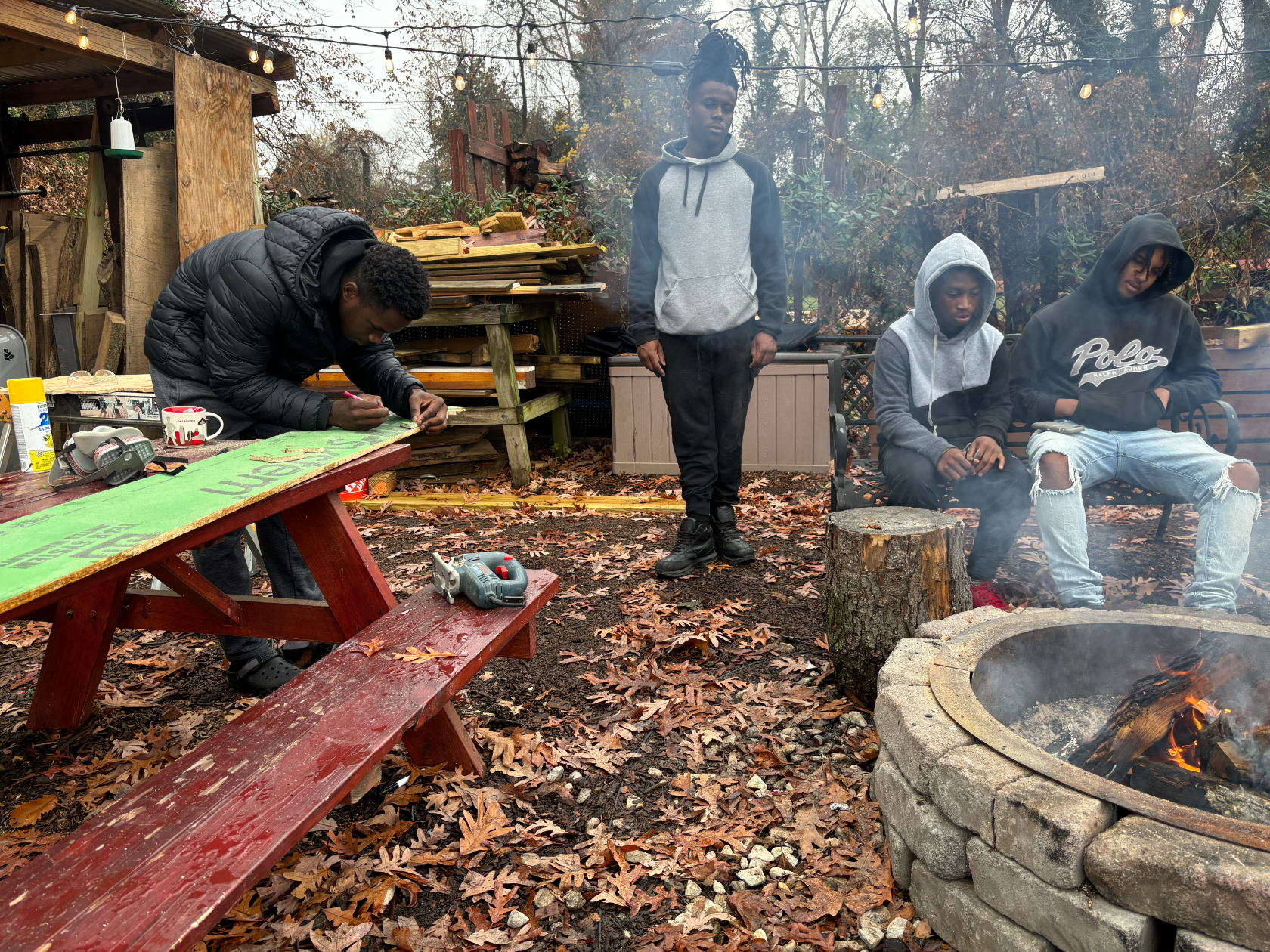
The home belongs to David Sampé, an energetic mindfulness coach who’s as quick to offer words of wisdom as he is to make you a s’more in the firepit out back. Around the fire on a recent Sunday, a group of teenagers awaits the arrival of a woodworking professional who will teach them how to make Christmas ornaments.
For over a year, Sampé has brought these students — juniors and seniors at Ballou High School in Southeast — to his Mount Pleasant home to learn carpentry skills. But unlike other woodworking clubs, they use discarded wood Sampé collects from dumpsters at home renovation projects around Northwest D.C.
Sampé started doing this in the middle of the pandemic lockdown — peeking into dumpsters, keeping an eye on local Buy Nothing groups, and stopping at construction sites to ask workers if they’d set aside some wood for him that they would otherwise throw away. He began whittling as a hobby and soon progressed to making benches in his spare time. The impact on his mental health was immediate, he says: “I felt that I was the happiest person in the neighborhood.”
For years, Sampé has taught workshops on breathwork and meditation to students at Ballou High School in Southeast. Last year, he invited a group of them to join him in crafting the benches. Eventually, he named the project “Gentrified Wood,” symbolizing the process of taking something overlooked and making it new, but also representing the changes he’s seen across the city and in his own life as a D.C.-area native.
As the Sunday sessions became more consistent, Sampé involved Aaron Dickerson, a board member of Edgewood Community Farm in Northeast D.C. who mills lumber and teaches the students proper carpentry techniques.
Sampé envisions Gentrified Wood projects lining the walls and seats of major restaurant chains that decide to open locations in D.C. He hopes to secure grant funding to serve more students and expand to other farmers’ markets around the city.
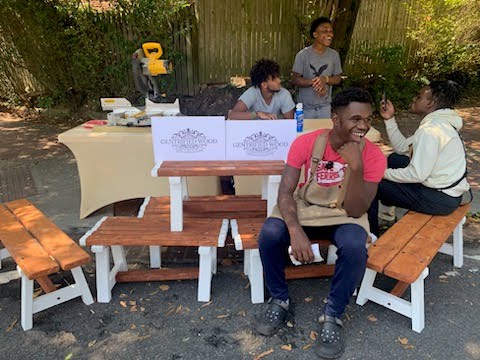
More immediately, the group is preparing for a Dec.16 holiday market at the Edgewood Community Farm, where they’ll sell those handmade Christmas ornaments.
The students also end their Sundays with a full belly, as Sampé is one of the founding members of ReDelicious, a food redistribution co-op that also operates out of his home.
After a local influencer posted about the co-op on TikTok, ReDelicious grew from a collection of about eight members to a bustling weekly food project. Volunteers set up food-sorting stations, cook lunch for visitors, and hand out free produce that would otherwise get tossed by neighborhood farmers’ markets.
Sampé sees ReDelicious and Gentrified Wood as separate projects that accomplish a similar goal: revealing the true potential in what some would consider trash.
“We redistribute wood and waste coming from gentrifiers that are coming into these neighborhoods and remodeling their home,” he says.
“Some of these young kings need help”
Gentrified Wood does more than teach new skills to the young men involved; while there, students can “express themselves freely without any blowback,” Sampé says.
One participant, 16-year-old junior Jelani Coleman from Southwest, says woodworking has allowed him to practice patience and dedication to a craft outside of classwork and wrestling practice. He says he wishes more of his peers had access to the mentorship and mindfulness Sampé has taught him.
“We need mentors out here to help us work and tell us what to do, so they can help us fix our life,” Coleman says. “Some of these young kings need help.”
Coleman says he enjoyed the two-week process of measuring, buzz-sawing, sanding, and staining the wood for a bench, and then selling it to a customer who said they would put it on their front porch.
Dwayne Nicholson, an 18-year-old who lives in Southeast, says that when he’s woodworking, he can just be himself and doesn’t have to look over his shoulder for police or anyone who’d wish to do him harm. In other words, he feels free.
“Nowadays, there’s so much going on,” Nicholson says. “There’s people younger than me walking around with guns trying to take people’s stuff for no reason. It makes you not want to go outside at all or do nothing.”
Sampé organizes outings to give the students a break from their usual environment and the “life and death decisions they have to make every single day of the week.” He takes them to Rock Creek Park, where they get to just be kids in nature, enjoying the sounds of water flowing and crickets chirping.
“Some of the hardest students out of Southeast, they’re so tough. But when you take them out into nature, man, they don’t even know what to do with themselves,” says Sampé, laughing. “They’re terrified.”
Sampé relates because at nearly 50 years old, he says he still feels the “scared little boy” inside of him and continues to heal from the trauma he experienced from his past life in the streets.
Escaping a “warzone”
Sampé grew up in District Heights, Maryland, before moving to Southwest D.C. in his teens, and says that leaving his porch as an 18-year-old in 1992 meant stepping into a “war zone.” In the late ‘80s and early ‘90s, some referred to D.C. as the murder capital due to its high homicide rate, and Sampé says he was knee-deep in the violence of the drug trade.
“Even to this day, the scar remains, and the healing never stops,” he says. “My way of healing is to continue to give back for anything that I took away 30-plus years ago.”
In his 20s, Sampé moved to New York City, determined to escape the pull of the streets. He had a son, Kingston, who he says changed the trajectory of his life forever. He picked up work in television production, taking internships and camera work contracts at major networks, he says.
And yet, Sampé’s D.C. life caught up to him: While some charges from a federal investigation were dropped, he says he was eventually convicted on a firearm charge and spent about three years in prison.
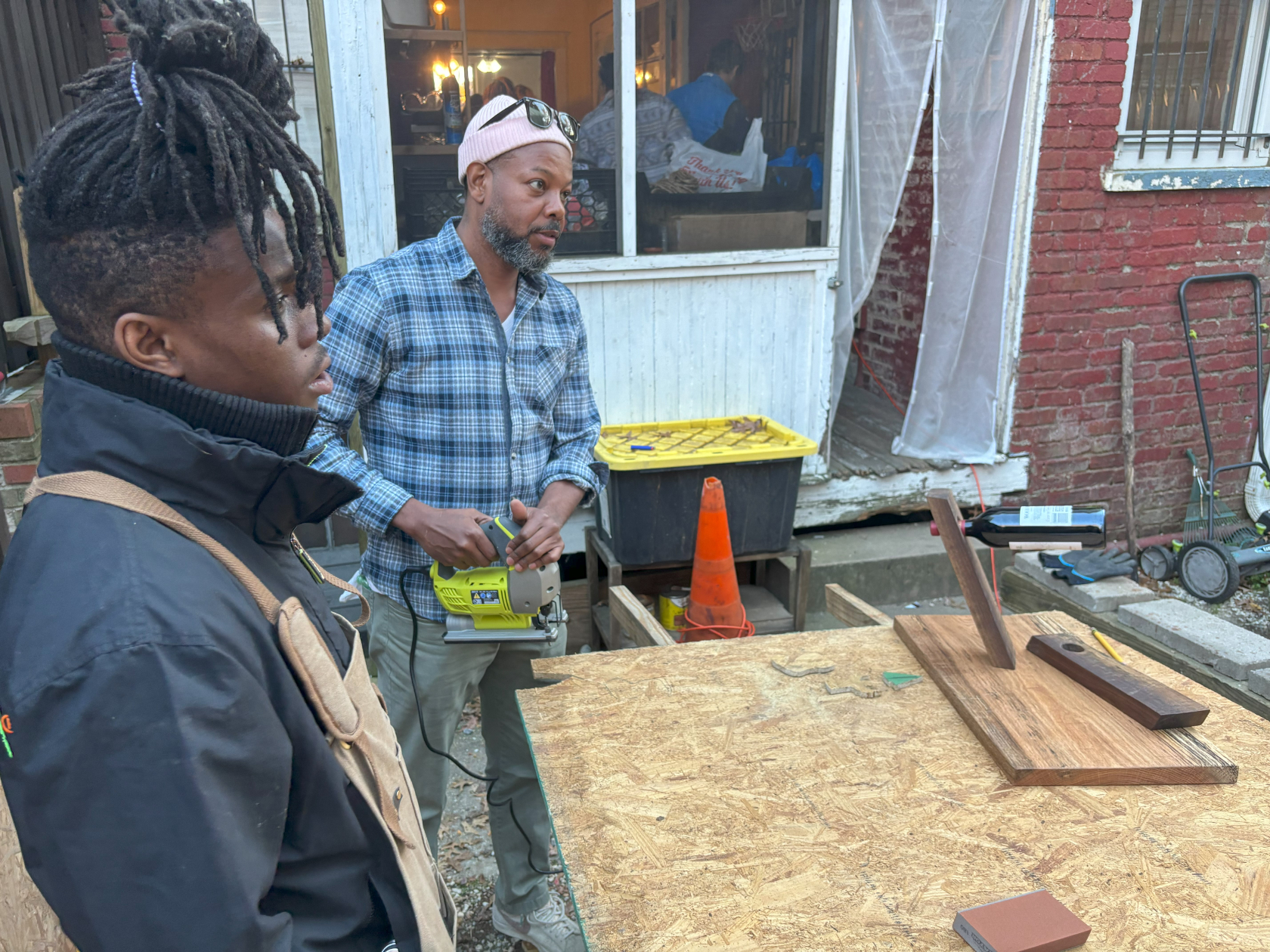
By the time Sampé was released, he’d entered a yearslong custody battle with his son’s mother, who struggled with drug addiction, he says. Eventually, Sampé won full custody and raised Kingston alone in New York. As Kingston approached middle school age, Sampé says he realized the New York City streets might grab hold of Kingston — just as Sampé had been pulled in decades earlier. Afraid history would repeat itself, Sampé packed up their lives and moved back to D.C. about six years ago.
It seems the decision paid off: Kingston is now a student at Jackson-Reed High School and a member of the crew team — a “well-rounded” individual who can get along with just about anyone, Sampé says. Kingston often participates in the Gentrified Wood projects.
“I am a service dog”
In the years since returning to D.C., Sampé has embarked on several projects that have provided social and emotional support to formerly incarcerated citizens. He spent years leading conflict mediation programs for the International Association for Human Values, a group associated with Art of Living (a somewhat controversial meditation center with locations around the world.) Within this role, he began teaching breathwork and meditation at Ballou in 2018. This month, he says he started a new job as executive director of Community Mediation DC, a group that offers offers free mediation services and conflict management training.
His past is complicated, sure — but in healing his wounds and offering most of his time to helping others do the same, Sampé keeps his moral compass pointing due north, he says.
“I am a service dog,” he adds. “If I am not of service, I am empty.”
With Gentrified Wood, Sampé helped Ballou senior Lorenzo “Zo” Martin-Green try something other than basketball and football. A talented wide receiver from Southeast with multiple scholarship offers, Martin-Green says it’s been nice to add “woodworking” to his resume.
“I’m not gonna lie, it was a little bit frustrating at first,” Martin-Green says of his first few carpentry lessons with Dickerson and Sampé. “But I’m an open-minded person, so it was kind of fun stepping out of my comfort zone.”
Martin-Green, 17, says he notices newcomers moving into the District and fears the legacy of D.C. natives will be forgotten with the shifting demographics and culture. The goal of the woodworking is to “leave our mark,” he says. “It’s like, y’all gotta remember our names somehow.”
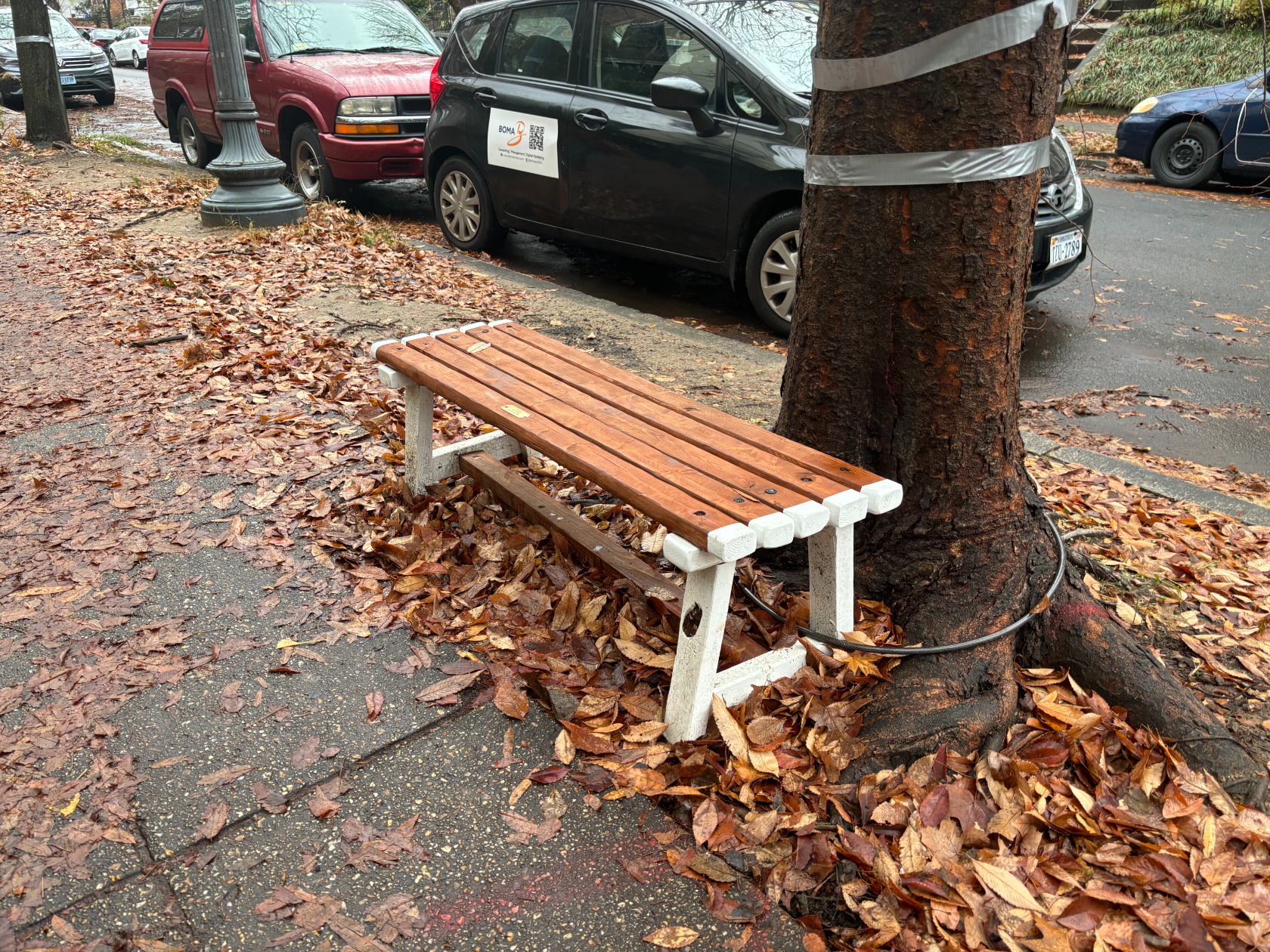
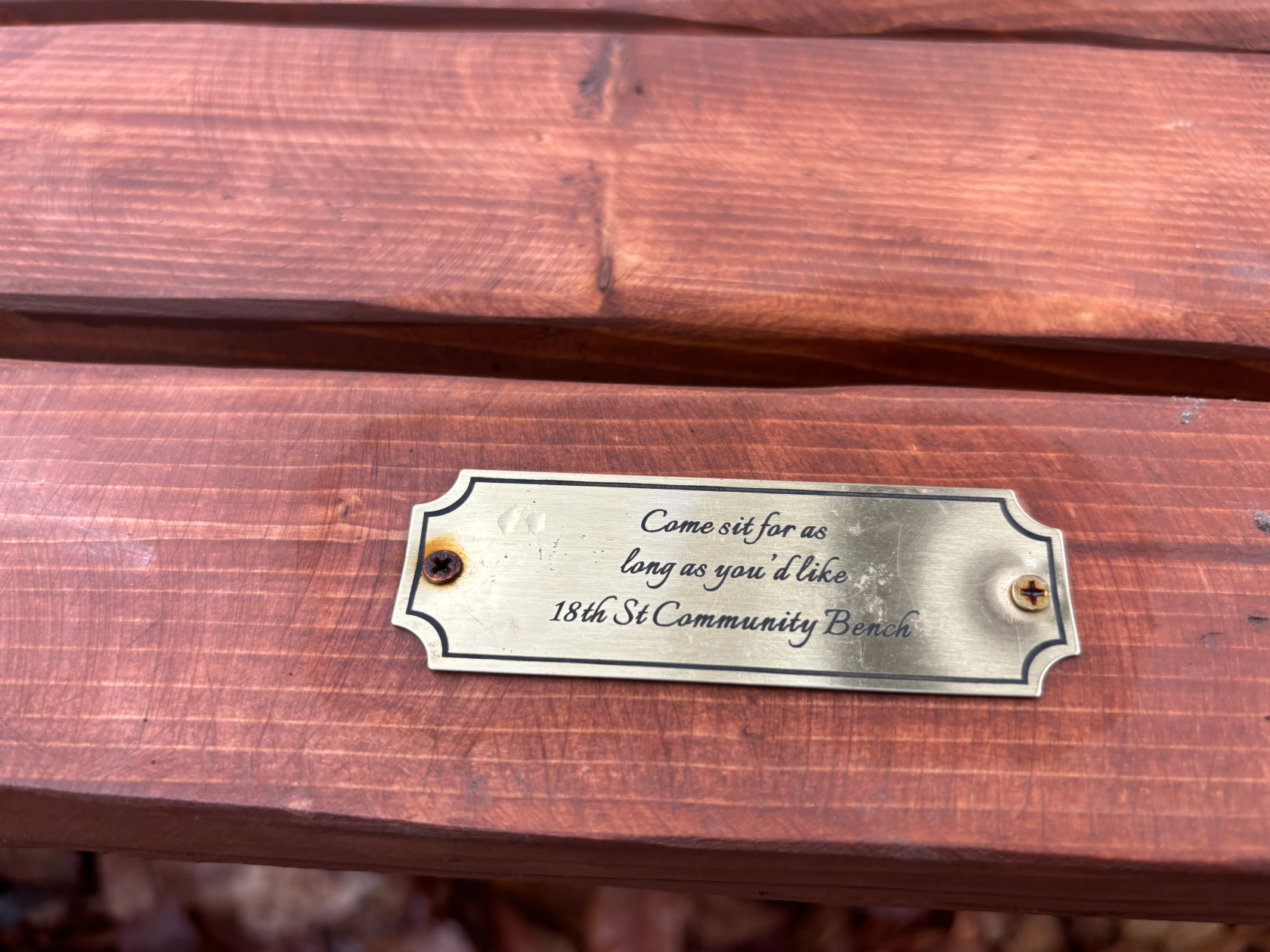
Perhaps Sampé’s greatest goal is to challenge the notion of who — and what — belongs in D.C.’s neighborhoods northwest of the Anacostia River. The benches include etchings that describe who made them, where the artists are from, and where the wood was found.
“In Washington, unlike anywhere else in the country, people come here and they rip up the roots, and they just toss them away like nobody was there before them,” Sampé says. “I feel like Gentrified Wood is a way of kind of really getting under that and saying, ‘Hey, listen, you know, there was someone here before you. And we’re still here.’”