Margaret Barthel
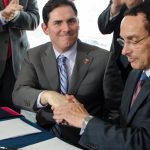
It’s been two days since Virginia officials and Monumental Sports and Entertainment announced a proposed $2 billion deal to bring the Wizards and Capitals to a new stadium in Potomac Yard in Alexandria.
Local and state officials were jubilant at the announcement, hailing the deal as an economic boon and citing the benefits of the massive new development. Residents, meanwhile, have been considerably more tepid in their response – a handful of protesters showed up at the stadium’s announcement, and some local groups have already begun posting signs opposing the deal.
Among concerns expressed at public meetings and across social media are worries about the crush of traffic a new stadium could add to the area, and the potential for residents’ taxes to be diverted from essential public programs to fund the project.
“Alexandria neighbors are a strong, vocal community, the Del Ray community in particular,” Virginia Sen. Mark Warner, himself an Alexandria resident, said on a press call Thursday morning. “I think that the state and the city probably should have done more outreach in those neighborhood communities, because they will have to be assured that their quality of life is not going to be dramatically upset.”
Officials backing the new development, meanwhile, have worked to allay concerns from residents about how the project will unfold.
If the project in fact moves forward (the agreement still needs to be approved by both houses of the Virginia Assembly and the Alexandria City Council), here’s what residents should know about the quality-of-life and financial concerns regarding the new stadium.
Transportation for new crowds
Large crowds of people were always eventually going to come to Potomac Yard. The neighborhood is the focal point of several major as-yet-unfinished development projects — Amazon’s HQ2 and a Virginia Tech campus, which is directly adjacent to the proposed stadium site — that are also expected to bring more people to the area. The stadium deal would mean still more people, with sports fans and attendees to entertainment events gathering in the neighborhood more than 200 nights per year.
The question for many residents is how all those people are going to get there and move around the area — without overtaxing the area’s existing transportation infrastructure. The neighborhood has a brand new Metro station, and is also served by George Washington Memorial Parkway and Route 1, both major (and majorly congested) roads.
“Traffic! Potomac [Y]ard isn’t made for this traffic,” tweeted one resident about the deal.
“I hope they take a page out of Audi stadium’s book for making it easy to get in and get out,” wrote another. “Bike lanes, wide sidewalks, scooters, valet for bicycles, Uber area, reserved parking, and last minute parking options, metro stop ~nearby.”
Others worried about the impact on travelers getting in and out of National Airport, which is close by in Arlington.
Alexandria and the state plan to chip in a combined $150 to $200 million for transportation improvements in the area, but it’s unclear what those projects would be. An FAQ from the city on the project references connections with DASH bus, a new bus rapid transit stop, safe streets improvements for Del Ray and Rosemont, and possible connections to VRE, Amtrak, and water taxis.
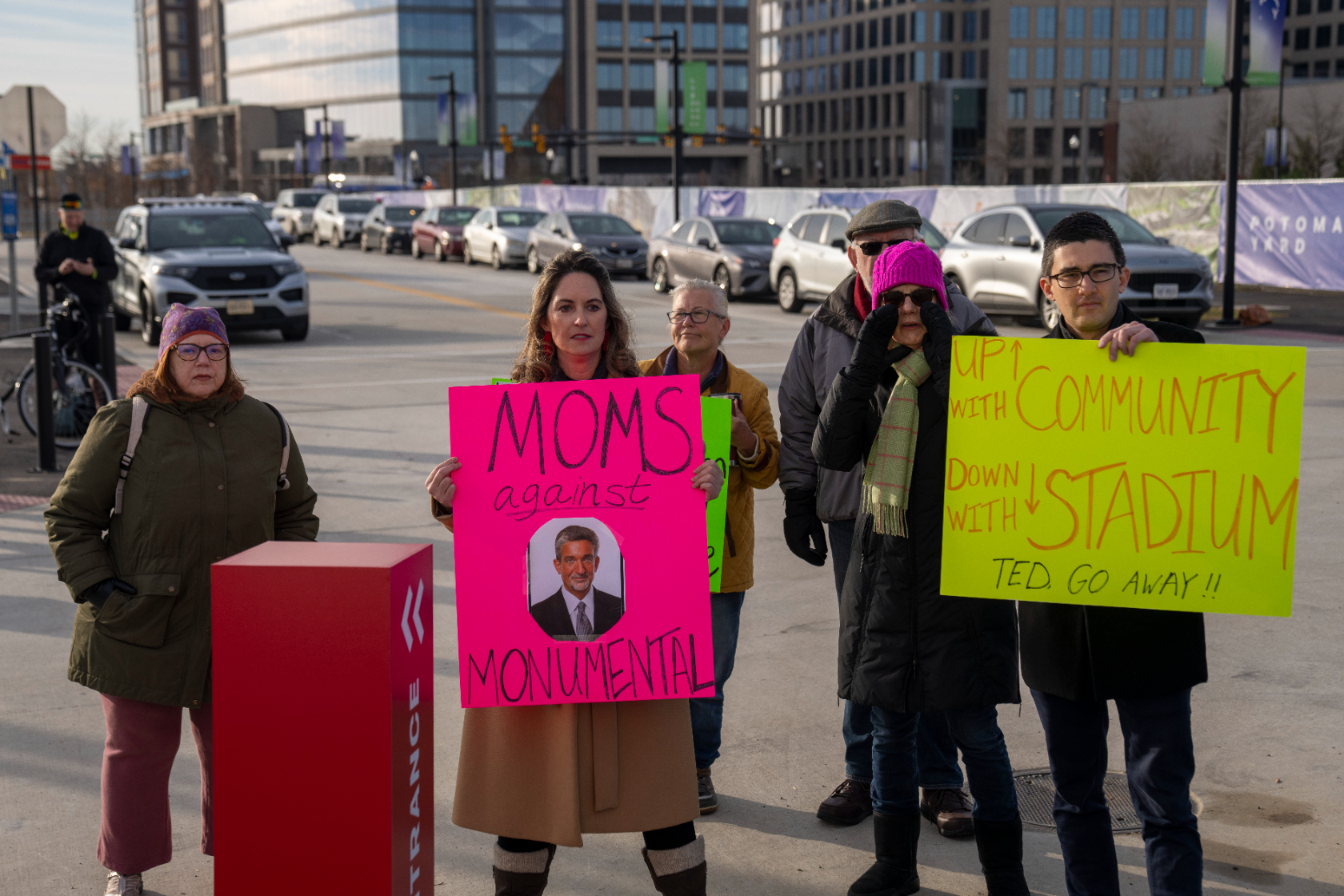
At a Del Ray Citizens’ Association meeting on Wednesday, Alexandria Mayor Justin Wilson suggested the city could implement a parking permit system for the surrounding neighborhoods, in an attempt to prevent spillover game-day parking. There are also possible improvements to Route 1 on the horizon.
“To the extent there’s any taxpayer impact in this project, it mainly relates to the transportation infrastructure that is going to need to be funded,” State senate Majority Leader-elect Scott Surovell (D-Fairfax) told DCist/WAMU. “But I also think there’s sort of a general broader societal benefit to having improved transit and transportation infrastructure around these projects.”
Surovell and other elected leaders, including Wilson, say they want to focus on ensuring the Potomac Yard Metro station — just opened this year and funded using tax increment financing as part of the Amazon HQ2 deal — is updated to be able to manage a surge of sports fans.
“The whole reason that Ted Leonsis decided to try to relocate that stadium to Alexandria is because it’s next to a Metro station,” Surovell said. “It wasn’t because it’s next to a road.”
But the new stadium proposal comes at a time when Metro is facing a $750 million budget deficit which could force it to severely cut service and close 10 Metro stations. It’s a potentially massive blow to the region’s economy if D.C., Maryland, and Virginia are unable to find a way to fund the transit agency. Last week, Virginia Gov. Glenn Youngkin sent a letter to the Biden administration, urging a full federal return to the office as a first step to solving Metro’s budget woes. (He did not directly reference Virginia’s financial obligations to Metro.)
The stadium deal — which would be a feather in Youngkin’s cap after losses in the General Assembly elections last month — could create a new incentive for Virginia to come up with the funding to support Metro.
For all the focus on transit, though, Metro General Manager Randy Clarke told WAMU’s Politics Hour that he was not consulted about the stadium deal, instead learning about it in news reports.
Impact on taxpayers
Other residents had a different question about the deal: will my taxes end up supporting billionaire Monumental owner Ted Leonsis instead of public services?
“Mixed feelings. I live in VA and have Caps tickets. It may be more convenient for me in some ways. A new state of the art facility would be a great improvement,” tweeted one Virginia fan in response to a call for reactions to the new stadium concept. “But I am not in favor of taxpayer subsidies for building. I need to see the final deal before being enthusiastic.”
“As a Virginia taxpayer, I’m not thrilled,” wrote another. “Taxpayer financing of sports stadiums has historically provided a poor ROI to taxpayers. Feel free to explain to me why it will be different this time.”
Estimates released with the announcement suggest the project will create 30,000 jobs and generate $12 billion in investment in the area, though there is a checkered history of stadium deals successfully driving significant economic benefits to the locations where they’re built.
The Youngkin administration and Alexandria economic development officials have offered up the broad outlines of the financing strategy for the new stadium: the Virginia Sports and Entertainment Authority, which the General Assembly will need to create, will issue bonds — essentially, agreements to pay back debt with interest over time — to fund construction of the stadium and surrounding development. The bonds will be paid back through rent payments from Monumental Sports and Entertainment, parking fees, the naming rights to the new stadium, and “incremental taxes generated by the facility,” according to statements from Alexandria Economic Development.
Tax increment financing is a method for paying back the debt on major capital projects through the increase in property tax values created by those projects. To create a TIF, local officials set the boundaries of the area and a base year as a point of comparison — and then any increase in taxes from that baseline goes into a separate TIF fund, rather than the general fund.
Officials said at the outset that no existing taxes or proposed tax increases for local residents will support the project, but the actual picture appears to be more complicated.
Monumental and Alexandria will spend $56 million each to build a new performing arts venue as part of the complex. The costs of transportation improvements at the site are likely to cost taxpayers $150-200 million.
Critics of tax increment financing argue it means diverting the growth in property taxes over time away from other public expenses, like schools or city services. By that measure, the proposed TIF structure could result in a major public subsidy — $1.05 billion paid back in tax revenue from the project plus naming rights and parking costs, of the total $1.35 billion in total public support for the project, per reporting from The Washington Post based on a JPMorgan Chase study on the deal. That could make the stadium agreement the most lucrative public subsidy for a sports arena ever, The Post reports.
Virginia officials, however, say the structure of the deal will mean that much of the new prosperity brought to the area by the new complex will essentially pay for the construction of the complex. Warner emphasized in a press call on Thursday morning that the agreement “doesn’t require the state to put up any money up front.”
“Instead, we absorb the tax revenue spawned from this entertainment district,” he said. “I think it’s a good structure.”
Surovell, who will lead one of the two General Assembly chambers that need to pass the deal in the upcoming legislative session, said lawmakers will need to scrutinize the specifics of the proposal.
“The deal itself needs to be vetted to make sure it’s financially prudent, make sure there’s no taxpayer risk, and make sure that we know how we’re going to move people in and out of the project,” he said in an interview, adding that including labor standards for the project is another important issue.
Surovell said he’d been briefed on the outlines of the Alexandria deal weeks ago, and hadn’t received updates on significant changes since then.
This story has been updated with additional details on the public subsidy for the stadium deal.