 Olga Imbaquingo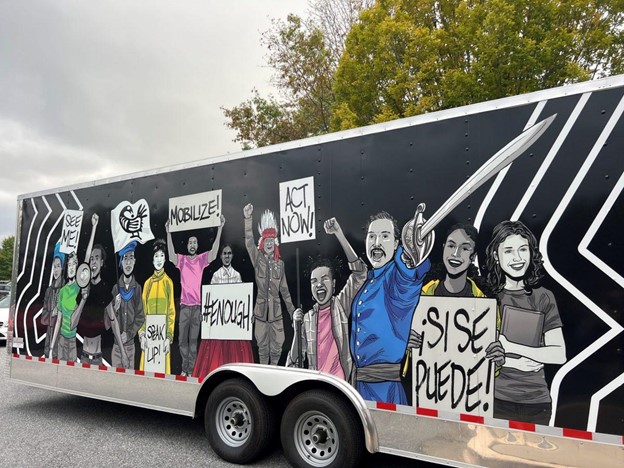
This story was produced by El Tiempo Latino. La puedes leer en español aquí.
Technology and the way we consume culture are expanding the concept of museums. What have heretofore been static temples are now also taking history and the achievements of everyday people to neighborhood schools. Using that concept, Sankofa was born: a mobile museum that began parking at schools in Prince George’s County in the fall.
The goal is to reinforce history, civics, and biology classes — and to tell students about what ordinary people are doing to build a better world. Sankofa Mobile Museum is a permanent project that takes its name from two words in the language of the Akan people of Ghana meaning “go back to the past in order to advance towards the future.”
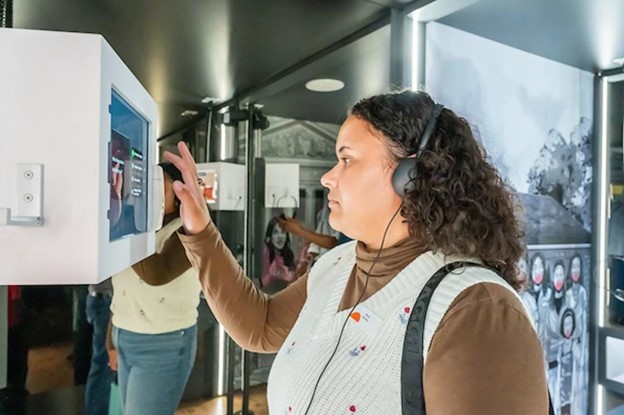
“It’s such an innovative idea to combine technology and stories from the perspective of unknown people who, through their example, help empower the community,” said Samantha Howard, the Latino affairs liaison for Prince George’s County. She reflected, “People don’t go out on the street saying ‘today I’m going to make history’ — they just live their lives, and through their actions they help change the world. That’s the beauty of this initiative.”
The vision for the Sankofa Mobile Museum took shape in 2019. Prince George’s County has several museums but observed barriers related to transportation and the lack of time to visit. The mobile museum was designed to connect students, teachers, and the community with local history spanning from more than a thousand years ago to the present.
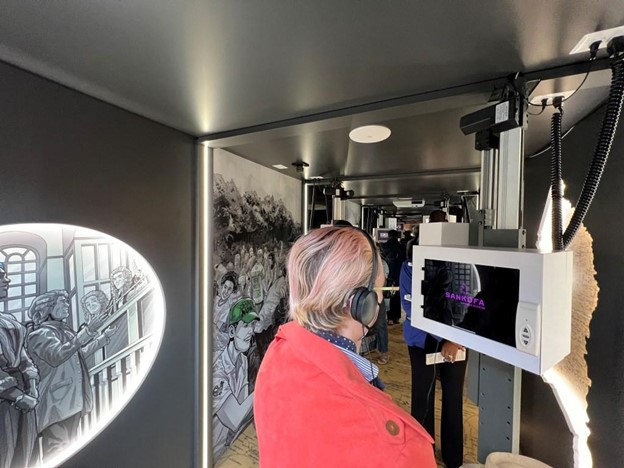
“We are going to take that history to schools without children and teachers worrying about taking a bus,” said Kevin Cabrera, the assistant division chief of historic resources for the Maryland-National Capital Park and Planning Commission. He put into perspective the history of Maryland with nationally significant figures such as abolitionist and activist Harriet Tubman, or writer and statesman Frederick Douglass.
Eight modules will reach schools and be used as support for the curriculum. For example, if they are learning about the Civil War, the museum will tell the stories of young African American soldiers who went to war. If they are talking about the weather, they will offer a story related to social activism or climate justice.
A Latina mom featured at the museum
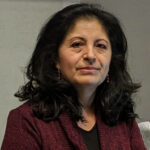
One of these stories is that of Cándida García, the only Latina present in one of the eight modules. “We purposely wanted to share the stories of people in their daily lives who, at the same time, take inspiring actions and seek change,” Cabrera said. “García came from Honduras, connected with Chispa (a Latino environmental organization), and has been very active in creating community gardens and green spaces for children in her neighborhood.”
Howard, the Latino affairs liaison, is encouraged precisely by the idea of setting an example and inspiring children with work like García’s. “It’s like saying to them, ‘look at this and reflect on it because this is your story.’ The best part is that these testimonies will be exhibited in schools that don’t have as many services and opportunities to provide culture.”
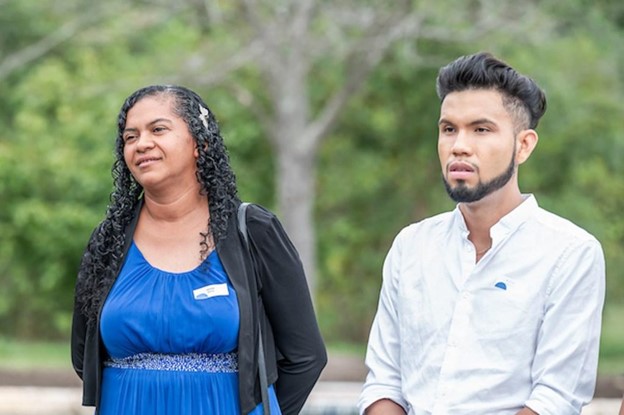
García is a mother and a visible face for her activism in Langley Park. She ensures that her children use libraries, accompany her to plant trees, or go to the state assembly and the Capitol in D.C. to demand cleaner air. “They took me into account for the museum because of what I have been doing for a healthy environment. My participation is in the climate justice module,” García said.
García is also a tree ambassador, involved in a project planting native plants in the area. Along with her husband, a construction worker, they lead the cleaning program with the support of school children at César Chávez School.
Lourdes Sulc, director of the Langley Park Community Center, nominated García for the mobile museum and would like her story to inspire children. Her voice can be heard in the museum: “Latinos must raise their voices more and get involved in community improvements. My daughter is in a recycling program at her school; she is also active in the math and civics club.”
Technology to bring culture closer
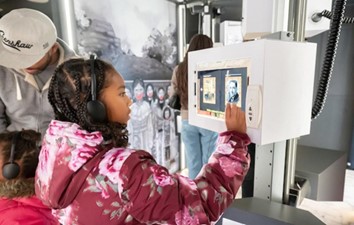
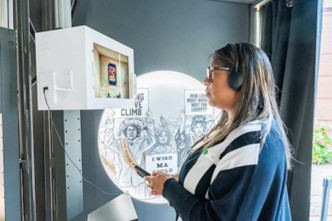
What will children see in the mobile museum? The cultural richness, struggles, and aspirations of people in their community. After hearing these life experiences, they will know that they don’t necessarily have to be another Martin Luther King Jr. or César Chávez to make a difference. “Let them feel that if a transformation is necessary, they are the best ambassadors for their neighborhood, school, or family,” Cabrera said.
The chances that children and young people, for whom the museum is designed, will be impressed by these stories are greater because of the help of technology. Videos, augmented reality, and virtual reality devices are at the center of the experience.
Schools are the priority, but on weekends and holidays, the museum will visit festivals, fairs, or summer camps. Cabrera, who became passionate about stories since childhood thanks to the fables his grandfather told him, aspires for the museum to be on the road all year round. (A visit from the mobile museum can be requested online.)
For now, Sankofa is not bilingual. But future plans include adding Spanish subtitles to the stories. “We have to find the budget to dub the modules to Spanish. Language is a barrier, but we are working to overcome it,” Cabrera said.
For Howard, this is like the drop of water that breaks the stone not by force but by perseverance. “These stories of ours are like those drops that keep falling and let us know who we are, and this is our contribution,” she said.
This article was translated into English by El Tiempo Latino.