Morgan Baskin
A civil rights organization filed a lawsuit Thursday against national real estate group AIR Communities, alleging that the company discriminates against prospective renters with housing vouchers, criminal records, and histories of eviction.
The complaint alleges that AIR Communities explicitly advertised on its website that it would not rent to people with prior evictions or criminal records, and implemented stringent credit and income requirements designed to deter people who use housing vouchers from applying for housing.
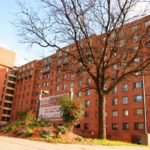
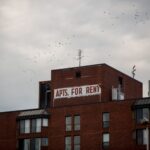
While the complaints are limited to two of AIR’s properties in D.C. – the Latrobe Apartment Homes in Logan Circle and the Vaughan Place apartments in McLean Gardens – the company owns 13 complexes total in the D.C. area, including three in the District, six in Virginia, and four in Maryland.
Under D.C. law, housing providers cannot refuse to rent to an applicant based on their sealed eviction records. This lawsuit is among the first legal challenges brought against a property owner related to recently adopted laws in D.C. that instruct D.C. Superior Court to seal eviction records older than three years.
It is also illegal in D.C. to deny housing to people who use housing vouchers, or to require voucher holders to meet certain credit or income requirements. D.C. also bars housing providers from refusing to rent to people with criminal convictions more than seven years old. A spokesperson for AIR did not immediately respond to DCist/WAMU’s request for comment.
“Discrimination against voucher holders further entrenches the racial segregation that has characterized D.C. neighborhoods for decades,” said Kate Scott, executive director of the Equal Rights Center, which brought the lawsuit against AIR Communities. “Banning residents from housing on the basis of their stale evictions, irrelevant criminal histories, or voucher status are some of the most egregious, harmful modern day civil rights violations.”
The Equal Rights Center conducted several fair housing tests in its investigation of AIR Communities’ leasing procedures. Organizations use testers, or false applicants, to determine whether the company in question discriminates against certain consumers.
On both the Latrobe Apartment Homes and Vaughn Place websites, the company allegedly advertised: “We screen for criminal background, and applicants may be disqualified based on history. We do not allow renters with felony convictions to live at our community . . . Renters may not have had previous evictions.”
In the case of the Latrobe Apartment Homes, the Equal Rights Center directed three testers to call the building’s leasing office and ask about its policies toward voucher holders, or those with a prior criminal conviction or eviction.
In each case, the leasing agent suggested the tester not apply or stated that the leasing system would automatically deny their application. And in the case of the tester who inquired about using a housing voucher, the leasing agent allegedly said in part, “we do not have any Section 8 units.” (There is no such thing as dedicated units for voucher holders in the federal program previously known as Section 8. Generally speaking, voucher holders are free to rent any available apartment on the rental market.)
Federal housing vouchers are one of the most common subsidized housing programs available. D.C.’s public housing agency administers more than $250 million in federal funds alone – supporting close to 12,000 families – for housing vouchers. Although source-of-income discrimination in D.C. remains illegal, the practice is still rampant, and lawmakers in D.C. have weighed various measures in an attempt to curb it.