 Jenny Gathright
D.C. police have released the body camera video of the fatal January 24 police shooting of 41-year-old Clifford Brooks, who was killed as he ran towards an officer with what appears to be a tire gauge. The chaotic incident happened after police had spent two hours talking to Brooks while he was having a mental health crisis; an officer shot him after he escaped from an ambulance and ran into morning rush hour traffic on North Capitol Street.
City officials identified the officer who shot Brooks as Claude Jackson; he has been with the department for 31 years and has been placed on administrative duty while the U.S. Attorney’s Office investigates the shooting and decides whether to bring criminal charges against him.
Police said they initially encountered Brooks shortly before 7 a.m. on January 24, when they responded to the 2500 block of Benning Road Northeast because he was experiencing a mental health crisis. Officers spent two hours speaking with Brooks, “successfully de-escalating the situation,” according to a statement from the Metropolitan Police Department. Then, D.C. Fire and EMS began to transport him to an area hospital, with police following behind the ambulance.
During the transport, near the 1300 Block of North Capitol Street, Brooks “became combative, and attacked the firefighter/paramedic who was riding with him, pinning her against the inside wall of the ambulance,” according to police. The paramedic fled the ambulance, and Brooks followed.
The police officers who had been following the ambulance then intervened, which is where the newly released body camera footage starts.
The footage shows Jackson exiting the car and running up to Brooks, who was in a brief physical confrontation with another officer. Jackson pepper sprayed Brooks, who fell to the ground before getting up and running into traffic on North Capitol Street.
Then a voice is heard over the officer’s radio, saying “Be advised, he’s not armed.” It’s currently unclear whether the officer on the radio was referring to the situation with Brooks; a police official told reporters on Wednesday that it was a communication over the main radio channel for all officers in the 5th District, so the person on the radio could have been talking about a different situation.
Jackson then used his radio to call for backup and for a police official to report to the scene while he continued to follow Brooks through traffic on North Capitol.
Jackson reached another police officer on the street, who confirmed that Brooks was hiding underneath a truck, the video shows. The two officers stood by the truck until Brooks emerged from under it with a metal object, which appears to be a tire gauge, and began to run towards Jackson. Police yelled “drop it” several times, and within seconds, Jackson fired five shots at Brooks from close range. After Brooks fell onto the street, Jackson fired a sixth shot.
Brooks was pronounced dead at the scene, according to police.
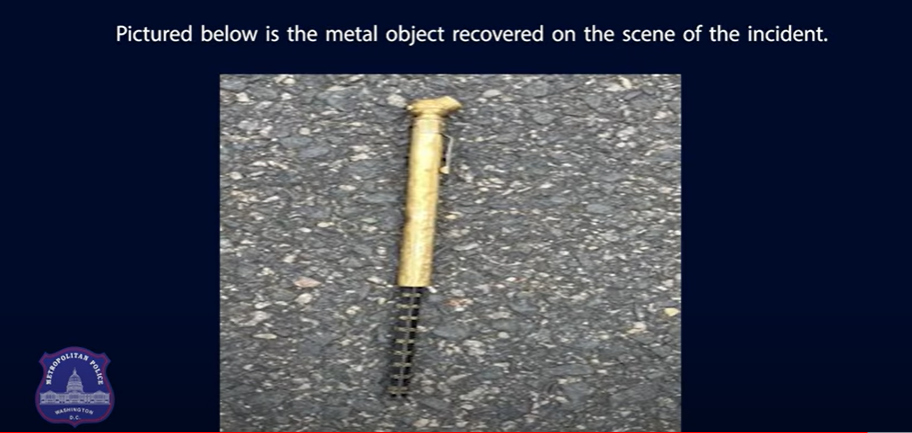
Jackson did not respond to a request for comment. A police official said Wednesday that it’s not clear what Jackson thought Brooks was holding in his hand, because he hasn’t yet given a statement to investigators (he’s permitted to remain silent at this stage of the investigation).
Much still remains unclear about the events that led up to the shooting; for example, the Washington Post reported that Brooks’ mother had asked for him to be involuntarily committed, which would have required police to restrain Brooks and ride in the ambulance with him. Police officials couldn’t say Wednesday whether the hospital transport was “voluntary” or “involuntary,” which would determine whether police followed department protocol in this case.
Brooks’ sister told the Post that her brother was “depressed … not violent,” and that shooting him during a mental health crisis was unjustified.
The Metropolitan Police Department is in the very early stages of a pilot where trained mental health professionals respond to calls with police. Professionals from the Department of Behavioral Health did not join police when they responded to Benning Road for the call of a man in crisis, according to MPD officials. Police officials said Jackson had received a 40-hour training in crisis intervention, as well as additional training in hostage negotiation that could have applied to the situation — but they added that at this stage, they could not comment on whether Jackson properly applied that training with Brooks.
“Any death is tragic, especially in a circumstance like this where the officer spent so much time trying to work with the individual and get them the help that he needed,” MPD Executive Assistant Chief Jeffery Carroll said at a press conference Wednesday. “With that being said, the officer does also have to make sure that he protects himself and the community that’s out there. So it’s a very difficult situation.”
After the U.S. Attorney’s Office determines whether they’ll bring criminal charges, MPD will launch its own internal review of the incident. Carroll said after that point, the department will decide whether it believes the officer should have avoided using deadly force.