 Jenny Gathright
Do you have a question about the Secure DC bill? Email it to me at jgathrig@wamu.org and we’ll try to answer it in an upcoming story.
Update: The D.C. Council voted Tuesday to advance Secure DC, with several additional amendments. The council will cast a second and final vote on the legislation in the coming weeks — and the bill is likely to change further before then.
On Tuesday, the council amended the bill in the following ways:
- First, the council struck language in an anti-mask provision that would have made it illegal for residents to wear a face covering while “caus[ing] another person to fear for his or her personal safety.” The bill still makes it illegal to wear a mask while they intend to commit a crime or intimidate, threaten, abuse, or harass another person.
- Another amendment eliminated a proposed expansion of DNA evidence collection that would have allowed law enforcement to collect DNA evidence from a person upon arrest.
- An additional amendment would allow the D.C. government to implement a record sealing law passed by the council earlier than initially planned — as early as later this year, should the measure be funded in the D.C. budget.
- Another amendment would sunset the bill’s changes to pretrial detention statutes after 225 days, and require that the city produce a study on its effects before then
Ward 8 Councilmember Trayon White was the only councilmember to vote “present” on the bill — the rest approved it. Councilmembers also debated possible further amendments, including a change to the portion of the bill that lowers the threshold for felony theft from $1,000 to $500 – but ultimately opted to reserve voting on them until the second vote.
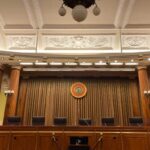
During the deliberation and vote, opponents of the bill packed the hearing room, with several wearing shirts saying “Don’t throw D.C. under the crimnibus.” Tia Bell, who leads the T.R.I.G.G.E.R Project, an organization that works with young people at risk of becoming victims of gun violence, says she’s concerned that the law’s focus on prosecution and punishment will ultimately hurt the neighborhoods most affected by the trauma of gun violence.
“I’m a youth advocate, and I see working and advocating for them how they are neglected and ignored. They are not seen or treated seriously until they are shot or do the shooting,” Bell says. “We are going to suffer. I’m scared.”
Original:
The D.C. Council will cast its first of two votes Tuesday on a massive, 100-provision public safety bill that would stiffen gun penalties, create new retail-theft related crimes, and lengthen the maximum prison sentence for repeated theft.
The bill would also mandate more government coordination and data reporting on aspects of the public safety and criminal justice system ranging from the city’s troubled 911 agency to the outcomes of diversion programs. It comes on the heels of a year where D.C. saw more homicides than in any year since 1997 — and at a time when residents across the city are on edge about violent crimes like shootings and carjackings, as well as property crimes like car thefts and retail theft.
Ward 2 Councilmember Brooke Pinto introduced the bill, called “Secure DC,” last month — and in a video Monday, she said she’s confident that the bill “will help turn the tide on the crime trends that have overwhelmed our communities.”
D.C. Council Chair Phil Mendelson told reporters Monday that the council, which has received criticism for alleged inaction on rising crime, “is doing its part.”
“The bill is moving forward,” Mendelson said. “This is a very lengthy and comprehensive bill.”
Secure DC is expected to pass Tuesday, particularly since Pinto’s team has made a series of changes to the bill to accommodate some colleagues’ concerns.
Most of the amendments came around midday Monday, when Pinto’s team circulated an “amendment in the nature of a substitute,” which is basically a new version of the bill that incorporates numerous changes to the language.
The changes scale back some of the more controversial aspects of the bill, like provisions that would have significantly altered police reforms from recent years. Pinto’s initial bill reduced public availability of police disciplinary records through the Freedom of Information Act, which had been expanded in a 2022 bill (but hadn’t yet been fully implemented). The revisions to the bill open back up public access to sustained and unsustained allegations of officer misconduct, and narrow exemptions on the release of officers’ medical history.
The amendments also remove a provision in the original bill that would have reduced the Office of Police Complaints’ access to Metropolitan Police Department records.
Still, the bill maintains several provisions that have been the subject of fierce debate on the council, including one that would allow the police chief to establish 100-square-foot “drug free zones” – a narrowed revival of a policy D.C. initially enacted in the ‘90s and later repealed.
Under Pinto’s proposal, police would be able to arrest people who they “reasonably believe” are gathering in a group to commit a drug offense after they fail to obey police orders to disperse. Proponents of the provision, including D.C. Mayor Muriel Bowser, insist it will give police an important tool to address residents’ rising concern about open air drug markets and violence connected to them. But some members of the public have pushed back against the policy, arguing it revives failed tactics from the city’s “tough on crime era” and opens the door to harmful police harassment. Some councilmembers have questioned whether it will even give police new tools, since they are already empowered to enforce the city’s drug laws.
Pinto’s new amendments require MPD to provide more parties with advance notice about drug free zones, clarify that the policy is not intended to prevent people from seeking drug treatment services, and institute more data reporting requirements for the police, but largely keep the policy intact. The amendment also clarifies that an area can remain a drug-free zone for at most 15 consecutive days.
The bill includes numerous other provisions. Some would tilt the law more in favor of pretrial detention for both adults and children. One section of the bill would create a culinary training program at the D.C. Jail and push the Department of Corrections to serve residents better quality food (though advocates say this bill is a watered down version of a previous Pinto bill that would have instituted stricter inspection and quality assurance requirements for the jail).
Another set of provisions create a new crime for organizing retail theft, and institute tougher penalties for theft. For example, the amended version of the bill would set a maximum sentence of 10 years for committing at least two thefts within six months when the aggregate value of the stolen property is $500 or more.
Overall, the leviathan legislation would create a number of changes to the D.C. criminal code. (After the first vote, the council will vote on the bill a second time, meaning the bill could change again between the first and second votes).
Supporters of the legislation, like Pinto, Bowser, and others, argue that the city needs to send a message with stiffer penalties to combat a sense of lawlessness that has overtaken the city. Others argue that passing legislation in this way muddles D.C.’s already confusing criminal code and leads to a structure of penalties that don’t make sense relative to each other.
Patrice Sulton, who leads the reform advocacy group D.C. Justice Lab and has been a vocal opponent of the bill, said she’s concerned about the way the bill alters penalties, allowing relatively minor crimes to be punished more heavy-handedly than serious ones.
“If you look at this bill text, a person faces three years of imprisonment for their fourth offense of child sex abuse, but faces 10 years of imprisonment for stealing $500 [worth of merchandise],” says Sulton. “This bill sends a message that certain people’s property interests are more important than other people’s personal bodily autonomy.”
And Sulton says she’s concerned more broadly with the process behind the bill’s introduction and movement through the council. Pinto says the process has been deliberate: she says she met with thousands of residents about public safety, and most of the bill’s provisions have already been debated for months in public hearings. But Sulton says she feels it’s impossible for the average member of the public to truly understand all that the bill would do to alter D.C.’s criminal justice system.
“I am very concerned about how little the public understands about what’s inside the bill that will be voted on,” Sulton says.
Advocates for criminal justice reform planned to attend the council’s vote on the bill Tuesday en masse to protest what they see as an overly punitive approach to public safety that will disproportionately harm D.C.’s Black residents. A council office that assesses bills’ potential impacts on racial equity issued a report saying the bill would likely exacerbate racial inequity in the District and includes several provisions that “are not substantiated by evidence-based research.”
Other residents and business groups have urged the council to pass the bill. More than 100 business leaders, from small restaurants to large trade groups, sent a letter to the council last month in support.
“A city that feels unsafe to its residents and appears unsafe to observers will repel residents,
businesses, and investments. It will not be a place where people want to shop, dine, or gather,” the letter said. “We are counting on you to lead at this critical moment. Protect the District of Columbia from an existential threat to its prosperity by urgently and collaboratively addressing public safety. Pass, sign, and implement the Secure DC Omnibus in its current form.”