 Jenny Gathright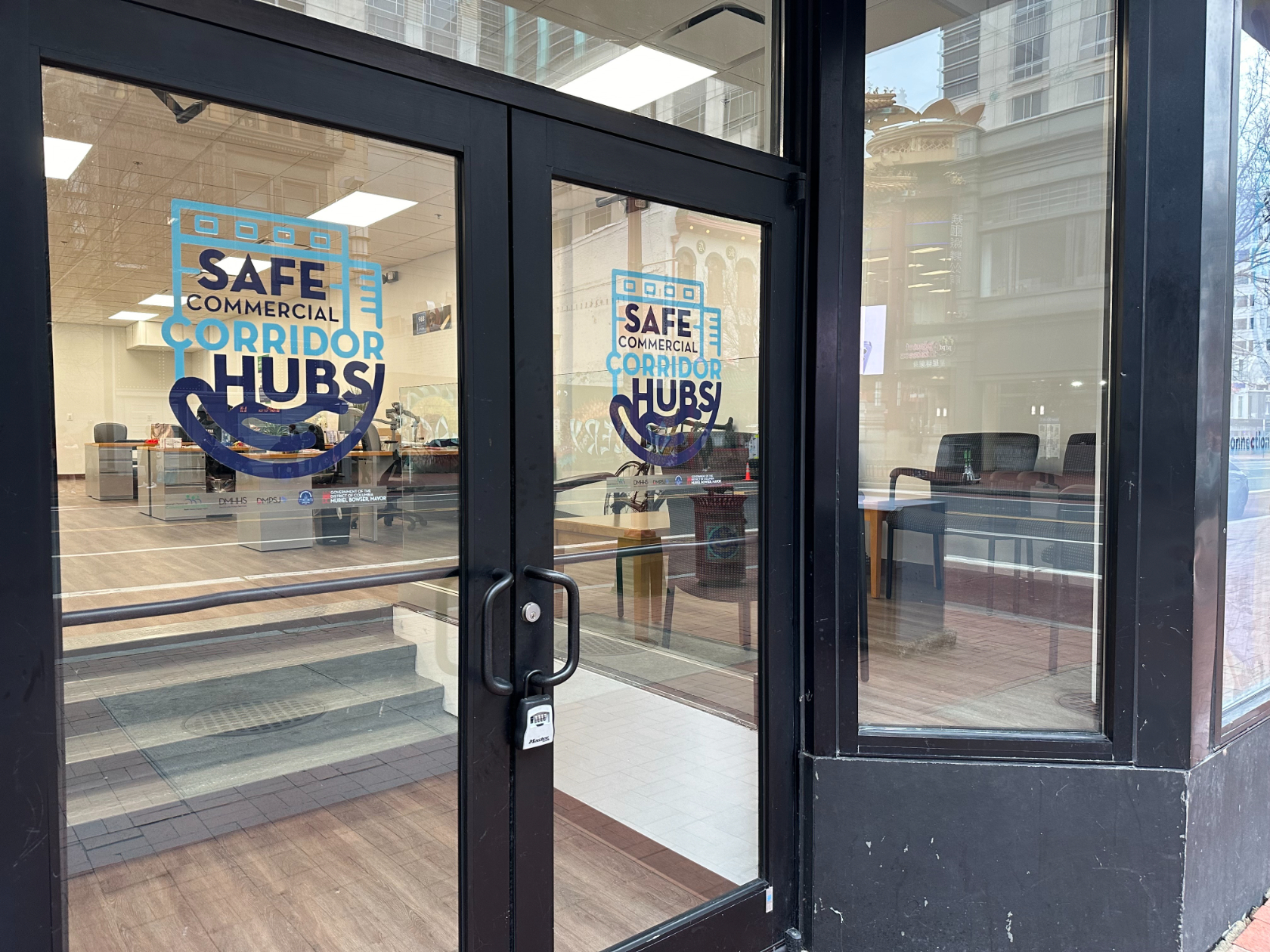
D.C. has opened a new police substation and office for community walk-ins in Chinatown, with the goal of creating a more visible police presence in the neighborhood and making behavioral health services more accessible to residents there.
D.C. Mayor Muriel Bowser, Metropolitan Police Chief Pamela Smith, and other city officials unveiled the new government outpost, which they’re calling a “Safe Commercial Corridor Hub,” in a press conference Monday.
Officials said police officers will use the “hub” like an extra office, and it will also be a home for staff from human services and behavioral health agencies. In addition to the Chinatown hub, the city plans to open two more — one in the U Street Corridor, and another in Anacostia – in the spring.
“I describe the hubs as part MPD substation and part neighborhood and human services,” said D.C. Mayor Muriel Bowser at a press conference Monday.
Officials say the hub in Chinatown will be another place where police officers can write reports and do other administrative tasks before getting back into the field. And according to Smith, the extra space means more officers can be around to respond to emergencies.
“The community continues to talk about wanting to see police presence,” Smith told reporters Monday. She said the hope with the new hub is that if “something happens in this area, we have a quicker response time.” Smith said that in addition to launching the hub, MPD has already assigned officers foot and bicycle patrol beats in the area to increase their visibility to residents.
But beyond policing, Smith said, the hub is about making sure “we can quickly get services to individuals who are suffering.”
The hub will house staff from the city’s human services and behavioral health departments to assist with substance use, behavioral health, and housing challenges, according to a press release. Staff from the Mayor’s Office of Community Relations, the Mayor’s Office of Nightlife and Culture, and the Mayor’s Office of Asian Pacific Islander Affairs will also be available at the center Monday through Friday, from 9 a.m. to 6 p.m. The hub, located at 675 H Street Northwest, will be open to walk-ins from the community during those hours, Bowser said Monday.
Officials said they hope the hub will help address the concerns Chinatown residents have raised in recent years about not only crime but also substance use and perceived public disorder in the neighborhood.
A study the city’s Downtown Business Improvement District conducted between 2021 and 2022 found that residents, employers, and visitors to the Gallery Place-Chinatown neighborhood expressed widespread concern about “perceptions of safety and unwelcoming conditions,” including “visible drug sales,” “aggressive panhandling and disruptive amplified busking,” and a “perceived increase in people experiencing homelessness.”
These concerns, business groups and city officials have warned, are tied to the city’s broader economic fate, as D.C. depends on the tax revenue from businesses in the area to fund essential services. Those issues have landed in the public spotlight in recent months, after the announcement from Wizards and Caps owner Ted Leonsis that he wants to move the teams away from their home in Chinatown to a new campus in Virginia.
Leonsis, for his part, has said his decision to move the teams to Virginia – a plan which still faces some roadblocks – had “very little” to do with crime in D.C. Still, rising crime in the Chinatown area has become part of the narrative surrounding the team’s potential departure. An official from Leonsis’ company, Monumental Sports & Entertainment, joined about 100 residents at a meeting on crime in the neighborhood over the summer, criticizing a “revolving door and lack of prosecution” that he said was contributing to the crime problem around Capital One Arena.
The hub, said Ward 2 Councilmember Brooke Pinto, is a way of signaling to residents that “we get it, we know that the status quo is not acceptable,” and “we are turning things around.” Pinto said she wants people to know that “the District of Columbia and Chinatown and downtown is an excellent place to live, to do business, to come do business if you’re thinking about it.”
In addition to standing up the hubs, the city is also awarding grants to organizations working on safety-related projects in areas in downtown, Shaw and Adams Morgan. Pinto’s omnibus crime bill, “Secure DC,” would expand the Safe Commercial Corridor grant program further; it passed its first of two D.C. Council votes last week.
After surges in 2023, many categories of crime are, in fact, down in the Chinatown neighborhood – and across the city – compared to this time last year, according to police data. Both homicides and assaults with a dangerous weapon are down by 50% and 24% respectively, according to MPD. Vehicle thefts are also down 22% compared to the first month and a half of 2023.
“We started the year with downward trends in crime, both in this neighborhood and citywide,” said Bowser. “But we know we have to work even more urgently to keep that up.”