 Rachel Sadon
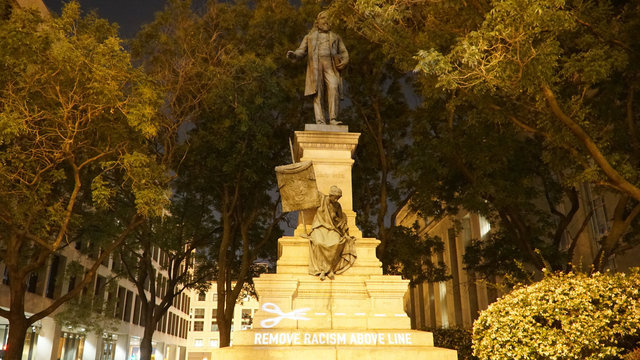 The statue of Albert Pike in Judiciary Square has been the site of a number of protests, including this light projection by artist Robin Bell, in the wake of the violence in Charlottesville. (Photo by Liz Gorman)
Taking down the only outdoor statue of a Confederate general in D.C. isn’t nearly so simple as the city government hiring a crane operator and plucking it off its perch in Judiciary Square.
The statue of Albert Pike, honored for his work as a Freemason rather than his military service, sits on federal land, and it was approved by an act of Congress at the turn of the 20th century. Regardless of the unanimous wishes of D.C.’s elected leadership, it will take another act of Congress to get it removed.
D.C. Delegate Eleanor Holmes Norton plans to introduce legislation to do just that this week, with the blessing of the Freemasons themselves.
“Here you have a dishonorably discharged Confederate general being honored in, of all places, the nation’s capital,” Norton says.
She met last week with representatives of the Freemasons, who are supportive of the District’s efforts to take down the statue.
“The Supreme Council of Scottish Rite Freemasonry, Southern Jurisdiction, USA will support an action by the District of Columbia to remove the statue forthwith so that it shall not serve as a source of contention or strife for the residents of our community,” Sovereign Grand Commander Ronald Seale wrote in a letter to Ward 2 Councilmember Jack Evans, who represents the area where the statue sits.
The statue was approved in 1898 and erected two years later. It was paid for and given by the Freemasons to honor a seminal figure in the fraternity’s history (Pike is honored with a museum at the House of the Temple in D.C., and his remains are interred there).
“He’s depicted as a civilian holding the Masonic book,” says Arturo de Hoyos, the grand historian of Scottish Rite Freemasonry. “It has nothing to do with the Civil War. It has nothing to do with any type of prejudice or racism.”
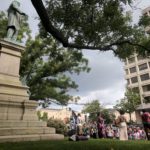
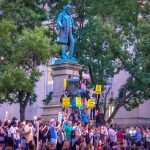
As the polarized debate about monuments and statues honoring Confederate generals grew in the wake of the violence in Charlottesville, local activists pointed to Pike and demanded his likeness come down, too.
“It doesn’t matter that he’s not being honored as a Confederate general. He still has a long history of supporting racist causes,” said Carlos McKnight, who organized a rally at the site to publicize the issue. Dozens of people showed up holding signs, including one that read: “Pro-slavery traitor, all-around asshole. Tear it down.”
It is actually the second time the statue attracted widespread criticism. In the early 1990s, followers of Lyndon LaRouche staged a weekly protest at the site to draw attention to Pike’s alleged KKK ties (for which there is no hard evidence). At the time, a D.C. councilmember introduced a bill calling for the statue’s removal, and legislators in more than a dozen cities passed similar legislation, but it never went anywhere.
“Certain things are the right thing to do regardless of the era. There are certain historical figures that should be remembered accurately, for proposing hateful ideas, and they should not be honored at any time,” Bill Lightfoot told DCist recently, about 25 years after he first proposed removing the statue. “I’m just glad to know that somebody has remembered and is doing something about it.”
This time around, At-large Councilmember David Grosso wrote a letter to the National Park Service—co-signed by the majority of his colleagues and the D.C. attorney general—calling for the Pike statue to be removed, and the mayor said she agreed.
Evans went so far as to find a crane operator to take it down before being scuttled by the National Park Service.
NPS, which has no recent records of removing a statue from land it controls, says it is agency policy not to remove a statue for any reason unless directed by Congress. And in the case of Pike, an NPS lawyer told Evans it would be illegal to take it down without Congressional approval because the legislative body had originally approved it.
“It’s an uphill climb to get the time of day passed through the Congress of the United States. It’s going to go down as yet another do-nothing Congress,” says Norton, who does not have a floor vote. “But I do think that Pike is very different, and that he will be seen as different, given the fact that the donor wants him to come down.”
When Evans approached the Freemasons about the issue about a year ago, he says they weren’t interested in its removal. But that has changed amid the recent controversy.
“There would be no reason to remove it if it wasn’t a point of contention,” says de Hoyos, the Freemason historian. “We don’t want this to be anything that becomes divisive to people. We’d rather see it taken down.”
He points out that the Freemasons don’t own the monument, since it was gifted to the government, and that it is ultimately legislators’ decision.
“I think that other people are making this a lot more of a priority than we are. It’s something that’s incidentally become a matter because of all these other unfortunate things that happened,” he says. “It doesn’t belong to us. Whatever the city wants to do with it, that would be perfectly fine.”
Update 10/5: Eleanor Holmes Norton introduced the bill today, saying in her introductory statement: “I oppose tearing down Confederate statues, because I believe they should be moved to more appropriate settings, like museums, to avoid erasing an important part of history from which Americans must continue to learn. However, Pike was a Confederate general who served dishonorably and was forced to resign in disgrace.”
Previously:
D.C. Councilmembers Want Statue Of Confederate General To Come Down, But Congress Is In Their Way
Mayor, D.C. Councilmembers Want Statue Of Confederate General On Federal Land Removed