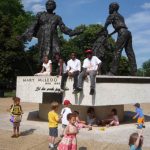
At the eastern end of Lincoln Park along East Capitol Street, there are bronze statues of a large woman and two large children (well, the statues are large). They are frozen in mid-dance, facing toward the city’s first statue of Abraham Lincoln and the Capitol in the distance. The figures are rough-hewn, like tree bark, and elevated on a massive stone platform itself about five feet high. The woman is Mary McLeod Bethune, and the children are symbols of the many children whose lives she touched.
Born in 1875, McLeod Bethune was the 15th of 17 children born to two freed slaves. Her early years were spent in Mayesville, S.C., working in cotton fields alongside her parents and many siblings. But she was luckier than most: at the age of 11, she got the opportunity to attend school. As a young teenager she went from lucky to stratospherically serendipitous, winning a scholarship to further her education first in North Carolina, then at the Moody Bible Institute in Chicago. And she was only getting warmed up.