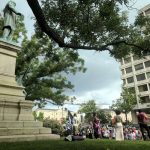
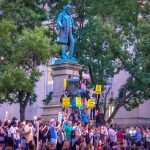
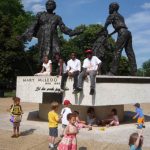
In October 1992, several dozen people gathered at the base of a statue outside the Labor Department building at 3rd and D Streets NW. Together they unfurled large white sheets, and with some effort, draped them over the tall statue. The costume was not part of a Halloween prank. The uninvited decorators were followers of fringe political figure Lyndon LaRouche, the sheets were stitched together to appear as Ku Klux Klan robes, and the statue was that of Albert Pike, the only Confederate general honored with a statue in the nation’s capital. They returned the week after, and the week after, demanding that the statue be taken down.
Attorney William Lightfoot, then an at-large member of the D.C. city council, was moved to introduce a bill calling on members of the Congressional Black Caucus, then-District mayor Sharon Pratt Kelley, and directors of the Depts. of Labor and the Interior, to join the cause. The resolution read in part:
The United States Congress, on April 4 and 5, 1898, authorized a private organization to place the statue of Albert Pike on the public land of the United States, being falsely informed only that Albert Pike was a leader of white freemasons in the southern states, and “a distinguished citizen of the United States, an able lawyer and statesman, an accomplished poet, and a brave soldier.”
The city councils of at least 18 cities joined in and called for removal of the statue — Birmingham, Austin, Newark, Pittsburgh, Buffalo and New Orleans (one of many cities Pike called home) among them. (LaRouche was serving time in prison for tax evasion at the time, but that didn’t keep him off the presidential ballot in several states where his supporters had organized.)
But not all who criticized Pike favored the statue’s removal.