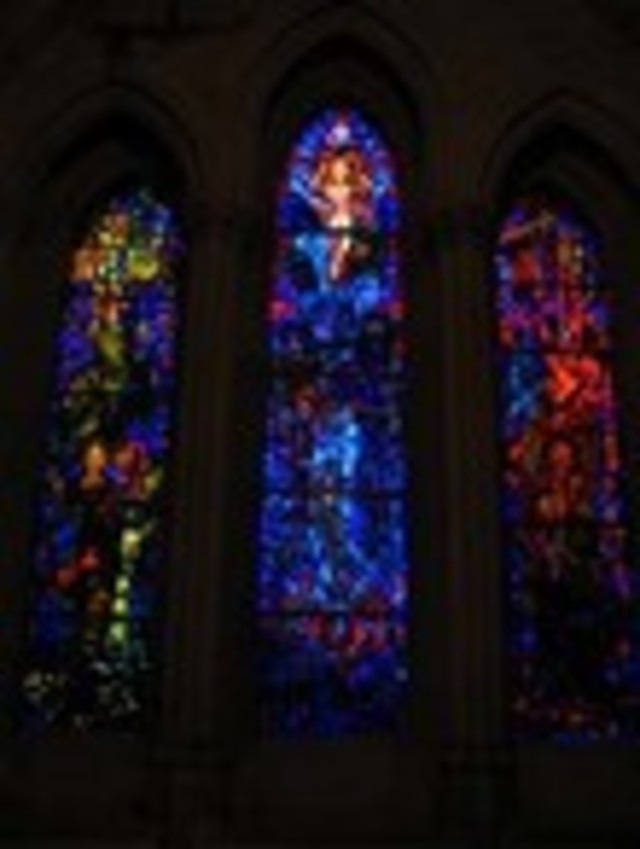
 Synesthesia was a pretty big topic with arts bloggers a few months ago. For the record, it’s a clinical condition that involves the confusion of stimuli between different senses. Most importantly for our post today, some composers—Messiaen and Scriabin, to name two—have had this condition and perceived colors visually along with sounds that they heard (and, we presume, vice versa). This was the theme of a free concert that we suggested earlier this week in our Classical Music Agenda, featuring the 21st Century Consort at Washington National Cathedral Tuesday night. As venues go, this was a natural place to think about color and music. Synesthete Olivier Messiaen was profoundly influenced by a visit he made with his parents, when he was a teenager, to La Sainte-Chapelle in his native Paris. The late Gothic builders of the Sainte-Chapelle removed the supporting function of the wall to its maximum, leaving most of the elevation to be filled with stained glass windows. The effect, especially on a sunny morning or afternoon, can be hallucinatory. The windows shown here, in the nave wall by the tomb of President Woodrow Wilson in the National Cathedral, could probably have induced some strange chords in Messiaen’s eyes/ears.
In his introduction, the cathedral’s director of music, Michael McCarthy, reminded us that the 21st Century Consort has a history at the cathedral, where they have played before as part of the annual Summer Music Festival. The group formerly known as the 20th Century Consort has dedicated itself for many years to the performance of contemporary music, in their concert series at their home institution, the Hirshhorn Museum and Sculpture Garden. They were seated at the midpoint of the nave, with us facing them backward, that is, toward the narthex rather than the apse of the cathedral.
Claude Debussy’s Prélude à l’après-midi d’un faune, premiered in 1890, is often described as one of the foundation works of modern symphonic music. The consort performed it first, in a chamber arrangement made for the Verein für musikalische Privataufführungen (Society for Private Musical Performances), founded by Arnold Schoenberg in Vienna as a place for modern music to be heard by an open-minded audience, from which the conservative reviewers of the time were excluded. The famous chromatic opening melody in the flute, which permeates the work was rendered radiantly in the ambery tone of flutist Sara Stern. At one point, her oboe colleague, Wes Nichols, seated next to her, nodded appreciatively at her slinky performance. Conductor Christopher Kendall kept the entire performance at a very hushed level, so that even in the fifth row, we strained to hear at times (we don’t know how much the impressively large crowd could have heard towards the rear).