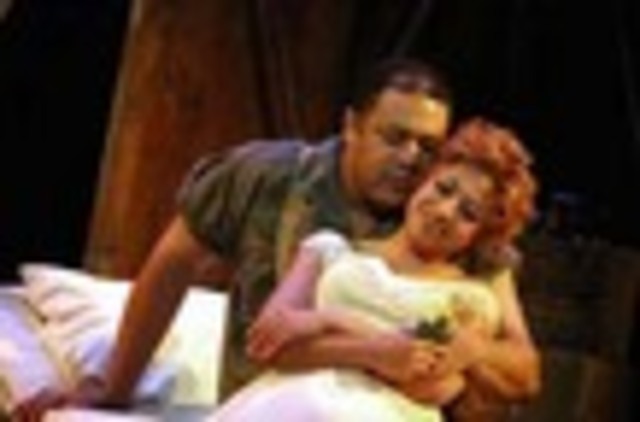
 Last Saturday, Washington National Opera opened its new production of George Gershwin’s classic American opera Porgy and Bess (1935), and this DCist was happy to be in the Kennedy Center Opera House for the performance Wednesday night. We know that many DCists wonder why we bother to cover things like opera and classical music, which seem too stuffy and expensive for many people. However, this opera especially is part of our heritage as Americans, and WNO has tried to make some more affordable tickets available. At the time of this writing, most of the remaining performances are sold out, but there are still tickets available for November 12. Regular tickets start at $45, and there are special deals for members of the Generation O program, for students and young professionals, ages 18 to 35. Sign up if you qualify. If you really cannot spend money on opera or cannot find a ticket, go to the National Mall this Sunday (November 6, 2 p.m.) for the live simulcast of the opera on a giant video screen near the Capitol. It’s free.
We certainly share the opinion of the newspaper reviewers (Tim Page in the Post and T. L. Ponick in the Times) that this is an excellent production and a rare chance to see an American treasure in a live performance. DuBose Heyward published the original novel, Porgy, in 1925 (available in a hypertext version by Kendra Hamilton), which he and his wife, Dorothy, then made into a play, on which Gershwin based his opera. As we mentioned in our preview of this opera, the first Porgy, Todd Duncan, taught voice at Howard here in Washington for many years. Although the action is set in South Carolina, its central concerns — poverty, alcoholism, drug use, racism, segregation — are no less relevant to our city today. Although the opera’s creative team relied a lot on stereotypes as they created most of the major characters, they come across at their most human in this production. The effect of watching a largely white audience react to this opera — in which the only white characters are racist law enforcement officials, who answer the beautiful singing of the black characters with bigoted lines in plain speech — still packs a punch, although perhaps not as much as at its premiere. In 1935, Todd Duncan had to make a special plea to convince the National Theatre here in Washington to drop its normal segregated seating policy. It does all of this over a fabric that weaves together hit melody after hit melody — a remarkable number of famous Porgy and Bess tunes have become jazz standards — with the sounds of the Dixieland and swing jazz bands. Saxophones and clarinets are featured prominently, as are percussion (especially mad, whirling xylophone parts) and the plink of the banjo.