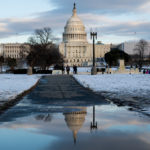
 This week’s Washington Post magazine features a sprawling story by David Von Drehel on Washington’s economic juggernaut. The piece jumps around a lot, throwing out some questionable economic assertions, overhyping (we feel) the terrorist menace, and curiously detouring on the morality of Washington’s growth in a post-September 11th world, but the main point of his story is clear: In the past four years, government spending in the area has skyrocketed (increasing by $18.5 billion over that period) and the local economy is consequently booming.
This isn’t exactly a shock; as Von Drehle points out, the history of Washington’s growth has mirrored the history of American crises and accompanying enlargements of the federal machine, from the Civil War to World War II. Looking around at the swelling metropolitan area, however, it’s tempting to believe that Washington is growing beyond its government roots. From the XM Radio headquarters in D.C. to the genomics companies that line I-270 in Maryland, it seems feasible that an independent economy might be blooming, free from Uncle Sam’s procurement umbilical cord. Von Drehle’s piece casts doubt on this, however, by showing how rapidly jobs have been created here; without Uncle Sam, it seems, there’s no way such growth would have been possible.
In all likelihood it is a combination of the two. The concentration of talent and money in the Washington area has no doubt fueled the development of new entrepreneurial enterprises with no direct government connection, but that money and talent certainly has the magnet of government procurement as its main attractive force. We’d like to get some sense of the difference, however, and so we go to our highly unscientific polling mechanism. If you would follow this link and let us know if you work for the government, for a company that contracts or subcontracts from the government (we’ll include policy firms here, like think tanks or lobbying groups), or for a company that does not get most of its business from government sources. Help us see just how tightly our readership is bound to the Feds.
Picture taken by Terecico.