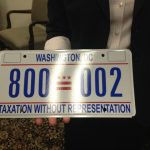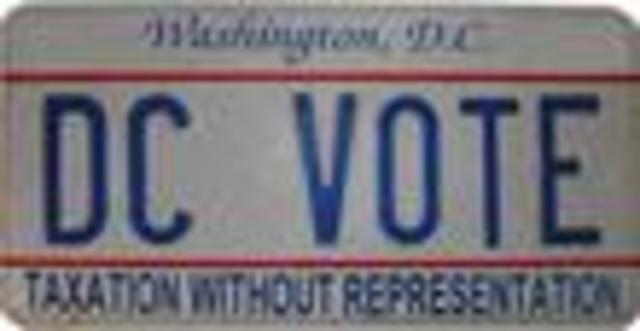

I usually respond to the miserable summers in Washington by visiting friends and family in dryer, cooler climates. At the moment, I am writing from a cottage on Coldwater Lake in southern Michigan, but at several points along the road, people who have seen my D.C. license plate — some of them probably the first time they have seen one — have asked the same question. Why does the D.C. government put “Taxation without Representation” on its license plates? When I explain the situation, which is so much on the minds of those of us who live in the nation’s capital — that we elect a representative to the House but that she is denied a vote on the floor — they are mostly surprised. It is not that many Americans outside the beltway do not care about D.C. representation, it may be that they just do not know that we do not have it.
Two months ago there was a ray of hope when a bill introduced by our non-voting representative, Eleanor Holmes Norton, and Rep. Tom Davis (R-Va.) sailed through the House committee on government reform. Its ingenious design, matching a single vote in the House — Eleanor and, if not Eleanor, certainly a Democrat — with a new and guaranteed Republican seat for Utah, meant that it had support from both parties. It also skirted elegantly around the unwieldy issue of statehood for the District of Columbia, which is politically impossible. (I have written before about how I think even getting Eleanor a vote is impossible: I suggested that we should be seeking the exact opposite.) Suddenly, it looked like Eleanor might soon be able to cast her vote, even if it would ultimately be useless because it would be annulled by her new colleague from Utah.