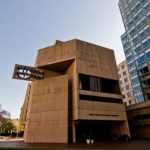
For all their symbolic power and grand civic functions, D.C. buildings built in the last half century have hardly created much buzz in terms of architecture, due in part to Washington’s reputation for staid and conservative design tastes.
On the occasion that a renowned contemporary designer finds a willing local patron, their scheme rarely makes it through National Capital Planning Commission review without serious revision or delay, as with Norman Foster’s glass canopy finally under construction over the renovated Smithsonian American Art Museum’s inner courtyard. More audacious designs, such as Frank Gehry’s Corcoran Gallery addition, can seldom piece together the necessary financial support and approvals to get past the drawing board. Rightly or wrongly, D.C.’s design overseers intensely guard the architectural character of the capital’s core, and that has kept the hot names in the design world — Hadid, Mayne, Leibskind, and others — working in New York, L.A., Europe, and elsewhere, to Post architecture critic Ben Forgey’s eternal consternation.
This made last Saturday’s opening of the new Residence building at the Swiss Embassy in Woodley Park particularly noteworthy. A collaborative entry by New York’s Stephen Holl and Lucerne’s Rüssli Architects won a 2001 design competition to replace the outdated former residence on the same site.
The design is a radical departure from the context of Woodley Park’s stately apartment buildings and embassies, and makes a bold statement about Swiss minimalism and modernism, to some success and failure. The facades alternate between a textured charcoal-colored concrete and sandblasted structural glass, the contrast meant to evoke the whites and blacks of the snow-covered Alps. Unlike many design concepts based on esoteric constructs, the metaphor holds well here, down to the placid pool and gravel insets in the courtyard. The effect will be particularly striking for those strolling by at night; when lit from within, the translucent glass walls will reveal a variety of textures and opacities, which Holl likens to melting ice.
Fortunately, most embassy events occur at night when the building shines, but during the day the materials don’t hold up to the same level of beauty. The frosted glass tends to look like cheap plexiglass from afar, while up close the textured concrete takes on the appearance of cheaply painted wood. The effect is a Monet gone wrong — a wonderful overall composition (that looks good in the right light), but deconstructs into a clashing mish-mash of materials upon close inspection.