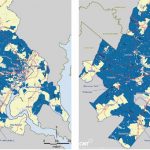

This morning, the Post reminds us that in cities, as in everything, there’s no such thing as a free lunch. The paper covers a new study from the Center for Housing Policy today, which finds that the advantages of cheaper suburban housing are quickly offset by the expense of longer commutes. The report goes on to note that even so, there is no question of living near the central city for lower income residents; for many, being nickled and dimed by commuting costs, some of which can be mitigated by using buses or carpools, is the only possible alternative when faced with the daunting level of rents and mortgages in D.C. and the near suburbs.
In the absence of government action, the problem isn’t likely to get better in the future. The report notes that suburban populations will continue to increase, and it’s not hard to understand why. As new residents move to the suburbs, their very presence increases congestion and commuting costs, which also act to increase the premium on living closer to the city center. Newer residents then have to move even farther out to find affordable housing, but they, too, suffer steadily increasing commuting costs as others join them in their quest for cheaper living situations. What you end up with is a lovely blob of countryside-covering sprawl.
These findings highlight the need for better metropolitan planning and improved transportation systems, but in the popular mind, at least, the connections between planning, congestion, and expense don’t appear to be clear. Consider another story from today’s Post, on the United States’ impending breach of the 300-million person threshold. In it, the Post speaks to Dowell Myers, an urban planning professor from the University of Southern California:
“I don’t think people view population growth as a plus anymore,” he said, noting that Angelenos are punished by it “every single day” when they go out in freeway traffic.
Of course, Los Angeles isn’t home to some 17 million people because America is filling up. There are plenty of places in California, or New York, or Virginia–to say nothing of the Plains or Mountain West–where a person can look out 10 or 20 miles in every direction and not see any evidence of man. Los Angeles is full of people because it’s a city, a vibrant hub of economic activity, and its citizens are punished on the freeways because of poor land use policies and a draconian approach to moving people around.