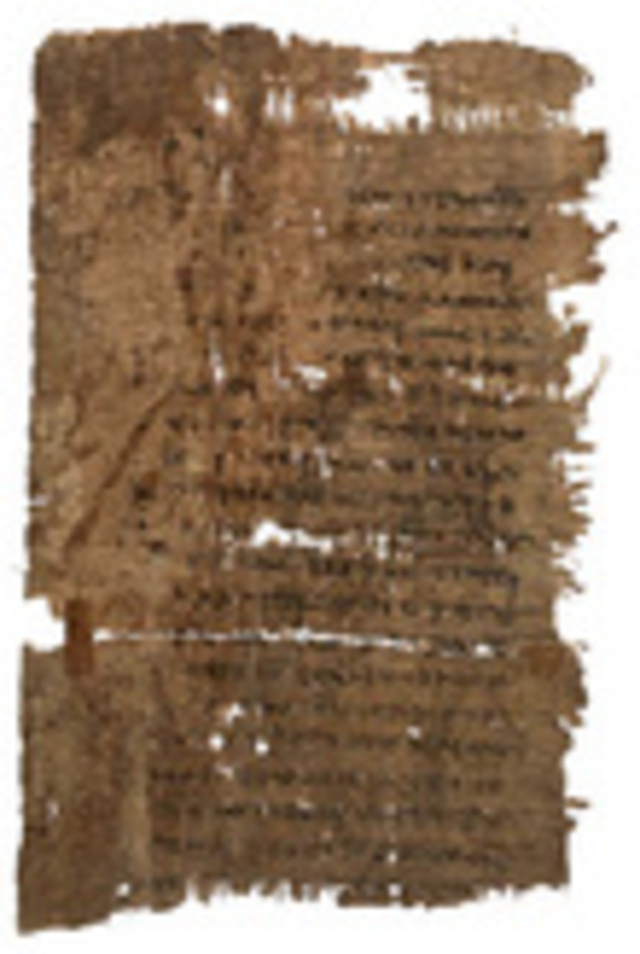
 Two exhibits in Washington right now examine both ends of the history of the Bible. The Arthur M. Sackler Gallery is showing In the Beginning: Bibles before the Year 1000 (through January 7, with a nice online feature), which brings together over 70 early examples of the Bible’s written tradition. The ancient papyrus and vellum pages are so fragile that the museum has to show most of them under faint and rather diffuse light, and always in sealed cases. Cosponsored by the University of Oxford’s Bodleian Library, and probably quite expensive because of insurance costs, this exhibit is a blockbuster, in a low-key way. Treasures have been loaned by the Bodleian, the British Library, the Bibliothèque nationale de France, the Monastery of St. Catherine on Mt. Sinai, and others, many of them shown for the first time ever in the United States.
The Bible has changed so much over the centuries, in language, in content, in the way it was copied and transmitted, in how people interacted with it. The show begins with some of the oldest fragments, Egyptian papyrus bits from around the year 200, like the Egerton Gospel and the Chester Beatty papyri. The pages in the first few rooms, in mysteriously dim light, are mostly devoid of visual imagery and, on the surface, may not be of great interest for visitors who do not read Greek, Latin, Hebrew, Arabic, Syriac, Armenian, Ethiopian, and Coptic. For this reason, the informative and well-produced audio tour is certainly worth your $5, especially since the exhibit itself is free. It adds some much-needed context about the significance of the pieces on display, for example, explaining the importance of the Nag Hammadi Codex II and related fragments, now known to contain portions of the so-called Gospel of Thomas, and the Codex Sinaiticus.