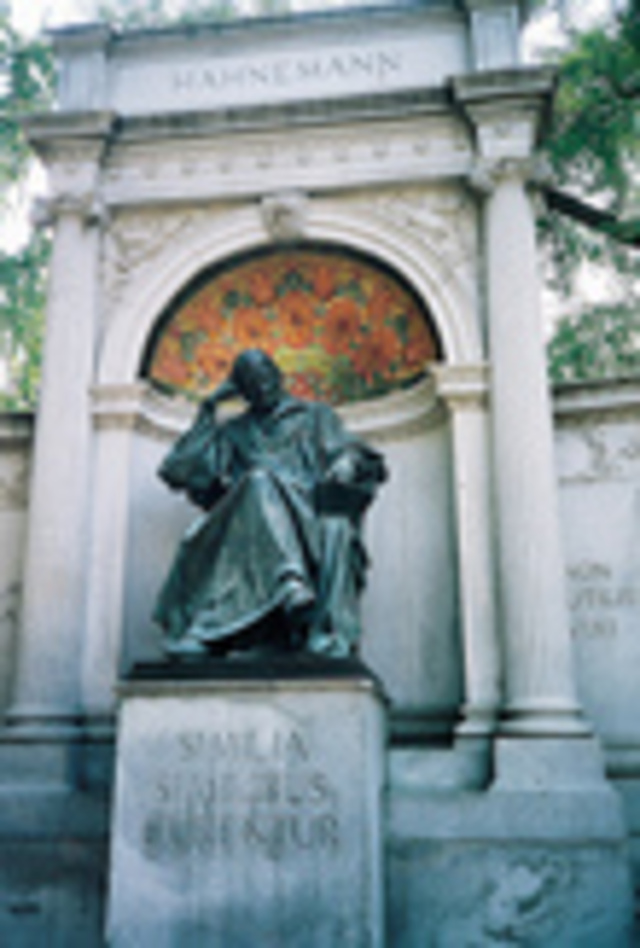
 Washington is full of monuments to famous people — Washington, Jefferson, Einstein, Hahnemann. Hahnemann? Not a forgotten vice president or a general, Christian Friedrich Samuel Hahnemann was the founder of homeopathic medicine. His impressive monument, located at 16th and Massachusetts NW near Scott Circle, isn’t too helpful — it says “HAHNEMANN” on the top, as if everybody knows who he is. There are also a few Latin and German sayings (he was born in Saxony in 1755), with one explaining he founded the homeopathic school of medicine. For those not familiar with homeopathy (i.e. most of us), Wikipedia says homeopathic medicine is an alternative medicine (which some call a pseudoscience) that aims to cure diseases by giving the patient a low potency dose of something similar to the disease, and that diseases are caused by chronic “miasms,” not germs. Wikipedia uses the example of giving the saliva of a rabid dog to somebody with rabies. That sounds safe.
So why is he here? Why not a famous acupuncturist or chiropractor? One reason is that the statue was funded entirely by donations to the American Institute of Homeopathy, and they claim the sitting president, McKinley, was a supporter of homeopathy (among others). And it is impressive looking — a large bronze Hahnemann sitting on a big chair under a half dome with a bright mosaic, surrounded by a semicircle of curving bronze reliefs of him at work. Homeopaths really love the guy – the AIH’s website says the rededication of the statue in 2000 was “a once in a life time experience.”
The sculptor, American Charles Henry Niehaus, has more sculptures in the statuary hall in the Capitol than any other sculptor, including the only one to be removed, Kansas governor George W. Glick, who was replaced by the slightly more famous Dwight D. Eisenhower. (Though California legislators voted for Ronald Reagan to replace Thomas Starr King). And as we mentioned before, there are no D.C. statues in the hall. The monument’s architect was Julius F. Harder, who also worked at the Chicago World’s Fair.
But besides the fact that it was virtually free to the government, the Institute must have had advertising on their mind, trying to get their doctrine some publicity and validation. Compare Hahnemann’s ornate, look-at-me statue to Einstein’s relaxed, bumpy seated figure hidden behind some trees, or American doctor Benjamin Rush, who’s just standing there at the Navy Bureau of Medicine and Surgery at 23rd and E NW. It makes one wonder why other controversial groups don’t try to get their most famous person on a statue in D.C.
The statue, dedicated June 21, 1900 and rededicated 100 years later, cost about $75,000 in 1900 dollars, or about $1.7 million in today’s dollars. It is located just east of Scott Circle NW.
Photo by flickr user rosefirerising