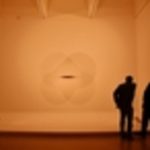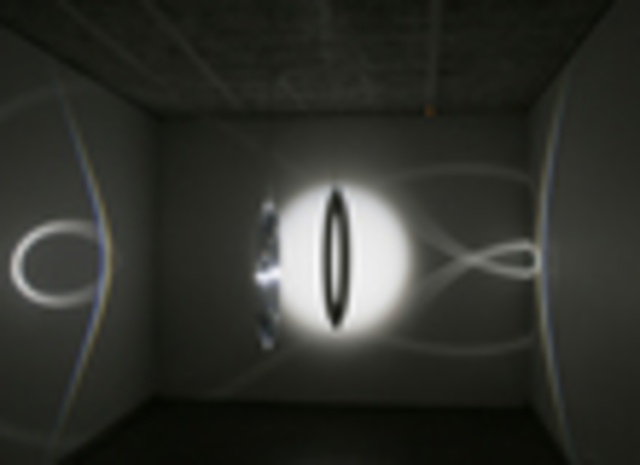
 Two new shows opened yesterday on the second floor of the Hirshhorn Museum, and an unexpected ice day offered the perfect chance to go see them. Refract, Reflect, Project brings together a few rooms worth of light works from the museum’s collection, some more recent and some classics. The most striking work was an installation by the Danish artist Olafur Eliasson, whose The weather project transformed the Turbine Hall of London’s Tate Modern in 2003. Round rainbow, from 2005, combines an acrylic circular prism, suspended from the ceiling and made to turn slowly by a small motor, with a focused light. The combination of shadows and refracted light, bright white and rainbow, creates a mesmerizing ballet of undulating circles, spirals, and parabolas. The idea is so simple, but the results prove again — as did the last major show of light works in Washington, the Dan Flavin retrospective at the National Gallery two years ago — that light is the most unabashedly beautiful modern medium.
Several other works are also worth experiencing just for their gentle loveliness. In Robert Irwin’s Untitled, from 1969, an acrylic disc mounted on the wall dissolves into its own four shadows, cast by lights mounted nearby. It is so dark inside the room containing James Turrell’s Milk Run, from 1995, that it takes a long time for one’s eyes to adjust to take in the work, a wall of faint light made by fluorescent tubes and colored gel. The longer you sit in there, the stronger and stranger the light becomes. In the first room is the Hirshhorn’s Dan Flavin work, “monument” for V. Tatlin, a cool white, V-shaped classic from 1967, alongside the most recent work in the show, Chilean artist Iván Navarro’s Flashlight, from 2006. This steel-framed wheelbarrow, adorned with yellow fluorescent tubes, is accompanied by a video, shown on a disappointingly small television set. The video, featuring a poem and soft song, I’m not from here, I’m not from there, shows the artist stealing gasoline, putting it in a generator, and putting the generator on the wheelbarrow to power the fluorescent lights. He then rolls the “flashlight” along a darkening railroad track, in a series of lonely, transient scenes. The object itself has visual interest, combining the functionality of a tool with the functionlessness of the lights (described in the poem as sunlight), but the weighty social commentary of the video is a little overbearing.