 Former Editor-in-Chief Ryan Avent writes a weekly column about neighborhood and development issues.
I asked in a post last week that developers not go out of their way to accomodate cars and that residents not go out of their way to drive. Reasonable propositions. Still, as a number of commenters noted, you can’t suggest something along those lines and then expect Washingtonians to be heroes, throwing knapsacks over their shoulders as they head off on a long march to the grocery store two miles away. If we want city life to look a certain way, we have to do our best to make that way easy and attractive.
Part of that process is improving access to and the quality of public transit. The city should make extending and upgrading its transit system a high priority, but that will take plenty of time and money to do. A complementary plan is considerably easier–allow neighborhoods to do more to serve their residents by zoning for retail in predominantly residential areas.
This is not something Washington does well. A look at the city’s zoning maps is illustrative. With the exception of a few neighborhoods, commercial zoning proceeds solely along main streets, resulting in large blocks of residential land without any retail establishments. It’s not an accident that many of the District’s residents have to walk long distances to pick up necessities; that’s specifically how the city drew it up.
Why is this a poor way to lay out one’s neighborhoods? For starters, as mentioned before, the longer someone has to walk to get something that they need, the more likely they are to use a car to do it. Longer walks decrease the load someone is able to carry on foot, further pushing them toward the use of a car. Even when just an odd or an end is needed, residents find themselves driving to get it, because no nearby option is available to them.
Of course, once someone is in a car, there’s no particular reason for them to opt for the closest store when a bigger or better one, perhaps with more parking, is just a little further away. There is no guarantee, even, that the driver will stay in the District. Whatever their choice, it’s likely to be one that caters to people using automobiles. By pushing residents into their cars, the city makes solvency more difficult for businesses seeking to attract pedestrians and easier for big box behemoths with acres of welcoming pavement. It also ensures that some dollars which might have been spent in the city instead flow into the suburbs, where more of those big box collections await.
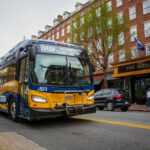
Picture taken by billadler.