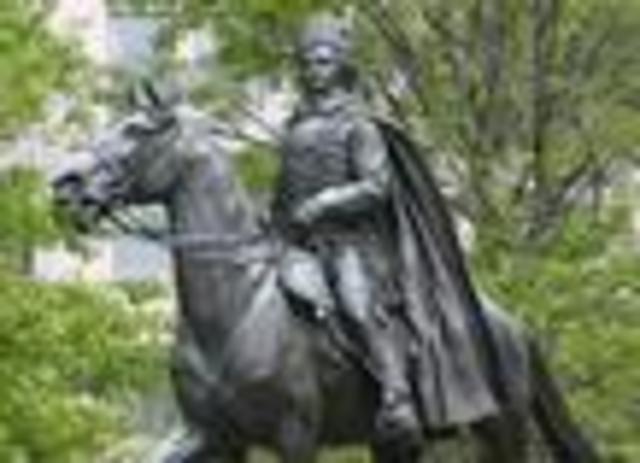
 In a city of monuments to great Americans, it’s easy to think that the more recent monumistas began the trend of honoring foreign heroes. But for nearly a century, a statue of Polish freedom fighter Casimir Pulaski has made its home at 13th St. and Pennsylvania Ave., in what is now known as D.C.’s Freedom Plaza. The plaza, designed in 1980, is mainly a tribute to Martin Luther King, Jr. and the civil rights movement, but the Polish military commander who fought and died for his adopted country is also honored by an equestrian statue on the square’s eastern edge.
Most Washingtonians might only associate Pulaski with Sufjan Steven’s tale of a dying childhood friend, “Casimir Pulaski Day”, but their knowledge ends there. Casimir Pulaski got his start in the 1760s, fighting off Russian forces in his homeland. When that ended in failure, the general fled to Turkey and later France. His greatest glory came in 1777 when he joined American revolutionary forces in their struggle against British rule. Pulaski became known as “Father of the American Cavalry”, and died at the tender age of 31 fighting the Battle of Savannah.
For the last three decades Pulaski Day, celebrated on the first Monday in March, has been marked with parades in Milwaukee and Chicago, and school holidays for children in both Wisconsin and Illinois in a nod to both states’ large Polish-American communities. In 2001, President Bush proclaimed October 11, the day of his death, as General Pulaski Memorial Day, though the day escapes most Americans’ notice.
The statue of Pulaski, designed by fellow countryman Kazimierz Chodzinski, was erected in 1910 and portrays him in full military regalia, including a jaunty wool hat and a distinctly European mustache.
Pulaski was no soldier of fortune. He whole-heartedly supported the cause of liberty in the America, seeing his dreams of emancipation from colonial rule as a real possibility in a fledgling nation. So raise a glass of wodka tonight for the Polish general whose memory still inspires Presidential honors and mournful tunes in America.
Photo by dbking under Creative Commons usage.