 An exhibit designed as career retrospective must be a daunting proposition, especially when focused on a prolific artist whose output ranged over sixty years. Too many pieces, and the exhibit becomes bloated. Too few, and the audience does not get an accurate cross section of the artist’s work. Thankfully, the curators of Saul Steinberg: Illuminations, on display at the Smithsonian American Art Museum, threaded this needle. In doing so, they have mounted a captivating and wholly satisfying exhibition of one of the most insightful American artists of the 20th century.
Steinberg (1914-1999) is best known for his illustrations that appeared in The New Yorker, many of which are included in this collection. The exhibit includes over 100 drawings as well as collages and sculptural assemblages. A native of Romania who became a U.S. citizen in 1942, he described his work as occupying the space “between perception and understanding.” His proclamation that the 20th century was “an immense prank” sums up his somewhat cynical outlook.
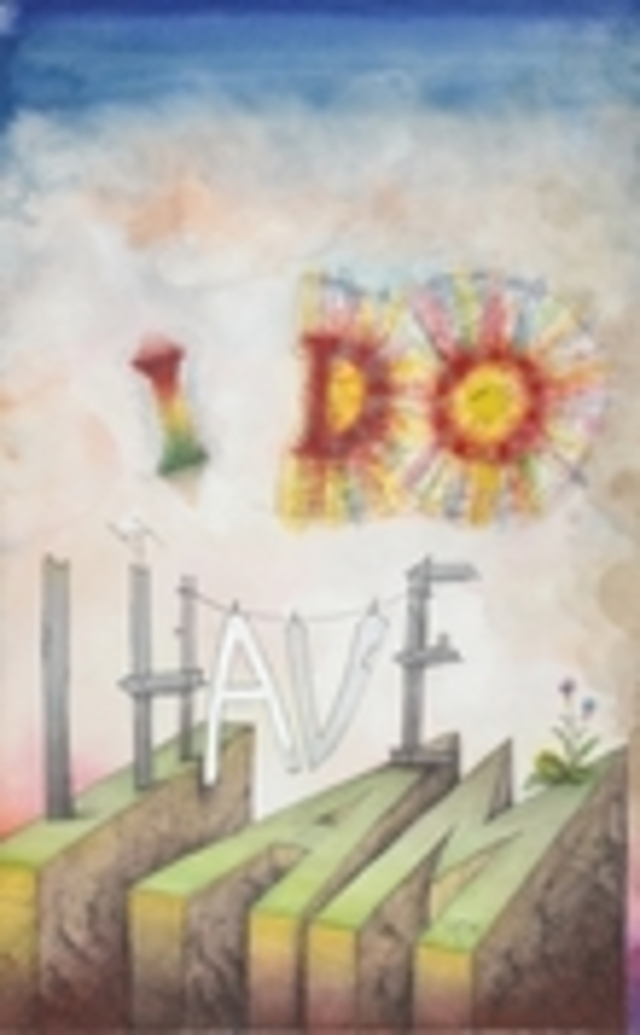
Steinberg’s most well known pieces, with A View of the World from 9th Avenue being the most celebrated, are included in the display. Particularly interesting are the map studies that led up to this seminal work. His Flat Earth, The West Side, and Wyoming effectively portray, and gently mock, the self-importance and hubris with which Americans tend to view our place in the world. Other recognizable illustrations on display are his Crowd at a Racetrack, Three Liberties, and Techniques at a Party which poke fun at New York’s high society. As a peek into Steinberg’s philosophy on the role of the artist, Artists and War portrays mechanical forces, literally rubber stamped on the page, aligning against one another as an equally monolithic group of artists sits to record the event. Of course, any Steinberg presentation would be incomplete without the sublimely uplifting I Do, I Have, I Am (pictured).