
Verdi’s Macbeth is the least worthy of the composer’s three settings of Shakespeare plays, but it is hardly fair to compare this homely little opera to the composer’s final masterpieces, Otello and Falstaff. Macbeth, the earliest of the three, has some beautiful melodies, some dramatic scenes, effective choral writing, and glimmers of what Verdi would eventually accomplish — the elimination of tired bel canto conventions or, short of that, the ingenious incorporation of those conventions into a dramatically convincing whole. A new production of the opera brings the Washington National Opera’s 2007-08 2006-07 season to a close, and it was good to hear this opera again in Washington, last performed by the company in 1981. It also fulfilled the WNO’s commitment to the Shakespeare in Washington Festival, on the heels of a Falstaff on methamphetamines from the Kirov Opera in February. Arguably the best of the Verdi-Shakespeare operas, Otello, has been missing in action (with only a fine glimpse of the final act last season), as it is just about everywhere in the world right now.
The best part of the evening was watching conductor Renato Palumbo in action. He has recently been appointed General Music Director of the Deutsche Oper in Berlin, and he shaped the opera beautifully. The orchestra’s sound, especially the low brass, was pointed and crafted well to the singers. It was therefore even more disappointing that the singers were not always with Palumbo. This was the main problem with what was otherwise a vocally strong performance from baritone Lado Ataneli in the title role: he often rushed ahead or dragged behind the beat, apparently heedless of direction from the pit. Bass Vitalij Kowaljow was an imperious and robust Banquo (especially in his final aria), and young American tenor John Matz made a favorable impression as Macduff.
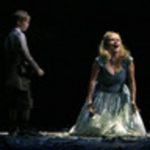
Far and away, the best role in the opera is Lady Macbeth, whose music and dramatic scenes provide most of the reason to stage this opera at all. Soprano Paoletta Marrocu, who was quite good in the 2004 Andrea Chénier here, was a dramatically convincing and attractive Lady Macbeth. The sleepwalking scene (“Out, out, damned spot”) and the banquet scene were examples of her fine acting. Vocally, she had the power necessary to communicate the bloody single-mindedness of this memorable character, except for some of the low passages, where she was completely covered. All evening long, however, something about her vocal production colored her pitch toward flatness. This was particularly painful in the brindisi, the toast during the banquet scene at the end of Act II, where the challenging staccato notes were badly out of tune.
The Witches in Macbeth, Washington National Opera, photo by Karin Cooper