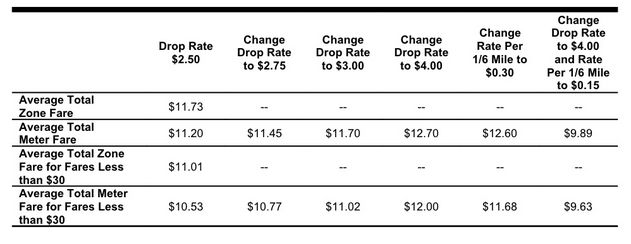
An alert tipster sent us a link to a District of Columbia Taxicab Commission release we missed. The results of the Taxicab Information Project, launched in October 2005 to study fare differences between D.C. taxis outfitted with meters against standard zone charges, were made public on June 19. Time and distance meters were installed in 21 D.C. cabs. At the beginning of each trip, drivers were instructed to drop the meter flag and record the given fare next to the charge under the zone system — though only the zone fare was collected. The above table provides a summary of the average fares in the zone system compared against variable meter fares, adjusted depending on where the initial flag drop price and per-mile charges are set.
As you can see from the table, average meter fares were less than average zone fares in four out of six scenarios (basically all but the most expensive meter settings). The study began when one zone still cost $5.50, but by the time it ended, the new zone prices were in effect. Meter fares were set for the original study with a flag drop of $2.50 and a charge of $0.25 per 1/6 of a mile. As a point of comparison, New York City taxi rates are a $2.50 flag drop and $0.40 per 1/5 of a mile.
The study indicates that on the whole, customers traveling fewer than four miles would generally benefit from being charged by the meter, while customers traveling longer distances have cheaper rides under the zone system. Average income for cab drivers was also extrapolated from the data, but the results were so variable by cab (some did much better with zones, others with meters) based on the length of trips they took, it would be hard to say which system would be preferable to drivers.
You can download the entire 52-page report in PDF form here. Mayor Fenty has until October of this year to decide whether or not to switch D.C. taxicabs to meters, as is being pushed by some members of Congress.