 Written by DCist Contributor Amy Cavenaugh
Baltimore-bred artist Morris Louis, who lived in Washington in the 1950s, is the subject of a 28-work retrospective on display at the Hirshhorn Museum and Sculpture Garden through January 6. Morris Louis Now: An American Master Revisited, curated by Jeffrey Grove of the High Museum of Art in Atlanta, is the first such consideration of Louis’ work in two decades — the previous retrospective was also at the Hirshhorn, which has five Louis paintings in its permanent collection.
Louis was an incredibly prolific artist, producing 600 compositions in the five years before his death in 1962. His works build upon the staining technique developed by New York painter Helen Frankenthaler, who poured thinned paints onto an unprimed canvas so the surface absorbed the color. Louis altered this technique by manipulating the canvas and paint in order to attain a flow of color across the surface in different directions.
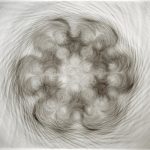
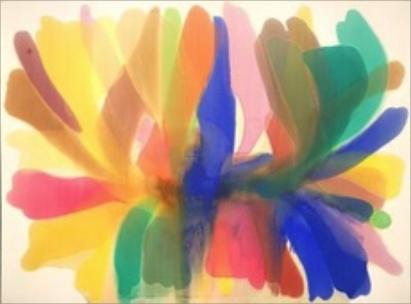
Morris Louis Now charts the progression of this method, and the paintings are grouped according to the four significant periods of Louis’ work. “Veils” (1954, 1958-59) consist of overlapping colors, “Florals” (1959-60) feature a dense center of color, “Unfurleds” (1960-61) have paint poured from the edges so they flow inward, while most of the canvas remains white, and “Stripes” (1961-62) feature lines of color. Point of Tranquility (pictured above), from the permanent collection, belongs to the “Florals” series, and was created by pouring paint from all four sides, so the color appears to bloom outward, like an opening flower.