 As they did in 2006, the Cleveland Orchestra came to the Kennedy Center Concert Hall on Monday night for a concert sponsored by the Washington Performing Arts Society. After Washington, they will play a three-concert series at Carnegie Hall and then leave for an extended European tour. The Clevelanders were once arguably America’s best orchestra and were always classed among the Big Five symphonic ensembles in the country, a placement that more and more people believe Cleveland has lost. That downward trend may be reversed eventually by their ultra-talented and relatively young music director, Franz Welser-Möst.
Welser-Möst has had a rocky career, being driven out of his post with the London Philharmonic and then running into critical trouble here in the U.S. One of his staunchest defenders among music critics has been Norman Lebrecht, who must have felt vindicated this summer when Welser-Möst was appointed Music Director of the Vienna State Opera, beginning in 2010. If there were issues for Welser-Möst relating to the Cleveland musicians or administation, they appear to have been resolved, because his contract there has been extended until 2012. Whatever else one might criticize, he has helped to put the Cleveland Orchestra back on disc, with a recently released live performance of Beethoven’s Ninth Symphony.
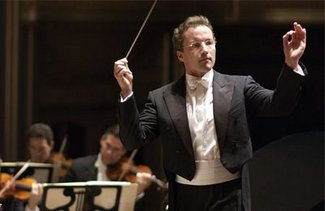
Slender, aristocratic, and in formal tails, Welser-Möst led a strong performance, opening with Mozart’s Symphony No. 28 in C major, K. 200. His slightly over-fast tempo in the first movement led to some smudges in the violin section’s sixteenth notes. Overall, the strings seemed ponderous at times (perhaps there were too many of them?), making the brass and percussion sound recessed. The soft second movement showed a firm hand in control over the soft end of the dynamic spectrum, and the third movement had an aptly chosen tempo, just right for Allegretto.