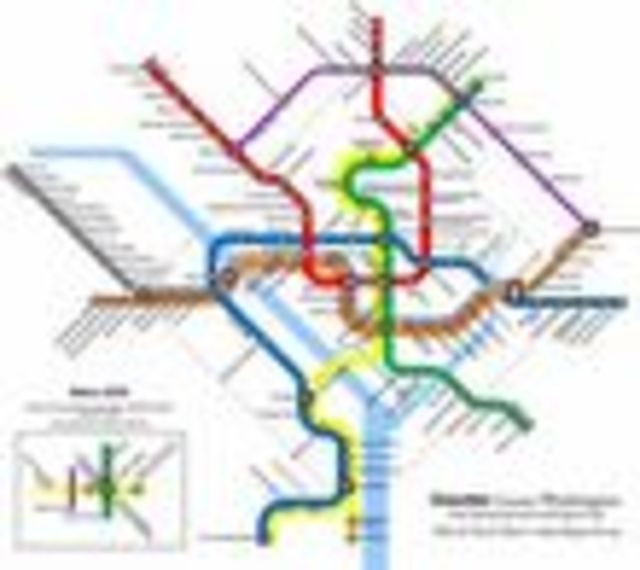
 It might have made us say, “huh?”, but Metro produced quite a hubbub with its recent presentation on future solutions to the system’s capacity needs – turns out, the transit agency has some pretty major upgrades in mind. David Alpert, curator of the local development blog Greater Greater Washington and a former Google Product Manager, produced a map to display all the changes that WMATA wants to make. We took the chance to grill David on these changes and see what he thinks about the ideas the agency is floating around for the next 20 years.
Okay, so let’s play along and say that in a perfect world, Metro gets to make all these changes by the year 2030. In your opinion, what change – if any – is going to make people stand up and say, “this changes the way I live my daily life”?
Within the scope of this map, the most influential single changes would be the Silver Line to Tysons, the Purple Line through College Park, and the Blue Line to H Street. Each of these enables getting somewhere that right now is much more difficult. Almost everyone drives to Tysons, and once trains go there, some people will start riding the train. More importantly, development will start shaping itself around Metro, including new residential buildings that cater to commuters into D.C.. That will significantly shape the way people live in Fairfax.
Likewise, the Purple Line will connect a lot of people to schools and jobs who have to drive today. It would clearly transform mobility for all Maryland students, cut congestion on the northern parts of the Beltway, and make it easier for Silver Spring and Bethesda to grow without building lots of parking. And a subway on H Street would stimulate development in that area and bring residents there much closer to the rest of the city.
Map created by David Alpert of Greater Greater Washington (click on map for larger). Used with permission.