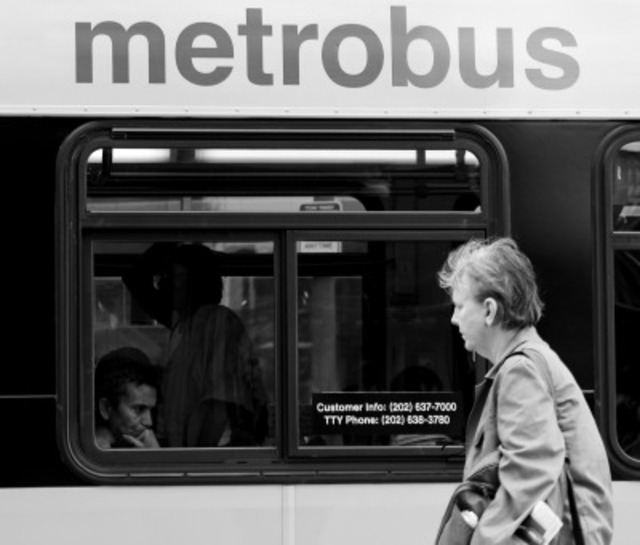
 Photo by bogotron.
In light of the deadly accident that killed nine people on Metro’s Red Line on June 22, there’s been plenty of talk about what’s wrong with Metro — and rightfully so; the agency is now at a obvious turning point in its history, where it suddenly needs to navigate a calamitous disaster and forge some sort of path regarding its future.
But it’s not all bad news in the world of WMATA — in fact, one needs to look no further than the ridership repercussions of the terrible accident to find something positive.
Today, the Post lends prominent B Section inches to a story about the proclivity of commuters to migrate to bus service in the light of the slowdowns and delays after the accident. What does the Post find? Most notably, those who were forced into riding the bus after their commutes were wrecked by the accident are sticking with it. Whether it’s out of concerns about Metro safety, or for brevity, or even on accident, it’s clear — a lot more people are using Metrobus:
According to Metro, bus ridership surged immediately after the June 22 train crash, which killed nine people and injured 80. Two bus lines, which allow riders to efficiently bypass stretches of the Red Line between the Metro Center and Silver Spring stations, have become especially crowded. About 17,000 more people took the 70, 71 and 79 buses that travel Georgia Avenue the week of the crash than the week before, a 19.5 percent increase. There was a 15 percent increase on the 16th Street service, which includes the S-1, 2, 4 and 9 buses.
This development, while certainly predictable, has to be of interest for the board of directors at WMATA, who as recently as March of this year were contemplating large cuts in bus service around the Washington area.
While it’s fantastic that more folks are using and enjoying the bus, another question arises: why did it take a fatal accident on the most ridden Metrorail line to notch such an uptick?