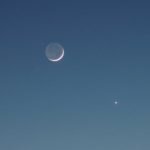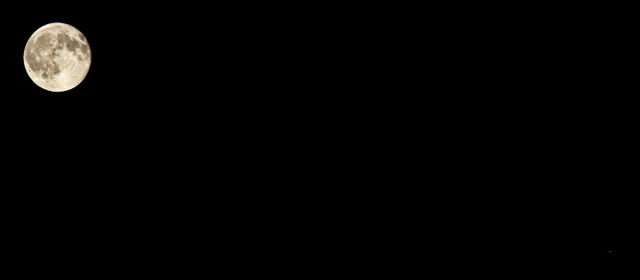
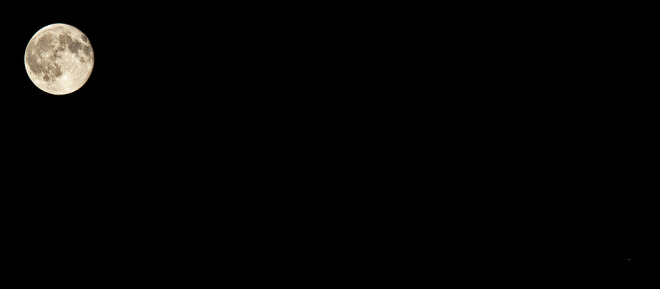
 Photo by maxedaperture. That tiny dot on the very lower right is Jupiter. Click over to Flickr to see it better.
Did you look up last Wednesday and Thursday to see two of the brightest objects in the sky — the Moon and Jupiter — trek ever so close to each other? It’s tough to say that maxedaperture’s photo above doesn’t really do it justice (because it sure as hell does the Moon itself justice), but the real view was so bright to make even non-fans of astronomy look up and, as a friend told me later, make him nearly run his car into a ditch. (Please practice safe sky viewing and pull over!)
If you missed it, never to worry: the solar system keeps spinning and bringing us more sights to look forward to. The Perseid meteor shower peaks this week, on Tuesday and Wednesday. The “shooting stars” are little pieces of Comet Swift-Tuttle, which we last saw in 1992 (and won’t see again until 2126) and, because its orbit brings it so close to Earth, its predicted to quite possibly be the bringer of our eventual doom — but we’ll leave that for our great-great-grandkids to worry about. In the meantime, however, that means the comet swings close enough to throw quite a bit of debris into our atmosphere. Naturally, the shower dims every year as the comet travels back out into the solar system, and we’ll have a little bit of the bright quarter Moon to outshine the meteors as they vaporize overhead, but the Perseids always bring a bit of a show no matter what. To find them, look towards the northeast sky near the constellations Perseus and Cassiopeia between 11 p.m. and dawn both nights.
If planets are more your thing, you’ll have some more good viewing opportunities. Though its moved away from the Moon, Jupiter is still an incredible sight, reaching opposition — that is, the Sun and the planet are on exact opposite sides of the Earth — on Friday. At opposition, Jupiter’s orbit brings it closest to us, so it will be incredibly bright and visible from sunset to sunrise.
Sky watchers should also stay tuned to DCist on Monday, when we’ll bring you a tour of the brand new Public Observatory at the National Air & Space Museum, scheduled to open later this month.