
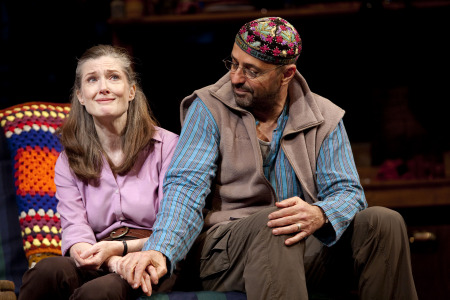
 Annette O’Toole and Stephen Schnetzer in Arena’s “Quality of Life.”
 Like an experiment exploring the limits of psychic pain, Jane Anderson’s Quality of Life seems determined to pile tragedy upon tragedy to see just how much she can throw on the backs of her beleaguered characters before they cease bending and simply collapse into a pile of rubble.
It’s fitting, then, that the bulk of the play actually takes place atop a literal pile of rubble, the remains of a California home burned to the ground by a wildfire. It’s mostly cleaned up by the time we see it; the house’s owners, Neil and Jeannette, are a pair of middle-aged hippie-ish intellectuals who set up a yurt, an outhouse, and an open-air kitchen on the foundation, and string their burned and melted belongings among the scorched trees like pieces of found art. Their calm, Zen acceptance of the whole incident may stem from the fact that they’re dealing with a far deeper tragedy: Neil’s body is riddled with tumors, and he doesn’t have long to live.
Into this well of sadness descends Jeannette’s cousin Dinah and her husband Bill, visiting from Ohio, who have burdens of their own. Their daughter was brutally murdered a year before, their marriage slowly falling apart in the aftermath. They’ve found solace in their born-again faith, and when these straight-arrow Midwestern conservatives come to dinner with the “I’m spiritual, but not religious” set, it’s a recipe for culture clash and cliché.