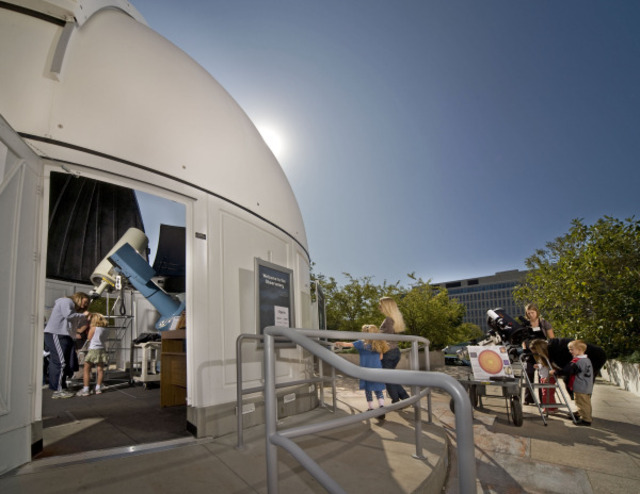
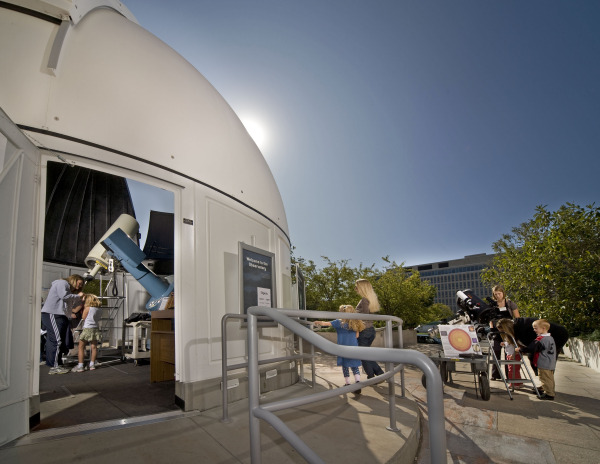
 Photo by Eric Long/NASM, National Air and Space Museum, Smithsonian Institution
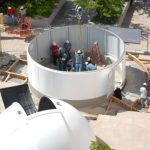
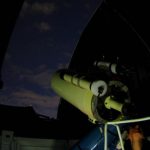
Back in early August, we previewed the Public Observatory Project at the National Air and Space Museum; this week the ribbon was cut and the telescope is officially in business. (Before I get too far, I should disclaim that I’m now a volunteer at POP — having worked in observatories during college, this was too good an opportunity to pass up — so I’m obviously a big fan of the project, and you may attempt to complete your DCist editor bingo card by trying to find me there during my weekly shift.) The observatory is focused on daytime observing and will be open Tuesday through Sunday, 10 a.m. to 2 p.m. The research-grade 16″ Boller and Chivens telescope, on loan from Harvard University, is fitted with a solar filter, making it perfect for viewing the Sun and Venus. On especially nice days, a portable 11″ Celestron scope is rolled out, to which are attached two smaller scopes fitted with H-alpha and CaK filters, allowing viewers to see different wavelengths of light coming from the Sun — during my first training session we caught spectacular prominence through the CaK scope. Programs with D.C. Public Schools will begin in November. The museum also has a new program in the Einstein Planetarium, Journey to the Stars.
Events:
>> Friday is a big day for planetary science: NASA’s LCROSS mission (short for Lunar CRater Observation and Sensing Satellite), which has been headed on an elongated path towards the Moon since June, will finally slam into the natural satellite’s surface. LCROSS’s target site had a last minute change last week to a different crater that scientists predict has a higher concentration of hydrogen — that is, water. The confirmation of water on the Moon has been big news the past couple of weeks, and LCROSS’s impact on Friday (which, scientists hope, should kick up lots of water from beneath the Moon’s surface) should provide incredibly helpful data. In addition to helping us further understand the Moon’s makeup, this discovery could have great implications regarding long-term human travel to the Moon and Mars. If you’re an early riser, head to the Newseum for an observing event featuring NASA’s Deputy Administrator Lori Garver and the museum’s 40-foot high-definition media screen. Doors open at 6:30 a.m., program starts at 7 a.m., LCROSS’s first satellite is scheduled to impact the Moon at 7:25 a.m. and the second at 7:30 a.m.