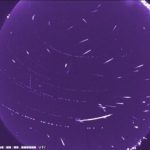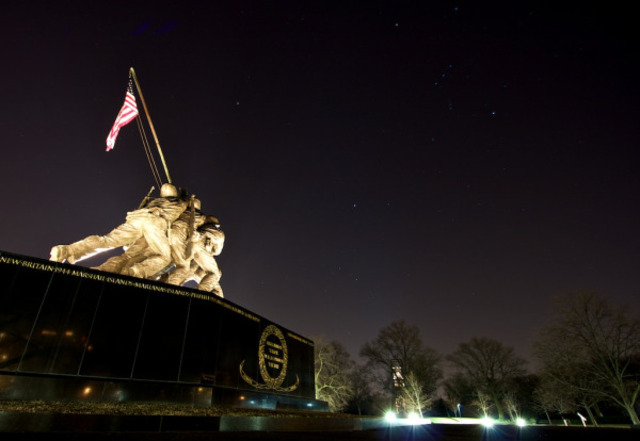
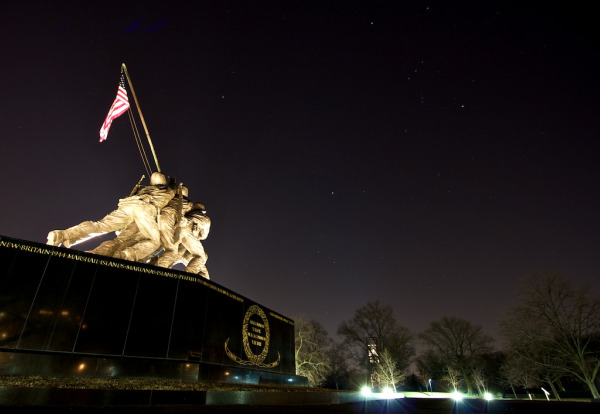
 Iwo Jima Memorial and Orion, where we should be able to spot some Orionids flashing through the sky this week. Image by Samer Farha.
The news isn’t good for stargazers this weekend. Both events we mentioned last weekend, the National Capital Astronomers “Exploring the Sky” in Rock Creek Park and NOVAC’s 27th Annual Star Gaze, are certainly going to be rained out. We’ll let you know if the annual Star Gaze is rescheduled.
Let’s trust Weather.com for a minute and assume the sky will clear up by Monday. That will give us a perfect window to catch the Orionids, debris from Halley’s comet the Earth travels through every October. If you’re reading this from outside the rain-zone, take a look up, because they actually started yesterday and will hit their peak next Wednesday, when we might see up to 25 meteors an hour. We might have an especially nice view that night, because the Moon will only be two days old, giving us a pretty dark sky.
The meteors will appear to originate from Orion, The Hunter, one of the first constellations every skygazer learns (many friends have told me they “feel at home” when they can find Orion in the sky). Orion is more of a winter constellation, so we’re still waiting a few hours after sunset for it to rise in the East. You can’t miss the hunter’s collection of high magnitude stars — look first for the three stars making up his belt (lining up almost vertical from the horizon), then to the left to see his shoulders, including Betelgeuse. To the right of the belt you’ll see the hem of his hunter’s robe, including Rigel, the sixth brightest star in the sky. “Hanging” from the belt is Orion’s sword, used to locate the spectacular Orion nebula, which is so big and bright it can be seen with the naked eye on clear, dark nights. (Back in the day, using a massive 9.5″ refractor, I used M42 as a teaching tool during Astronomy 110 labs.) Although you might catch an Orionid streaking anywhere in the sky, keep your eyes towards the hunter for the best view. The International Year of Astronomy site has a great FAQ about the Orionids.
After the jump: more on LCROSS, and your calendar of super awesome upcoming events.