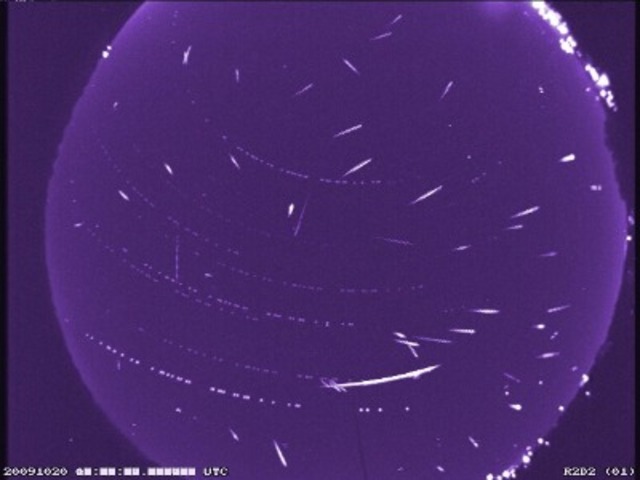
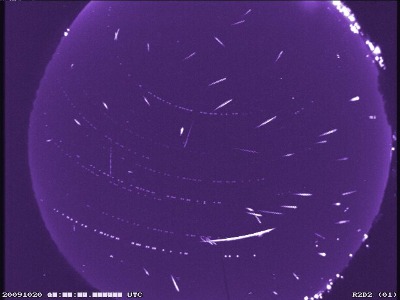
 Composite, false-color image of the 2009 Orionid meteor shower, by NASA’s Marshall Space Flight Center.
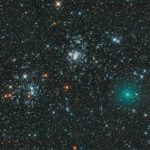
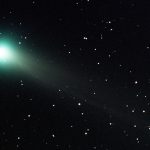
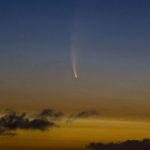
The fall weather may be appealing, but the gloomy skies the past couple of days haven’t really helped anyone looking up for Comet Hartley 2, which made it’s closest pass yesterday. It’s still pretty darn close (just 11 million miles away!), so if the skies clear up you can find the icy comet to the left of Taurus in the constellation Auriga, starting a little after 10 p.m. Meanwhile, NASA’s Deep Impact probe, on its EPOXI mission we discussed last week, ventures closer to Hartley every day, preparing for its fly-by on November 4.
What else might we catch related to comets in the sky tonight? The annual Orionid meteor shower reached its peak starting last night and continues through this evening. Orionid meteors are fragments of Halley’s Comet, which the Earth passes through twice a year (the other shower is the Eta Aquarids in April/May). As you might guess by the name, these meteors visually originate from the constellation Orion, which rises around midnight in the east. You need to be a bit of a night owl/early riser for the Orionids, as the best time to catch the one of the about 20 meteors per hour is after 3 a.m. until sunrise, when the constellation is closer to zenith. Another challenge: the moon is almost full tonight, providing a glaring spotlight that may hide the fainter streaks in the sky.