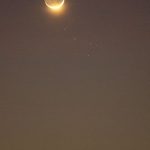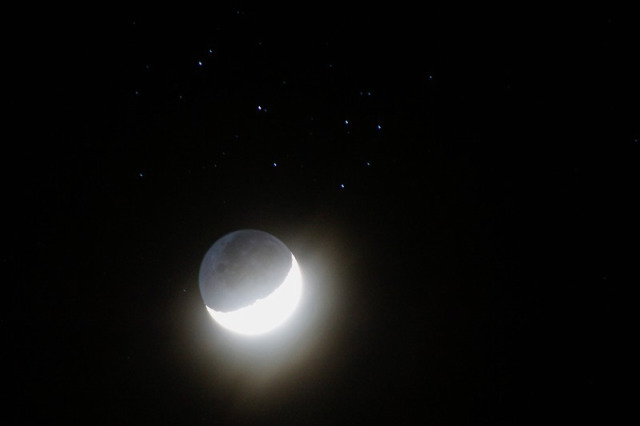
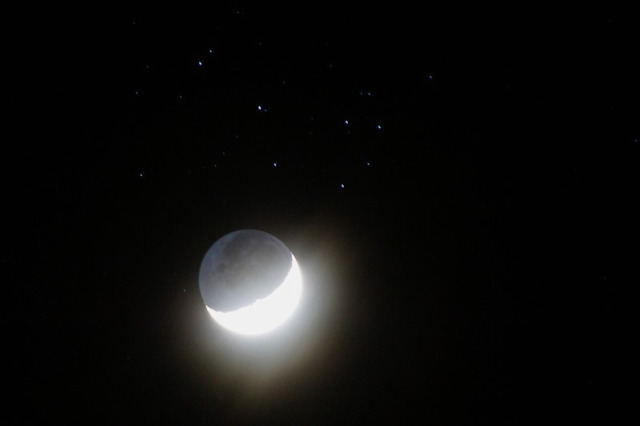
 Image of the crescent Moon and Pleiades star cluster by philliefan99.
Once these pesky rainclouds clear out — they should by Wednesday — take a minute to enjoy a fantastic show at dusk. Venus and Mercury, the two planets closer to the Sun than Earth, are both visible about a half an hour after sunset right now. Sky and Telescope has a good visual, with Mercury trailing Venus to the lower right in the western sky. Wait until next Saturday to see them closest together in the sky.
For best viewing, you should try to find a clear line of sight to the western horizon. Because Mercury orbits so close to the Sun, we never see it very high in the night sky, when we can actually see the small, rocky planet. In our view this week, Venus is actually 50 million miles further away than Mercury, but will appear much brighter due to its gaseous (and thus, reflective) atmosphere, bigger size, and current location in its orbit (did you know Venus has phases?). The Venus-Mercury sight is a nice treat and won’t last long — Mercury’s orbit around the Sun is only 88 days, so it’ll be heading back into the glare of the Sun soon.
>> Last week there was a conjunction of the crescent Moon and Pleiades star cluster. Resident astrophotographer philliefan99 took a lovely image, seen above — and we’re glad he did, because this won’t happen again until 2023. The Pleiades is a great, easy-to-find target for new skygazers. While you’re out looking for Venus and Mercury later this week, wait until just after they set — around 8 p.m. — and you’ll find the Seven Sisters chasing them to the horizon, setting around 10:30 p.m.