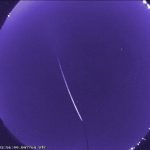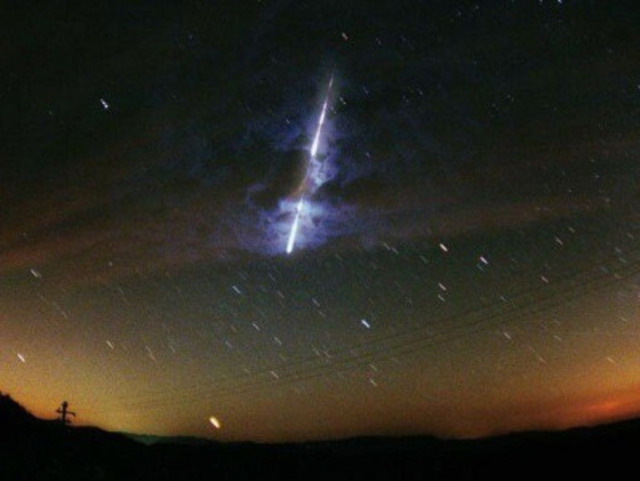
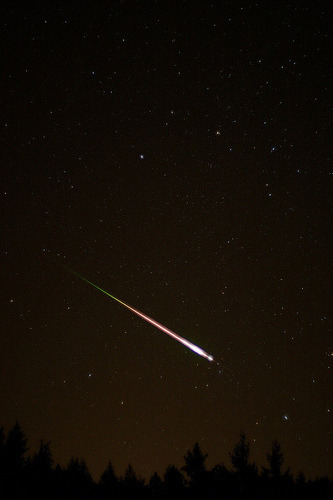
 Photo of a Leonid meteor by
 Last Thursday, it seems a fireball lit up the sky over Washington. I’m sorry to say we missed it at DCist HQ and only heard about it later via the Washington Post, which reported that sky-gazers in D.C. — and as far away as New York and West Virginia — saw an incredibly bright greenish-yellowish streak across the sky at about 9:55 p.m. The American Meteor Society records these “fireball” sightings, this time logging over 50 entries at an average apparent magnitude of -13, which is equivalent to the brightness of a full Moon. (If you recall, the very bright ISS passes I mentioned on Friday were only around -3.)
Here’s a quick Astronomy 101 refresher: generally, objects traveling in space that are smaller than ten meters across are “meteroids.” When meteroids hit the Earth’s atmosphere and create a visible streak in the sky, they’re “meteors” (also what some call “shooting stars,” the, ahem, non-technical term); astronomers use the term of art “fireball” for a meteor that creates an especially bright sight, usually -3 and lower, like our visitor last week. Finally, when they hit the ground intact, they are designated “meteorites.” While, as proved last week, you might see a meteor at any time of the year, the best time to look up for them is during a regular meteor shower. The next best time is August 12-13, with the Perseids.