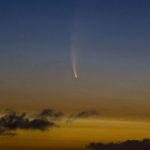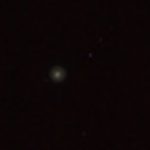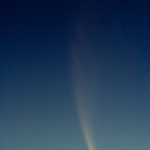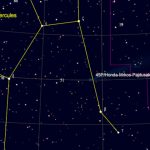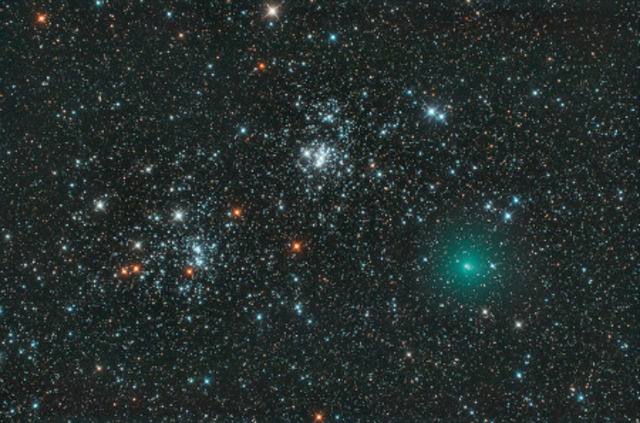
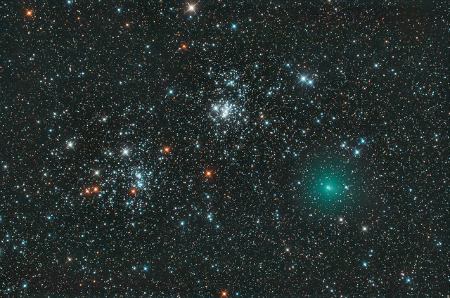
 Photo of Comet Hartley 2 by zAmb0ni via Creative Commons. Click through to read about the photo process.
October greets us with a fun astronomical event: Comet Hartley 2 will be at its most visible with just a little help all month, and visible but steadily fading from view through the end of 2010. Sky & Telescope has all the comet info you need, including that it was discovered in 1986 and will make its closest known approach to Earth this year, passing at just 0.12 AU (an AU is a commonly used unit of distance that stands for ‘astronomical unit’ and equals the distance between the sun and the Earth, almost 93 million miles, so 0.12 AU is about 11 million miles). If you’re away from the city lights, you may be able to see Hartley 2 as it reaches 5th or 6th magnitude on October 20 with your naked eyes; for the rest of us, a simple pair of binoculars should do the trick just fine. (Here’s Hartley 2 being chased by Pac-Man on NASA’s Astronomy Photo of the Day.)
To find Hartley 2, look just north of east for distinctive Cassiopeia, which we talked about a few weeks ago. The Queen is laying on her side these days, so follow her crown down towards the horizon for the constellation Perseus, named for the Greek hero who slayed Medusa. Tonight, you’ll find Hartley 2 just a smidge to the left of Perseus’ brightest, center star, Mirphak. By the 20th, its brightest day, the comet will have traveled further ‘down’ to the hexagonal constellation Auriga, just to the left of Taurus. Hartley 2 will be just to the lower right of Auriga’s brightest star, Capella.