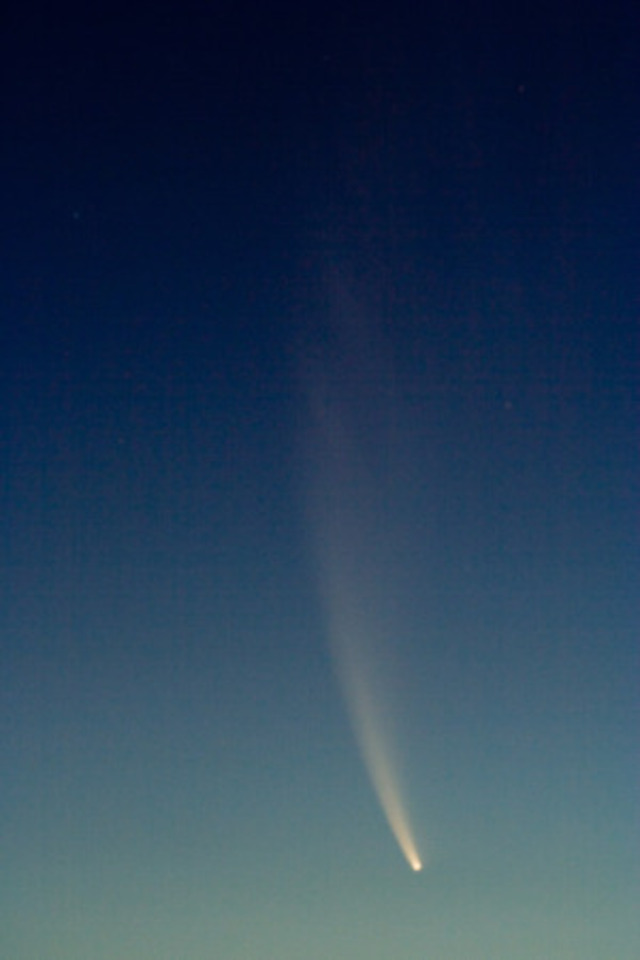
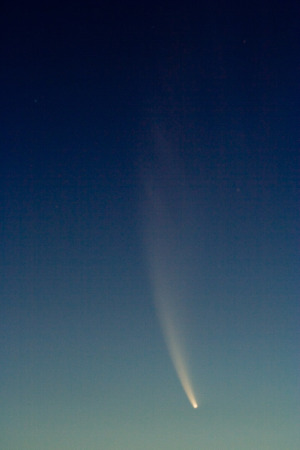
 Photo of Comet McNaught in 2007 by Peter Baker (via Creative Commons).
The news is all about the planets this week. For fiery flashes on Jupiter, Mars and Venus aligning with stars, nearby comets, and possible alien life in our solar system, keep on reading.
>> If you think NASA and professional astronomers are the only ones to make spectacular discoveries, just take a look at Jupiter. Amateur astronomers Anthony Wesley in Australia and Christopher Go in the Philippines were the first to see another amazing asteroid impact on the gaseous planet’s surface. National Geographic hosts the astronomers’ video of the collision, producing a fireball the size of the Earth in the atmosphere. Astronomers are gobsmacked at timing of the event, so very close to the 2009 impact of a nearly mile-wide asteroid that left a scar the size of the Pacific Ocean on Jupiter (and was also first seen by Wesley). As Space.com notes, at the time Comet Shoemaker-Levy smacked into to Jupiter in 1994, astronomers thought such an impact would only happen every 50 to 250 years. The planet is visible in the early hours this week; check Sky & Telescope for times when the new, temporary spot will transit the surface into our view. (It was just last month, by the way, that news-hog Jupiter lost a stripe.)
>> If you have binoculars or a telescope, use Jupiter to locate the hard-to-find Uranus — oh, no, I’ve never heard that joke before, good one! — so distant as to be at the very edge of sight with our naked eyes in dark sky (so certainly tough near the city). The blue planet will be within one degree of Jupiter on Monday night.
>> Mars and Venus are both evening planets this week. If the weather clears, you’ll find Mars tonight and tomorrow just within reach of Regulus, in the constellation Leo and one of the brightest stars in the sky. Look for them in the western sky just after dusk. Next Friday, also just after dusk in the west-northwest sky, Venus will form a line with Pollux and Castor, the “heads” of the twins in Gemini.
>> Remember Comet McNaught, which gave us such a spectacular show in 2007? The famous comet — which was recently called the biggest comet measured to date — (Oops, different comet — astronomer Robert McNaught is a busy bee!) A different comet discovered by McNaught will be visible through mid-June, beginning tonight. You’ll have to be an early riser and need binoculars or a telescope. Look towards the east just before dawn as McNaught passes through the constellation Andromeda. From the Northern Hemisphere, the comet will begin to travel lower in the sky, but will also become brighter toward the end of the week, as the Moon wanes and it begins to pass through Perseus, finally disappearing from view towards the end of June. Comet McNaught reaches perihelion (the outer edge of its orbit) on July 2; astronomers believe that McNaught is on an hyperbolic orbit, so once it leaves the solar system, it likely won’t return.