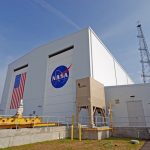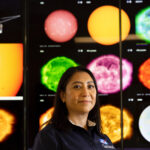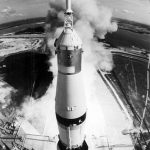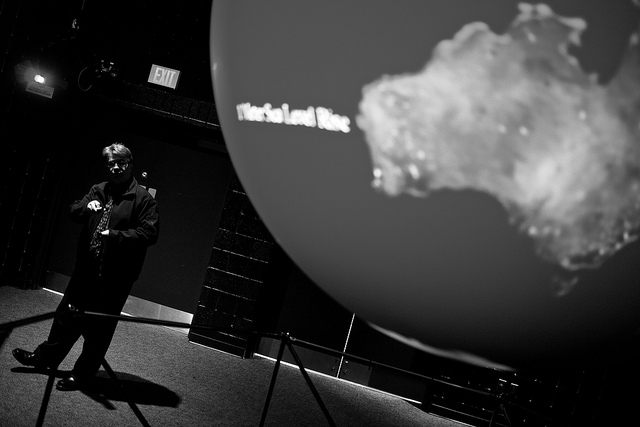
Early in October, we told you about NASA’s Goddard Space Flight Center’s “Tour & Tweet” event. DCist photographer Steve Goldenberg signed up for the tour and took the set of photos in the gallery above; click through for his descriptions as they were led through the facilities.
The center was named after Dr. Robert Goddard, the “father of modern rocket propulsion.” His breakthroughs in aerodynamics and rocketry — not to mention his 1920 publication that discussed the possibility of reaching the moon — played a large role in making spaceflight a reality. (You can see a model of the first successful liquid-propellant rocket that Dr. Goddard developed and launched in 1926 at the National Air & Space Museum on the Mall.) The press lambasted Goddard and the idea of traveling to the moon, and though he continued to make great strides in both engineering and flight theory, he remained mostly unrecognized for his efforts throughout his life. Goddard died in 1945.
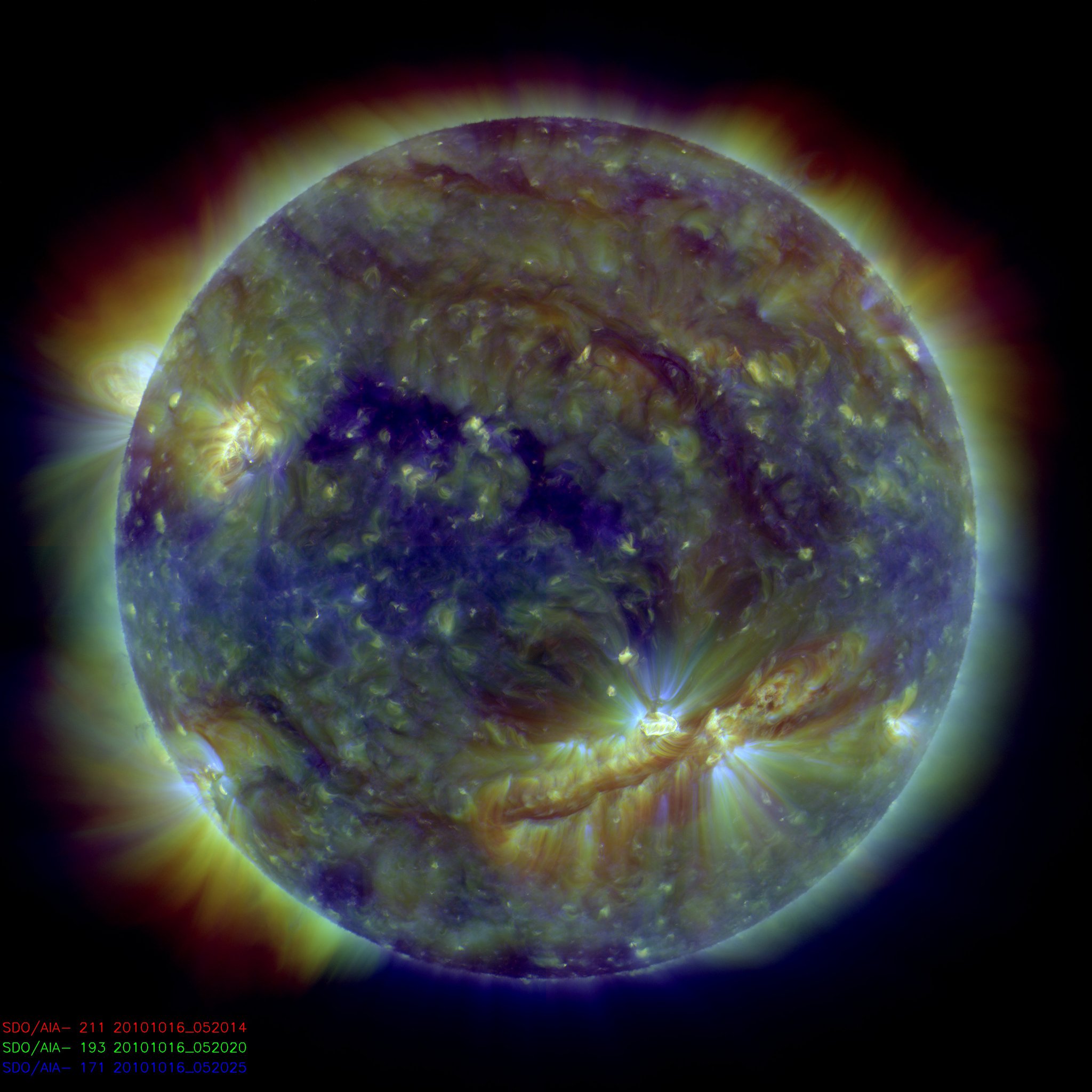
When NASA built its first space flight center in Greenbelt, Md. in 1959, they named it after the great rocket pioneer. Now, Goddard Space Flight Center is the control center for numerous NASA missions, specializing in observation spacecraft that orbit Earth (as opposed to those that travel out into the solar system). Among a large list, Goddard is homebase for the Hubble Space Telescope, which in its 20 year mission has helped scientists refine the age of the universe and discovered some of the first evidence that extrasolar planets exist around stars similar to our Sun. Goddard also runs the Earth Observatory System, which is where we get those incredible images we’ve posted here on DCist. The center is also in charge of the Solar Dynamics Observatory and the other missions studying, measuring, modeling and taking spectacular images of our Sun. Goddard is also the parent facility for the nearby rocket launching site, Wallops Flight Facility, which we discussed earlier this year. Of course, these are only a few examples of the amazing projects going on just a few miles north of D.C.