Martin Austermuhle
 Eight District residents arrested in a number of recent protests for D.C. voting rights and autonomy are headed to trial, while nine others opted to pay a fine after appearing in a D.C. courtroom this morning for a preliminary hearing.
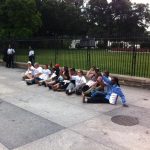
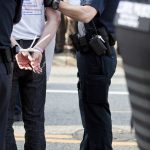
The protesters — 17 in all, 15 of them arrested during an April 11 demonstration on Capitol Hill and two arrested in a similar event on April 15 — faced charges of unlawful assembly and failure to obey, both misdemeanor offenses that carry up to 90 days in jail and $500 in fines.
After briefly caucusing with each other and with a number of lawyers that represented them in the brief hearing, 9 chose to post and forfeit — in essence, to pay the equivalent of a traffic citation and give up any rights to contest the charges in court. (Of the 41 people arrested on April 11, the majority paid a $50 fine that day; those that chose to post and forfeit today owed $100.) The remaining eight, including D.C. Shadow Senator Michael D. Brown and D.C. Vote Director of Public Affairs Eugene Kinlow, opted to plead not guilty and are due again in court on June 28.
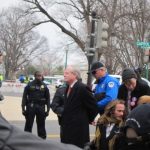
Prior to the hearing, which took place in the D.C. Misdemeanor and Traffic Community Court, D.C. voting rights activists gathered to rally in support of those arrested. In a number of speeches, speakers compared the fight for equality in the District to similar movements in the Middle East. “As Tunisia, Egypt and Libya have sought freedom, so shall we,” said former mayor Sharon Pratt Kelly, who herself was arrested in a pro-statehood demonstration on Capitol Hill in 1993.
D.C. Shadow Representative Mike Panetta, who was arrested on April 11 but opted to pay the fine that same night, drew a similar comparison. “What happened a few weeks ago was our own fruit stand,” he said. The movement that unseated Tunisian President Ben Ali only months ago was started by a fruit vendor who had been angered over government restrictions on his business.
Councilmembers Sekou Biddle (D-At-Large) and Yvette Alexander (D-Ward 7), both arrested on April 11, were also in attendance at the rally and in the courtroom.
Before the hearing started, the 17 protesters peppered lawyer Ann Wilcox with questions on the procedure and the consequences, inquiring on what a trial would look like (no jury, just a judge), whether they could face jail time (yes, though unlikely) and if a conviction would go on their record and affect their professional lives (yes to both, though a conviction could be later sealed, she said).
Corryn Freeman, a student at Howard University who was arrested on April 11, seemed torn on whether or not to proceed to trial. “I’m really not sure. There are pros and cons to everything. Being convicted might send another message, it might have a broader audience hear our message. But if I choose not to get convicted and I choose just to pay up, I can get arrested again and I can stand with D.C. Vote again.” Those who go to trial and are found guilty could face months of probation, during which they cannot be arrested and may even be forbidden from going to the scene where their initial arrest happened.
Freeman, who wants to attend law school and called the cause “righteous, noble and justifiable,” eventually chose to pay the fine.
To date, 55 people have been arrested in four protests for D.C. voting rights and autonomy. Activists promise more protests and arrests are to come, and serve the purpose of putting pressure on President Barack Obama and congressional Democrats to stand against any further riders that directly target the District. The April 11 protest was set off by a congressional budget provision banning the District from spending its own money on abortions; the measure sailed through the House yesterday, its passage prompting another protest in which Councilmember Mary Cheh and several other women were arrested.
As the 17 entered their pleas and were informed on how to proceed, Judge Richard Ringell, who deals mostly with traffic violations and DUI charges, recognized them for “standing up for what they believe.”