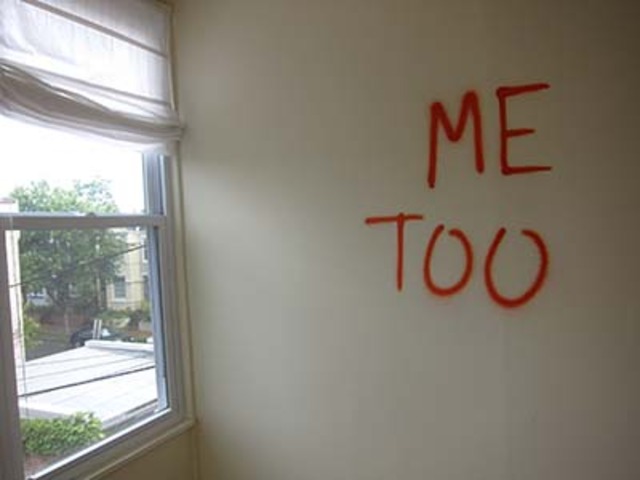
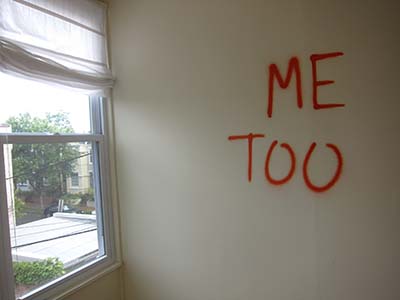
 Detail from Patrick McDonough and Matias’s Untitled (Me Too). Photo by Pat Padua.
Art does not exist in a vaccuum, and this is proven in stark fashion by a recent collaboration between Washington-area artists Patrick McDonough and Matias. Their installation at Porch Projects, a domestic exhibition space near Stanton Park, may provoke an uncomfortable reaction from the visitor. This provocation is by design. But if I told you all about it, I’d spoil the experience. So this art review comes with a spoiler alert. If you are interested in a confrontational work that may challenge your idea of what art is, email porchprojectsdc [at] gmail [dot] com for an appointment, and stop reading here. In fact, I’d like to suggest to the more adventurous of our art-minded readership to just make that appointment and read no further.
If you want to hear about the artwork and don’t mind knowing how the story ends, read on.
Artist/curator Mariah Johnson moved to Washington from Los Angeles and Chicago, and created Porch Projects with a mind to bring those city’s homegrown gallery spaces to D.C. Such projects, along with site-specific work lately hosted at Transformer (where you have only a few more days to see Lindsay Rowinski’s excellent Trying to be There) and at other area art spaces, give the local art scene an organic flavor. Johnson writes, “I think it would be great if more artists realized that we can do things like this for ourselves. We don’t have to wait around for someone else to give us a show, or for someone to give us a free space…we all have free space already, be it in the coat closet, on the balcony, under the stairs, in the microwave that never gets used, in a back pocket, in the trunk of a car, etc etc. We just need to think creatively about how to use that space.” McDonough and Matias’s Untitled (Me Too) is the third installation in the 1917 row house that Johnson calls home.
Johnson is a gracious host and this hospitality is part of what Untitled (Me Too) works with, and against. I reviewed McDonough’s reck room installation at Flashpoint last year, and he messaged me recently to tell me about his new work. The Porch Projects blog features pictures of spray painted walls that suggested a home invasion, which in a sense describes the work. The pictures intrigued me, and I made an appointment to visit. But when Johnson led me to the exhibit space, originally an enclosed sleeping porch, I found the white walls of the space were clean except for the artist’s spray-painted text.
And that’s it.
It struck me later that I was kind of punked. Johnson told me that one visitor to the exhibit opening thought the host should be offended. The director of Porch Projects was generous enough to offer her home to the artists and to the more than forty opening night guests. But the resulting work seemed, to one visitor, a slap in the face to that generosity. The work is minimal and passive aggressive, the spray-painted words, “IF YOU WANTED US TO DO SOMETHING YOU SHOULD HAVE GOTTEN A BIGGER SPACE” coming across like the work of petulant street artists who feel entitled to mar your middle-class property, bourgeoise pig!
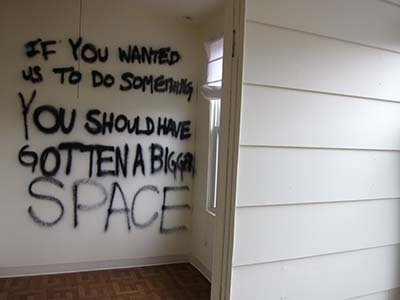 Detail from Patrick McDonough and Matias’s Untitled (Me Too). Photo by Pat Padua.
But the artists discussed their intentions with Johnson beforehand, so she knew what she was getting into. And the response to the work has been, perhaps surprisingly, mostly positive. When visitors on opening night faced the minimal work, it started a conversation about art. To take the work seriously, as more than just a prank, you have to engage with the work and your reaction to it. What is it about? Aggression, the volatile personalities of artists, the textures possible and not possible with the most basic of tools — a can of spray paint and a blank wall. McDonough’s invitation leads to a kind of brush-off. The work makes you feel a little uncomfortable. Opening night festivities included a cookout, and although the artists did not want to declare the cookout as a social aspect of the work, beer and grilling certainly tempered its reception. For me, a solo visitor, Johnson herself became a collaborator, offering her hospitality and continuing the conversation about art. Untitled (Me Too) is made to alienate, but it is this very alienation which encourages the viewer to engage with the work, and with the artists.
I asked Johnson a few questions about her background and the current exhibit.
Could you tell me about your experience with domestic art spaces in L.A. and Chicago? How do such spaces relate to the commercial gallery scenes — are they separate or symbiotic, or both?
In Chicago, apartment galleries (that’s usually how they are referred to there) are a long-term tradition. It seems like artists of all levels participate in them, either by showing their work or creating/curating/hosting the spaces. They take on a wide variety of shapes and sizes, from stand-alone backyard sheds to a medicine cabinet in a spare bedroom. Some are aiming to emulate the white cube while others make it clear that you are in a domestic setting, a different kind of space. Some spaces last for many years (like Michelle Grabner’s The Suburban), while others only manage to produce one or two shows. I think in Chicago these spaces are in a symbiotic relationship with the other kinds of art spaces in town (commercial galleries, non profits, museums, etc.). These spaces fill the role of letting artists experiment and gain exposure. The art community looks upon these spaces as serious if they present themselves with any amount of professionalism or rigor, which is usually the case.
In L.A., I did not see or hear about as much of this kind of activity until maybe 2008, when a friend of a friend (Eve Fowler) started Artist Curated Projects. At that time, L.A.’s economy had already been sour for about a year, and commercial spaces were closing or reigning in their programming, and I think artists were kind of looking around for a new or different way to operate. Eve and her roommate Lucas Michael started ACP in their East Hollywood apartment, where they hosted several shows. It was obvious that you were in their living space, as there was a video screening on their television and artworks in the kitchen and on the dining table. The audience was primarily artists. At some point, ACP branched out to hosting events in other artists’ homes, curated by the artists who lived there. My work was included in the ACP show Kimono My House, which occurred at Anna Sew Hoy’s house in 2009. ACP also participated in an occasional event called Block Party in the Highland Park neighborhood, in which artists or other arts professionals would curate shows in their dwellings and sign up to be listed on a map of a given evening’s art shows. You had to be in the know to participate. ACP is now partnering with galleries and nonprofit spaces, so I think its purpose has evolved somewhat. But initially, I think this was very much a separate, for-artists-by-artists kind of activity. The atmosphere tended to be very casual and nonchalant: dirty dishes in the sink, lots of Tecate or Asahi everywhere, kids and dogs running around, artwork maybe being touched or stepped on, no printed gallery guides, etc.
You talked with Patrick and Matias about their idea for Untitled (Me Too). Were you at any time apprehensive about what they had planned?
I was perhaps a little curious about how the work would be received, but I did not really feel apprehensive. I felt like I was giving them a safe place to try on and experiment with this kind of passive aggressive and minimal attitude. I’m not sure they’d get to do something like this in another space in town. Since I myself am an artist, I can related to wanting or needing that kind of freedom and opportunity for feedback once in a while.
What kind of response has there been in terms of people making appointments to see the work? What was their reaction in contrast to the opening?
There have been three appointments, including yours, which is a pretty solid number for so early in the run of the show [which opened July 8 — ed.]. Appointment makers tend not to stay as long as opening attenders, but that’s probably because of the lack of party atmosphere in my house on a daily basis. However, I think everyone has taken the work at face value, not been dismissive, and wanted to talk with me about it. I think if a viewer is willing to make an appointment and get themselves over to my semi-remote location, then they are the type who really likes to engage with artwork and dialogue. Over all, I think viewers have found a good deal of humor in the work and tend to spend quite a bit of time just looking at it. They also tend to talk about it in terms of its formal qualities as much as the content of the text.
Untitled (Me Too) will be on view at Porch Projects through August 31. Closing reception and artists’ discussion takes place on Wednesday August 31 from 7 to 9:30 p.m. (Artists’ Discussion from 7:30 to 8:30 p.m.). Exhibition available by appointment at other times. Email porchprojectsdc [at] gmail [dot] com.