Martin Austermuhle
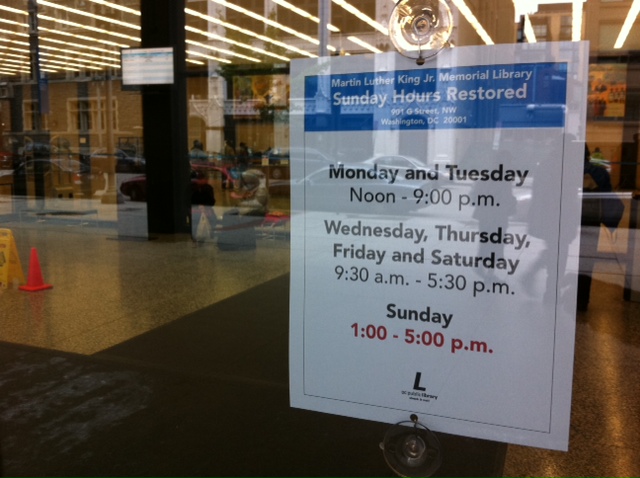
The writing was certainly on the wall for the Martin Luther King, Jr. Memorial Library. So sure were library employees that the District’s flagship library would end Sunday hours on October 2 due to budget cuts that they had already changed the hours of operation listed on the glass windows along the library’s main entrance — next to Sunday, the word “CLOSED” had been posted.
But yesterday the library remained open, the beneficiary of a last-minute scramble late last week to find the $316,000 needed to keep it open from 1 to 5 p.m. on Sundays through October 2012. (The savings came from a lower-than-expected interest rate on $900 million in bonds recently sold by the city.) As patrons lined up to enter, Mayor Vince Gray, Councilmember Tommy Wells (D-Ward 6) and D.C. Librarian Ginnie Cooper were on hand to greet them, shaking hands.
“Welcome to your library,” they said.
Despite the victory for library advocates — they noted that the King Library had remained open on Sundays for 25 years — budget challenges remain for the city’s library system, notably in terms of books and library materials. According to information provided by library officials, the budget for books and materials took a 40 percent reduction from 2011 to 2012, meaning “fewer books, fewer downloadables, fewer of everything,” according to Cooper.
“I’m almost more concerned about a continued reduction in our book budget of the magnitude we have now,” Cooper said. “We spend less per capita than any of the libraries around us. You’ll know our book budget is less in February if there’s some blockbuster that everyone wants to read, but we only have 10 copies instead of 40. A year from now, the collection will begin to suffer.”
Wells, who runs the D.C. Council committee that oversees libraries, parks and recreation centers, said that one of his priorities will be to fight for increased funding for library materials.
“We’ve got to rebuild that. People don’t see it, but they’ll experience it,” he said. “The cutbacks aren’t very public, and part of my job with oversight of the committee is to make them very public.”
Wells said that the District’s library budget has been slashed by $10 million from its high point, cuts that have affected not only materials, but also evening hours at neighborhood libraries and programs like weekend youth literacy initiatives. According to library officials, it would take $3.75 million to expand morning and evening hours at neighborhood libraries, and $300,000 to fund literacy classes for young children.
Wells seemed optimistic, though, saying that new buildings and increased income and sales tax collection shows that things may be looking up for the District.
“We can grow out of this,” he said.