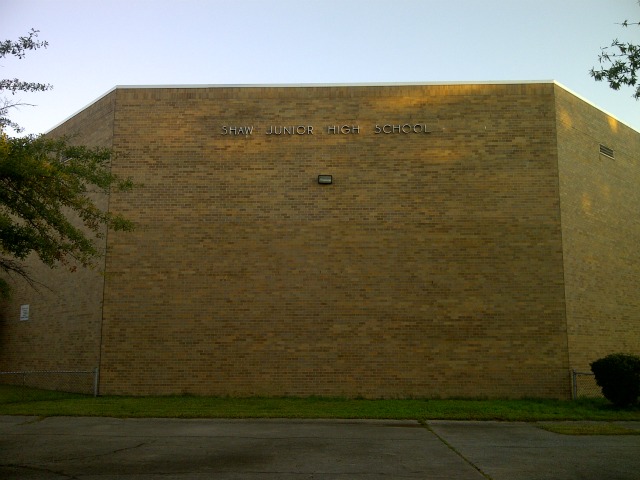
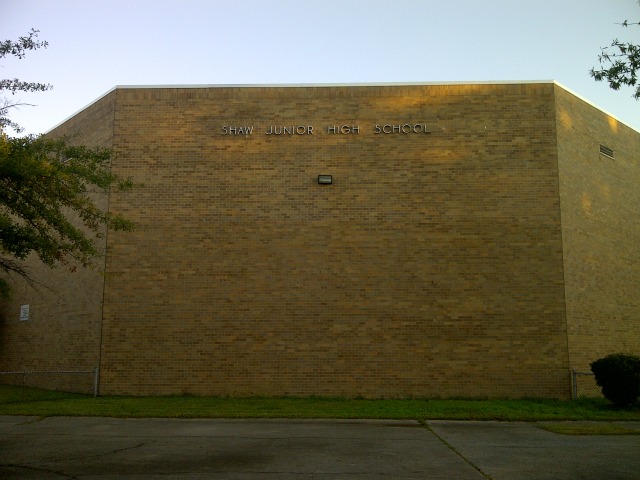
On October 10, 1923, students at Shaw Junior High School celebrated the birthday of Colonel Robert Gould Shaw. There were readings from Governor John Andrew’s war correspondence — pertinent to Shaw’s appointment as commander of the storied 54th Massachusetts Regiment — and wreaths placed on the Colonel’s portrait.
The neighborhood now known as Shaw took its name from the school, which took its name from the man who led one of the first official black units in the Union Army, and became, somewhat reluctantly, an abolitionist hero of the Civil War.
Shaw Junior High School, as an institution, was organized in 1919 at the M Street High School building. In 1928, it moved to a new location at Seventh Street and Rhode Island Avenue NW, a site originally constructed and used for the McKinley Manual Training School (eventually called the McKinley Technical High School).
Shaw, the neighborhood, was not identified by any one name for the better part of the 20th century, but more frequent references to the “Shaw area” around the school emerged in the 1960s.
While Shaw flourished for decades as the city’s preeminent black neighborhood and business district — in the late 1800s there were about 15 black businesses in the neighborhood and by 1920 there were well over 300 — by the 1940s, Shaw Junior High School was severely deteriorating. It garnered the name “Shameful Shaw,” and for years the neighborhood around it lobbied for an improved school, as it too declined. On April 8, 1966, the Washington Post made one of its first explicit references to Shaw, the neighborhood, in “Shaw Area Will Launch New-Style City Renewal:”
The area — 130 city blocks between 14th Street and North Capitol Street and M Street and Florida Avenue N.W — houses 6 percent of the city’s people, a quarter of them in overcrowded conditions. More than half of the outwardly often respectable houses are appraised as “deficient.”
The woefully deteriorated and overcrowded Shaw Junior High School, long known as “Shameful Shaw,” is a symbol of the neglect of the area.
Nearly thirty years after the Shaw Junior High School building was labeled “educationally inadequate,” the school finally moved to a new building. On September 5, 1977, Washington Post reporter Courtland Milloy wrote:
For nearly three decades Shaw Junior High School was referred to as “Shameful Shaw” because students studied in a government-certified fire trap, played on crumbling stairways, drank from plumbing judged unrepairable and played basketball in a gym with a ceiling so low they couldn’t shoot a jump shot.
On Wednesday, a new Shaw Junior High School opens two blocks from the old school, at Rhode Island Avenue and 9th Street NW. It is a $13 million “community school” spread over 7 1/2 acres.
Shaw, like many neighborhoods, has struggled with its identity in the face of changing demographics and economic realities. But at its core, its culture is deeply rooted in black history. In “A Great Agitation for Business:” Black Economic Development in Shaw in Washington History magazine, Michael Andrew Fitzpatrick characterized the community in the last century, before the 1968 riots:
The neighborhood was distinguished by influential residents, important churches, literary and professional societies, and excellent public and private schools. Black businesses and entertainment establishments drew African Americans from all over Washington.”
So, it may come as no surprise that as the neighborhood evolves, those who remember, and those who were taught to remember when the area was a beacon of black culture, are resisting change to even small slices of the “Shaw” designation. From the Washington Post’s Paul Schwartzman in 2005:
[Derege] Zewdie is among a cluster of Ethiopian entrepreneurs who have brought life to a long-neglected strip in Northwest Washington. They have worked long hours buying and renovating properties, opening restaurants and shops and offices, including one planned as a headquarters for an Ethiopian Chamber of Commerce.
They also are seeking recognition, lobbying the city for a street sign christening the strip “Little Ethiopia,” a designation that would “give the rest of the world a chance to know who Ethiopians are,” Zewdie said. “It will be on the map.”
But the location — Ninth Street NW between U and T streets in Shaw — is in a neighborhood steeped in American black history and culture, prompting some community leaders to dismiss the Ethiopians’ campaign as inappropriate.
“They haven’t paid their dues,” said Clyde Howard, 71, a retired postal worker and longtime Shaw activist. “Where were they during the [1968] riots? They’re Johnny-come-lately. What gives them the right? Just because you opened a store?”
According to Fred Lewis, a spokesperson for D.C. Public Schools, in 2008 Shaw Junior High School and Garnet-Patterson were consolidated into one school due to under-enrollment at both (some more context from Jay Matthews). Technically, the city closed Garnet-Patterson and consolidated Shaw and Garnet-Patterson into Shaw @ Garnet-Patterson, housed at 2001 10th St NW. The two schools opened as one in August 2008.